
Dofollow and Nofollow Links: Differences and Their Impact on SEO
Dofollow and nofollow links differ by a single attribute in the code: a link without a rel attribute is a standard link that Google may treat as an endorsement, while rel="nofollow" tells the search engine that the site's author does not vouch for the link's destination. Since 2019, however, nofollow has not been a hard directive, but a hint, and alongside it operate two more specific tags: sponsored for paid links and ugc for user-generated content.
In link profile audits, we most often see two mistakes. The first is chasing only dofollow links and treating every nofollow as a wasted publication. The second is placing nofollow in the menu and footer of your own website, inserted to "save" link juice or crawl budget. Both stem from pre-2019 knowledge.
How do dofollow and nofollow links differ in HTML code?
"Dofollow" is not an attribute, but a colloquial term for a link without restrictions. This is what a standard link looks like:
<a href="https://example.com/">Link text</a>
And this is a nofollow link:
<a href="https://example.com/" rel="nofollow">Link text</a>
Notations like rel="dofollow" or rel="follow" can be found in code, but these are not values recognized by Google. They do not break anything, nor do they provide any benefit. The same applies to rel="external": some CMS platforms add it automatically to outbound links, but for evaluating the link, only the nofollow next to it matters.
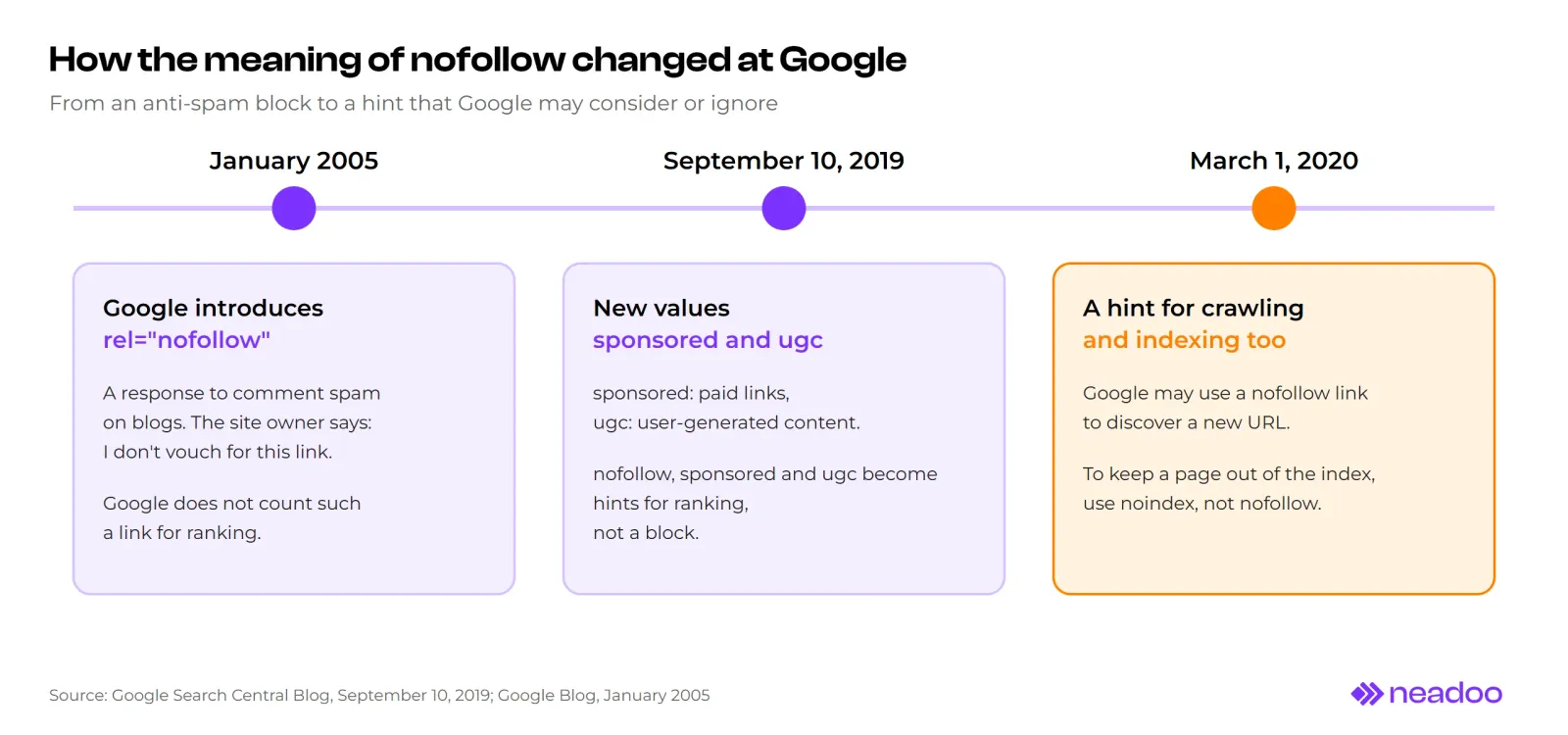
The nofollow attribute was introduced in January 2005 as a response to blog comment spam. Blog owners had no control over what commenters were pasting, so they were given a way to tell the search engine: I do not endorse this link.
Do nofollow links pass SEO value?
Nobody knows for certain, and that is the honest answer: since 2019, Google has treated nofollow as a hint, meaning it decides on its own whether and how to consider such a link. The change was announced on September 10, 2019. Nofollow became a ranking hint immediately, and a crawling and indexing hint starting March 1, 2020.
In practice, this means three things:
- Google may use a nofollow link to discover a new URL and understand the context of the destination page.
- Google does not publish when such a link influences rankings. Claims that a nofollow link "passes X percent of value" have no basis in documentation.
- Nofollow does not block indexing. In its 2019 post, Google points out that relying on it to prevent a page from being indexed was never recommended.
In our view, nofollow should be judged by where it sits. A link from an article on an industry portal brings readers who click because the topic is relevant to them. Such referral traffic is visible in GA4, and that is often worth more than another dofollow link from a directory that nobody reads.
The rel=sponsored and rel=ugc attributes
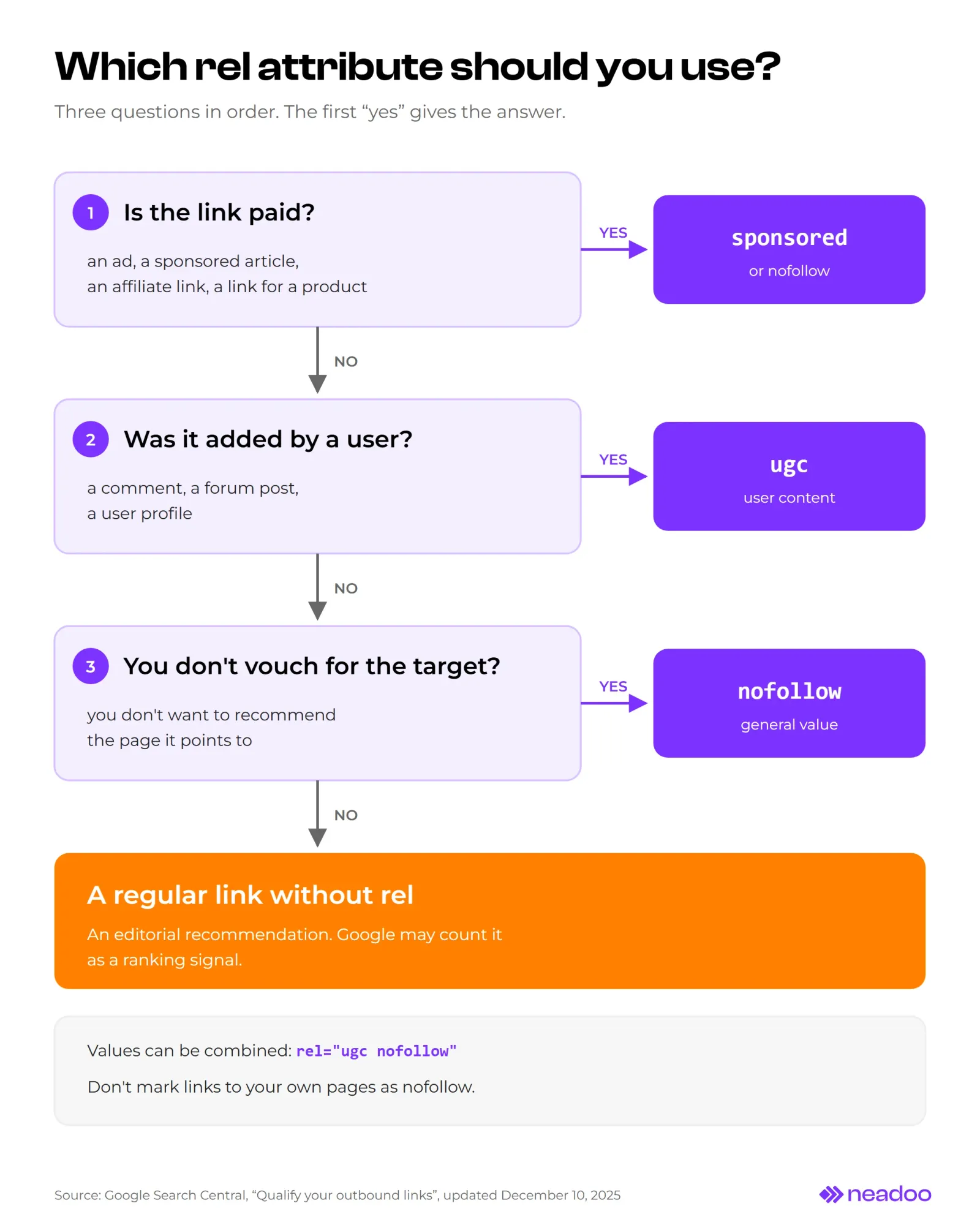
Since September 2019, Google has recommended three values instead of one: sponsored for ads and paid placements, ugc for user-generated content, and nofollow for other cases. These values can be combined, separated by a space or a comma, e.g., rel="ugc nofollow".
rel Value |
When to Use | What Google Says |
|---|---|---|
sponsored |
sponsored articles, banners, affiliate links, any link paid for or in exchange for a product | recommended designation for paid links |
ugc |
comments, forum posts, user profiles | recommended designation for user-generated content |
nofollow |
links you don't vouch for that don't fit the two above | use when other values don't apply |
| no attribute | standard editorial recommendation | link can be treated as a ranking signal |
Existing nofollow links on advertisements do not need to be changed. Google explicitly states that nofollow is still sufficient for marking paid links, and you can switch to sponsored whenever it is convenient.
In WordPress, the sponsored attribute is usually added in the link editor via an SEO plugin, such as Yoast SEO or Rank Math. Check the option's name in your version of the plugin, as it varies between releases.
Where do noopener and noreferrer fit into all this?
noopener and noreferrer are browser security and privacy attributes, not signals for Google. The former cuts off the newly opened tab from the page the user came from. The latter additionally conceals the source page URL. The latter has one consequence that few remember: traffic from such a link may show up in analytics as direct visits rather than referrals. We described the details in our article on noopener and noreferrer attributes.
Let's check your website's potential
Share your website and email - we'll get back to you with a real analysis, no strings attached.
How should you tag links in link building?
The attribute depends on where the link came from, not on what you would like to receive. In its spam policies, Google classifies buying and selling links that pass ranking signals, excessive link exchanges, and automated programs for link creation as link spam.
- Sponsored articles. A publication purchased through a platform like WhitePress or directly from a publisher is a paid link. According to Google's rules, it should have
sponsoredornofollow. The fact that the publisher leaves it without an attribute does not change its nature. - User-generated content. Comments, forums, and social media profiles usually have nofollow or ugc assigned by the platform. Such links do not build rankings, but a post in an active discussion can bring in traffic.
- Editorial mentions. A link that a journalist or blog author added on their own because your data or tool was useful to them is a natural link without an attribute. This is what outreach with material that editors want to quote leads to.
When conducting link building for clients, we plan paid publications and efforts aimed at editorial mentions as two separate streams. The first is predictable; the second provides links that cannot be bought.
Is there an ideal ratio of dofollow to nofollow?
There is not. Google does not specify any ratios, and the percentage ranges popular on the web have no foundation in any verifiable study. The ratio is a byproduct of where the links originate, not a target.
A warning sign is not a percentage, but a pattern. Hundreds of links without an attribute from unrelated sites, with identical anchor text, acquired in a short time frame look like a link exchange system regardless of what percentage of the profile they represent. We discuss the consequences of having such a profile in our articles on black hat SEO and the algorithmic penalty.
Should You Use Nofollow in Internal Linking?
No. Nofollow on links to your own subpages does not save link equity or crawl budget, and Google does not recommend it. In its documentation on qualifying outbound links, Google states that for links within your own site, you should use the disallow rule in robots.txt.
Most often, we see nofollow used on links to shopping carts, login pages, terms of service, and privacy policies. This does not work for three reasons:
- Nofollow is a hint, so Google can still discover and crawl such a URL anyway, for example, from an XML sitemap or a link from another website.
- Nofollow does not remove a page from the index. That is what
noindexis for. - Nofollow does not resolve duplicate content issues caused by URL parameters. That is what canonical links and clean parameter handling are for.
Each of these tools addresses a different issue:
| Goal | Tool |
|---|---|
| bot should not crawl the URL | disallow in the robots.txt file |
| page should not be indexed | noindex in the robots meta tag or HTTP header (the page cannot be blocked in robots.txt in this case, because Google will not see the directive) |
| multiple URLs with the same content | rel="canonical" |
| link equity should flow to important subpages | standard links without attributes from the menu, content, and breadcrumbs |
If a website actually has an issue with crawl budget, we start with filters, parameters, and redirects, not with link attributes. We discuss this in our guide on crawl budget, and the link structure itself in our guide on internal linking.
How to Check If a Link Is Dofollow or Nofollow?
The fastest way is in your browser: right-click the link, select "Inspect", and read the rel attribute in the <a> tag. The absence of rel or a rel attribute without nofollow, sponsored, or ugc means it is a standard link.

- A single link. Browser developer tools show the code after the page loads, including attributes added by JavaScript. Viewing the page source (Ctrl+U) shows the code straight from the server, so an attribute added via script will not be visible there. If the results differ, inspect the page using the "URL Inspection" tool in Search Console.
- All links on a page. Browser extensions, such as Ahrefs SEO Toolbar or MozBar, highlight links by type.
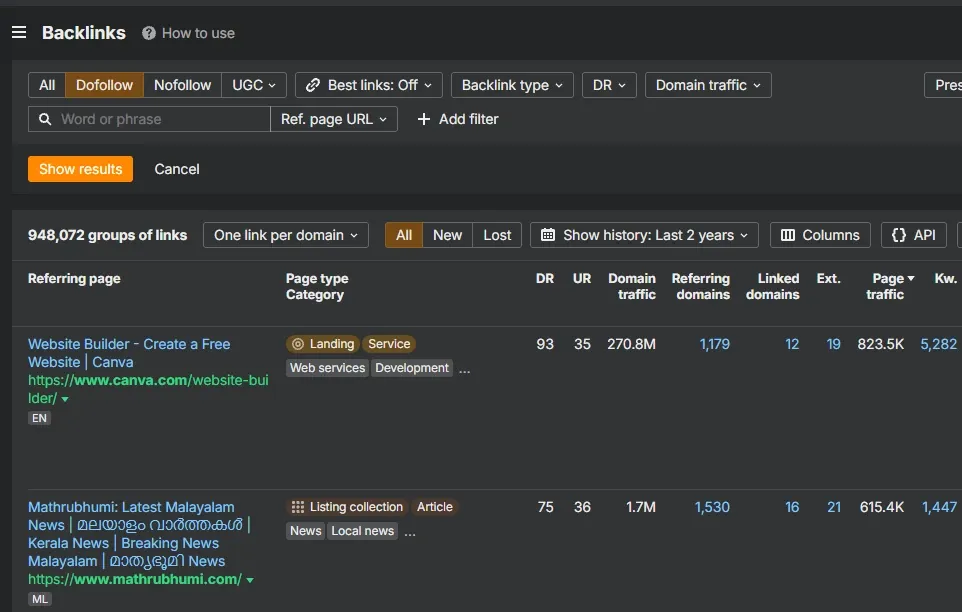
- Entire backlink profile. Ahrefs and Semrush allow you to filter links by attribute. The "Links" report in Google Search Console shows linking sites and top anchor texts, but it does not include rel attributes.
We have covered how to read such a profile and what conclusions to draw in our articles on link profile analysis and off-site audits. Today, we also conduct the same audit to evaluate which sources AI answers draw from, because visibility in generative search engines depends on brand mentions in places cited by LLMs, regardless of the link attribute.
Frequently Asked Questions About Dofollow and Nofollow Links
1. Does the absence of a rel attribute mean a link is dofollow?
Yes. An <a> tag without a rel attribute or with a rel attribute that lacks nofollow, sponsored, or ugc values is a standard link that Google can consider as a ranking signal.
2. Do nofollow links carry any value?
Yes, although it cannot be measured directly in ranking positions. Google treats nofollow as a hint and can use such a link to discover a page. A nofollow link from a site people actually read also drives referral traffic.
3. What is the difference between rel nofollow and rel sponsored?
sponsored specifically marks a paid link: an advertisement, sponsored article, or affiliate link. nofollow is a general-purpose attribute used when none of the more specific values apply. For paid links, both are acceptable.
4. Do I need to update old nofollow links to sponsored?
No. In a 2019 blog post, Google stated that there is no need to change existing nofollow markups, and you can transition to sponsored whenever it is convenient.
5. Does nofollow block page indexing?
No. Since March 1, 2020, Google treats nofollow as a hint for crawling and indexing as well. To keep a page out of the index, use noindex.
6. Is a sponsored article without nofollow risky?
Yes. Under Google's guidelines, a paid link passing ranking signals is considered link spam, regardless of whether the attribute was omitted by the publisher or the buyer. It is safer to ask the publisher to use sponsored.
Sources
- Google Search Central, Qualify your outbound links to Google, updated December 10, 2025
- Google Search Central Blog, Evolving "nofollow" - new ways to identify the nature of links, September 10, 2019
- Google Search Central, Spam policies for Google web search, link spam section
- Google, Preventing comment spam, January 2005