
Black Hat SEO and Negative SEO - Techniques to Avoid
A drop in search engine rankings can hit your website overnight, even if you haven't changed anything radically. Usually, two phenomena are behind this: black hat SEO, which involves a website owner or their agency violating Google's guidelines, and negative SEO, which is deliberate sabotage by competitors, also known as de-indexing or de-ranking. Below, we describe the prohibited techniques of both practices, Google penalties, and ways to protect your website. Making this distinction is essential when running legitimate SEO positioning, because it determines whether you should look for the causes of the drop internally or externally.
What is black hat SEO and how does it differ from negative SEO?
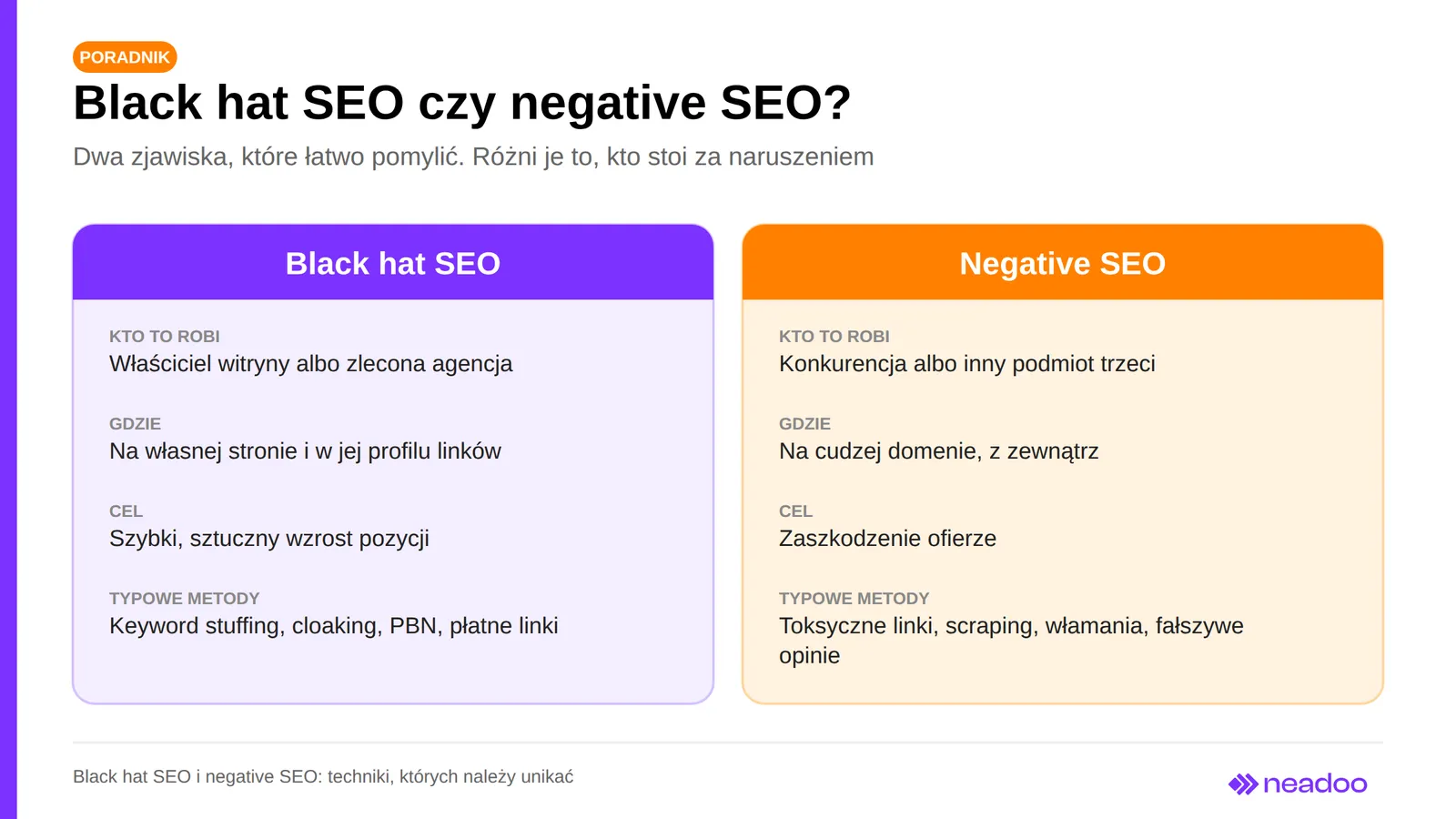
Black hat SEO (spamdexing) is an unfair search optimization practice that a website owner or their hired agency deliberately applies to their own site. It violates search engine guidelines to quickly and artificially inflate a website's visibility at the expense of user experience: visitors end up on a page stuffed with keywords, hidden content, or aggressive redirects that do not match their intent. Black hat SEO techniques are divided into on-page actions (the code and content of one's own website) and off-page actions (dishonest link building). The phenomenon is also sometimes written as blackhat SEO, blackhatseo, SEO black hat, or black SEO.
Negative SEO reverses this setup: the sabotage is carried out by a third party, usually a competitor, targeting someone else's domain. Instead of optimizing their own site, the attacker generates signals intended to harm the victim: toxic links, scraped content, hacking, and fake reviews. Unlike black hat SEO, the attack does not require access to the victim's code or control panel. Both phenomena share a violation of ranking rules. They differ in who initiates them and for whose benefit, which determines the defense strategy.
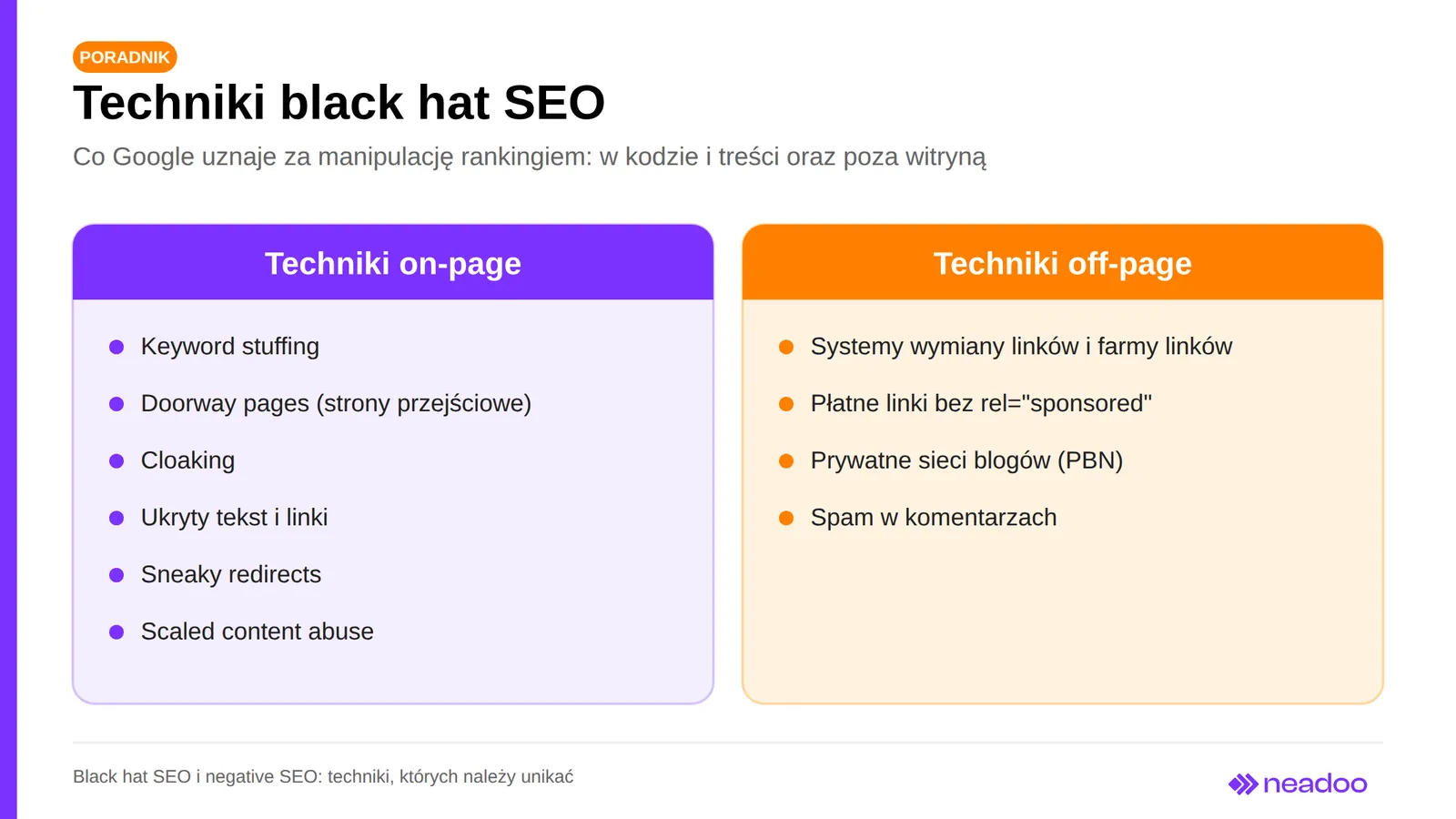
On-page black hat SEO techniques: website content and code
Google's algorithms detect attempts to deceive crawlers: artificially fabricated code, hidden elements, and low-value copy. Forbidden techniques include content manipulation, code tampering, and the mass production of pages offering zero value to users.
Keyword stuffing, doorway pages, and mass-generated content
Keyword stuffing is the unnatural cramming of keywords into content, headers, and metadata at the expense of readability. Repeated key phrases also appear in title tags, meta descriptions, and alt attributes. Doorway pages (gateway or bridge pages) are created solely for specific queries to capture traffic and forward the user to another page. They have no intrinsic value, and their content is often mass-generated for variations of the same phrase.
Scaled content abuse is the mass creation of pages that provide no value to the user. Google does not ban AI tools: what matters is the scale and lack of value, not how the content was produced. Thousands of similar articles published in a short time frame are a classic red flag, regardless of whether they were written manually or generated automatically.
Cloaking, hidden content, and deceptive redirects
Cloaking involves showing search engine bots different content than what is presented to users, typically based on the User-Agent or IP address. Hidden text and hidden links involve using a font color identical to the page background, shrinking the font size to zero, positioning text outside the visible area, or using CSS rules like display: none. The element disappears visually but remains in the code. This category also includes structured data spam - markup that does not reflect the actual content of the webpage, used to stand out deceptively in search results.
Sneaky redirects, or deceptive forwarding, send the bot to one piece of content and the user to an entirely different page. They often co-occur with doorway pages: a doorway page targeted at a keyword, a covert redirect, and a commercial landing page.
Off-page black hat SEO techniques: dishonest link building
Off-page tactics manipulate the external link environment to artificially boost domain authority without touching the website's own code. Link exchange networks (link swapping schemes) and link farms are networks of websites built solely to cross-link with one another. Using link exchange networks can be direct ("you link to me, I link to you") or reciprocal/rotational, where links circulate among multiple domains. Google classifies such link-building schemes as link spam.
Paid dofollow links violate guidelines if the transaction lacks a rel="sponsored" or rel="nofollow" attribute, which also applies to sponsored articles and barter deals. Private blog networks (PBNs) - support networks hosted on expired or acquired domains - are also risky. They are given away by shared footprints, such as the same IP address, CMS template, or registrar. Once detected, the entire network loses its value all at once.
Comment spam involves the mass, automated posting of links unrelated to the topic of the post. This technique, along with link farms and link exchanges, dates back to the era before the Penguin update (2012), which was the first to systematically penalize unnatural link profiles. Since then, the quality and context of a link have mattered far more than the raw volume of backlinks, and since December 2022, Google has also neutralized such links using its SpamBrain system.
Let's check your website's potential
Share your website and email - we'll get back to you with a real analysis, no strings attached.
What does a negative SEO attack look like?
Negative SEO involves several types of attacks, but links alone are usually not enough: Google claims that in most cases it evaluates which links to trust on its own, and SpamBrain neutralizes many spammy links. Break-ins, content scraping, and fake reviews can be more dangerous.
Toxic links with exact-match anchors
In a link-based attack, toxic backlinks are generated en masse from link farms, hacked websites, and domains in the gambling or adult industries, in a short time and at high volume. The attacker uses exact-match anchor text - an anchor identical to the target keyword phrase, repeated hundreds of times. Such a pattern deviates from a natural anchor text distribution (brand, URL, generic phrases) and is an alarm signal, but it rarely ends in a penalty because Google can usually neutralize it.
Scraping and content theft
Content scraping involves the automated harvesting of articles, product descriptions, and blog posts to external domains, sometimes across hundreds of websites. The attacker hopes the copy will be indexed faster than the original, for example by submitting the URL in Search Console or building fresh links to it. Such content copying creates duplicate content. Google usually identifies the original, but with a new or weak domain, the copy may sometimes rank higher.
Break-ins, robots.txt, and fake reviews
The most dangerous scenario is a server breach. The attacker injects code that serves different content to search engine bots (hack cloaking), swaps out links, and modifies robots.txt to block indexing of key subpages or the entire website. The result is a sudden loss of top rankings without an apparent reason. A break-in is also used for redirects to phishing sites and posting fake negative reviews on business profiles, such as a Google Business Profile. This lowers the website's credibility in the eyes of other users and harms brand reputation regardless of how the algorithm evaluates the site.
Google penalties for using black hat SEO: manual penalty and algorithmic filter
Manual penalties are imposed by the Google team and are visible in the Manual Actions report in Google Search Console. Algorithmic filters operate quietly after an update to the search engine. They share the same goal - eliminating ranking manipulation - but differ in their detection mechanisms, communication, and path to recovery.
A manual action is the result of human review, for example following a spam report. The report describes the violation of Google guidelines (unnatural links, scaled content abuse, cloaking), and an email is sent immediately. Lifting the penalty requires removing the underlying cause (such as cleaning up the link profile or using the Disavow Tool) and submitting a reconsideration request using the "Request Review" button.
An algorithmic filter operates without notification and without human intervention. Anti-spam systems (formerly Panda and Penguin, now part of the core ranking systems, along with SpamBrain) evaluate a domain with every model update. In 2026, Google has already rolled out several anti-spam updates, including in the spring, summer, and early fall, so you can identify a filter's impact by matching update dates against your organic traffic graph.
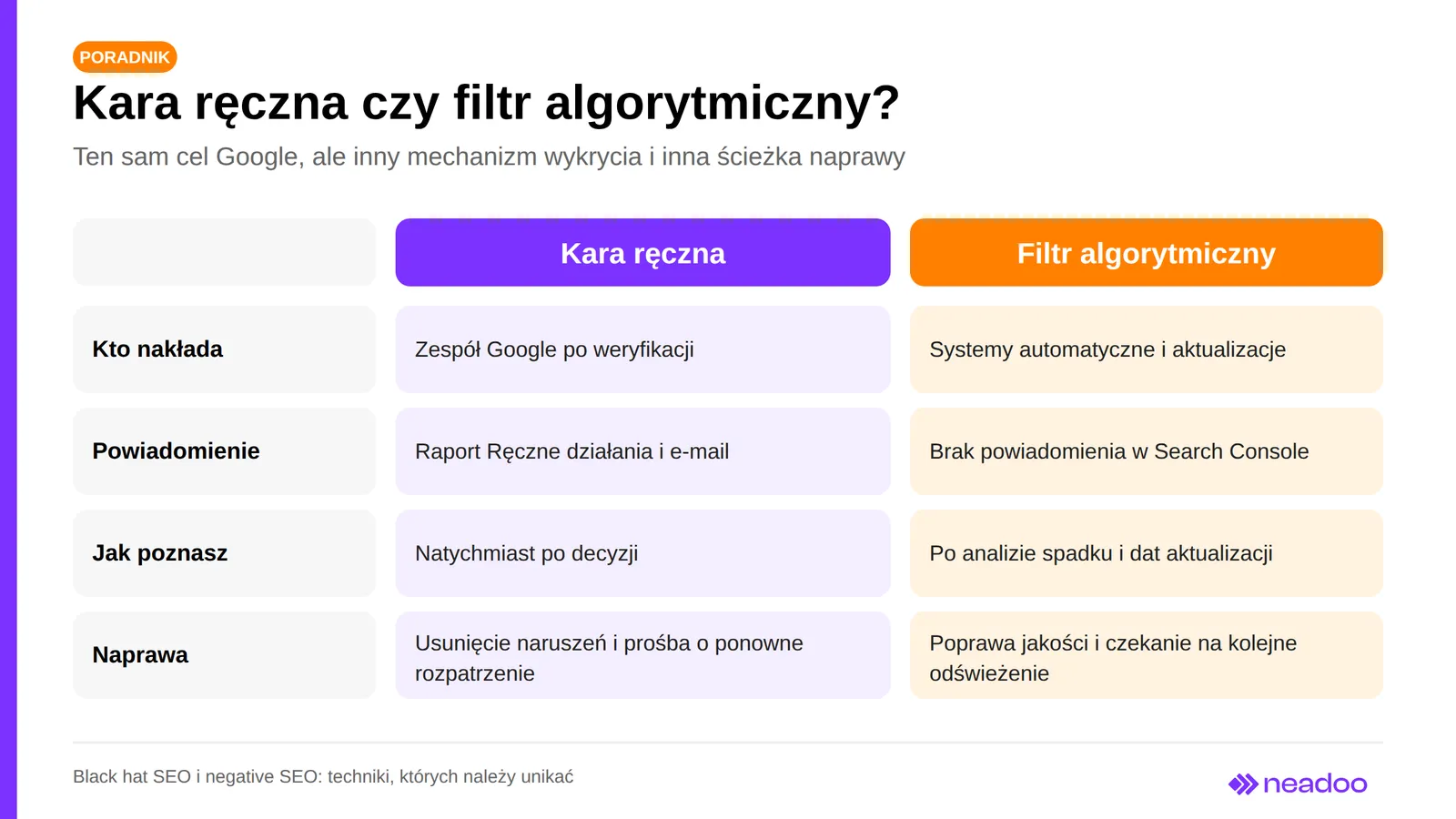
| Feature | Manual penalty | Algorithmic filter |
|---|---|---|
| Imposed by | Google team after review | Automated systems and updates |
| Notification | Manual actions report and email | No notification in GSC |
| Impact detection | Immediately after the decision | After analyzing traffic drops and update dates |
| Resolution | Removing violations and submitting a reconsideration request | Improving quality and waiting for the next refresh |
The consequences vary: from drops in ranking for select keyword phrases in organic search results to the complete removal of a domain from the Google index in cases of egregious and repeated violations. "Filter" and "ban" are colloquial expressions, not official Google terms. The lack of an entry in the report does not mean there is no penalty; most often it indicates that the drop stems from algorithmic action.
How to protect a website from negative SEO?
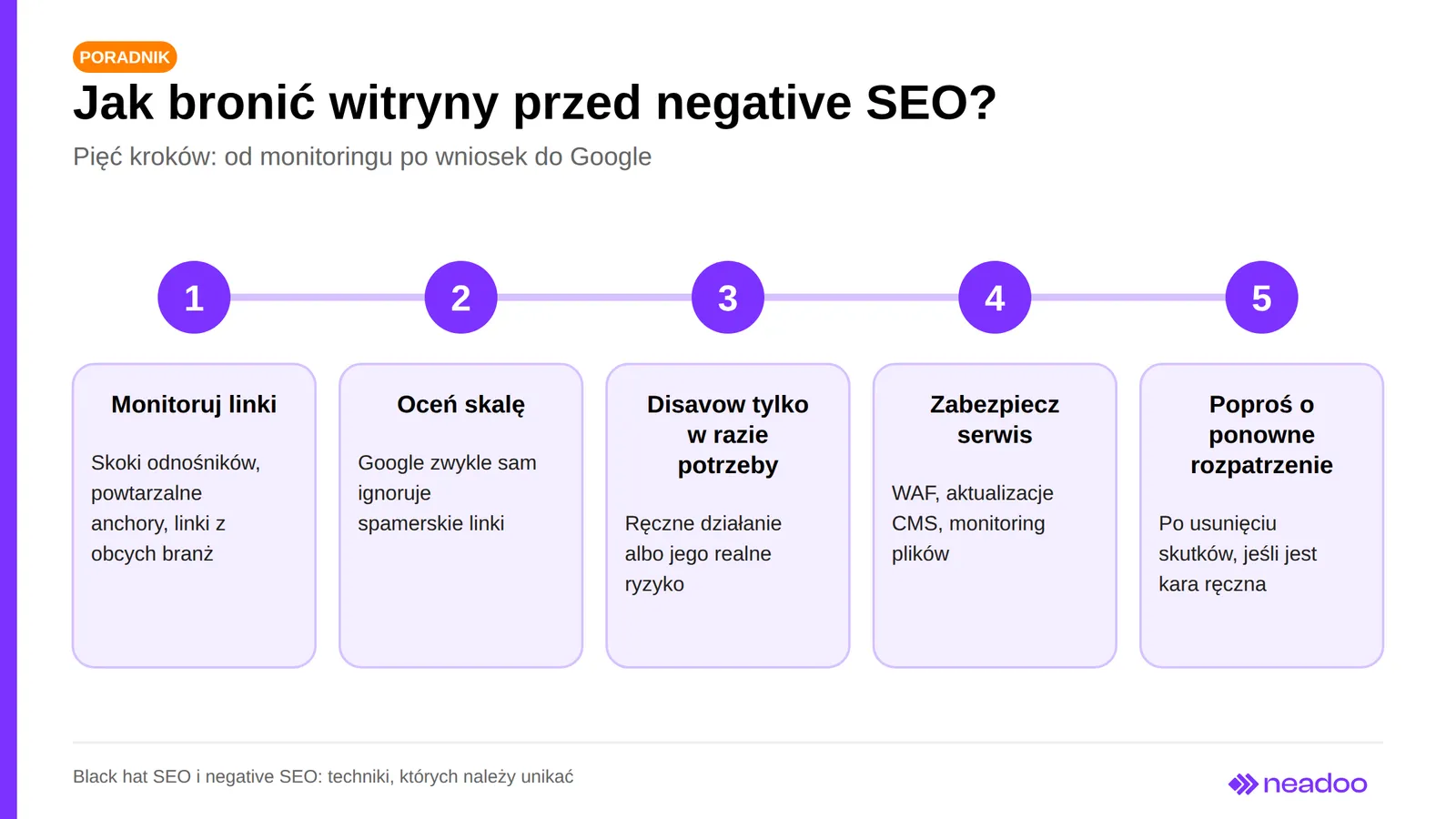
Defense relies on three pillars: early detection of anomalies in the backlink profile, disavowing toxic links only when necessary, and technical site security.
Link monitoring and the Disavow Tool
A regular SEO audit of the external link profile catches sudden spikes in link counts, repetitive exact-match anchors, and links from industries unrelated to the site. This points to an attack, not organic growth. However, do not react to every suspicious link: Google ignores most spammy links on its own, so they generally do not threaten your website.
The Disavow Tool uses a text file containing domain: directives (entire domains) or individual URLs that you submit via Search Console. It does not remove links from the web or from the report; it simply asks Google to disregard them when assessing the site. Google treats it as an advanced tool: it makes sense when dealing with a manual action for unnatural links or when one is likely, not as routine cleanup. Start by exporting links from GSC, isolate link farms, gambling sites, and exact-match blasts, and try to remove the links at the source before submitting the file.
Securing the CMS and reconsideration requests
After a breach, first eliminate the impact of the infection and manipulation: malicious code, unnatural redirects, and toxic links. Only then, if the site has a manual action or an issue in the Security Issues report, submit a reconsideration request. In the request, describe the detected issue, the steps taken (for example, 301 redirects from hacked URLs, a disavow file), and technical proof. Google may reject an incomplete submission.
Protection is aided by a Web Application Firewall (WAF), ongoing updates to CMS core and plugins, and file integrity monitoring, such as comparing checksums. Such monitoring quickly detects unauthorized changes to robots.txt, templates, or the database before they lead to mass cloaking.
White hat SEO vs. black hat SEO: weighing the pros and cons
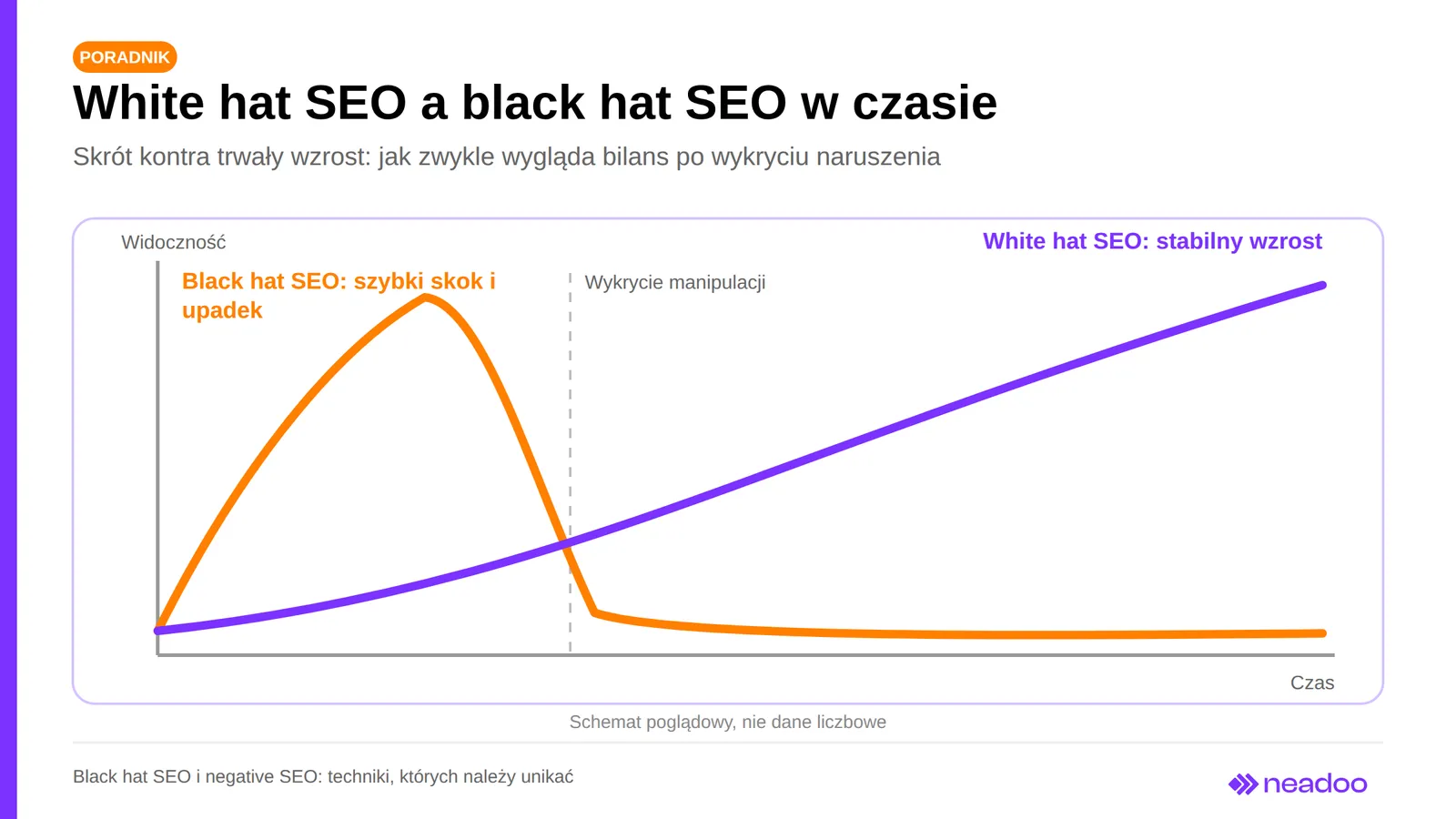
The long-term balance favors white hat SEO. The short-term gains of black hat SEO often end in business paralysis: the costs of recovery audits and penalty remediation far exceed the investment in stable SEO aligned with Google guidelines. White hat SEO encompasses technical optimization, properly implemented structured data, high-value and unique content, content marketing activities, and natural, gradual link building. It delivers lasting results that appear more slowly but withstand algorithm updates.
| Criterion | White hat SEO | Black hat SEO |
|---|---|---|
| Speed of results | Gradual, predictable growth | Rapid, temporary spike |
| Sustainability of results | High, resilient to Core and Spam Updates | Low, high risk of loss upon detection |
| Cost in case of penalties | Low risk, no recovery costs | Audit, disavow, reconsideration request |
| Recovery time after a penalty | Not applicable | Typically from a few months to a year, with no guarantees |
Black hat SEO takes shortcuts: low-value mass content, link schemes, and code manipulation. It yields short-lived results: gains may appear within days, but once detected, they often collapse just as quickly. Even after a penalty is lifted, there is no guarantee of regaining previous rankings, as lost time and algorithmic trust must be rebuilt almost from scratch. On top of that comes the loss of trust from users and prospective customers. Compliance with Google guidelines is therefore an element of business risk management, not merely a matter of ethics.
FAQ
Does Google ignore toxic links on its own without using the Disavow tool?
In most cases, yes: algorithms and SpamBrain neutralize many unnatural links. The Disavow Tool is recommended mainly when dealing with a manual action for unnatural links or a high risk of receiving one.
How long does it take for a website to recover its rankings after a manual penalty is removed?
Usually anywhere from several months to a year, with no guarantee of returning to previous positions. Google does not specify a set timeframe, and much depends on the scale of the violations.
What should I do if a competitor copies and publishes my content?
Make sure Google indexes the original first (for example, by submitting the URL in Search Console), and in case of copyright infringement, file a content removal request with Google or contact the copy's hosting provider.
Does buying cheap links from Allegro or forums always result in a penalty?
Not always, as Google will simply neutralize some of these links. However, paid dofollow links violate guidelines regardless of the source, and cheap links often come from link farms, which increases the risk of a manual action.