
WhitePress - What Is It and How to Use It in Link Building?
Publications in external media have long been among the most effective elements of an SEO strategy, provided they land on websites with real traffic and a credible link profile. WhitePress functions as a platform connecting advertisers, editorial teams, and content creators in one place, automating the publication of sponsored articles and link acquisition. For agencies like Neadoo, WhitePress means access to one of the largest publishing databases on the market, but also the responsibility of selecting sites that genuinely translate into client visibility in search results and on Google.
What is the WhitePress platform?
WhitePress is an online marketplace bridging advertisers, publishers, and content creators that automates the publication of sponsored articles and link acquisition. WhitePress operates under a white-label model - the article is published on the portal's website without any branding from the intermediary, platform logo, or link to WhitePress in the page source code. WhitePress is not the only service of its kind on the market, but it stands out due to the scale of its publisher database.
Access to the WhitePress publishing database is free after creating an account - only then do actual publication prices and the full selection of portals become visible. In the platform's own messaging, invitations such as "create a free account on our platform and check the publishing offer" frequently appear. WhitePress operates on an international scale: the platform supports 36 countries and 36 languages, making it possible to run link-building campaigns both in the Polish market and across foreign markets.
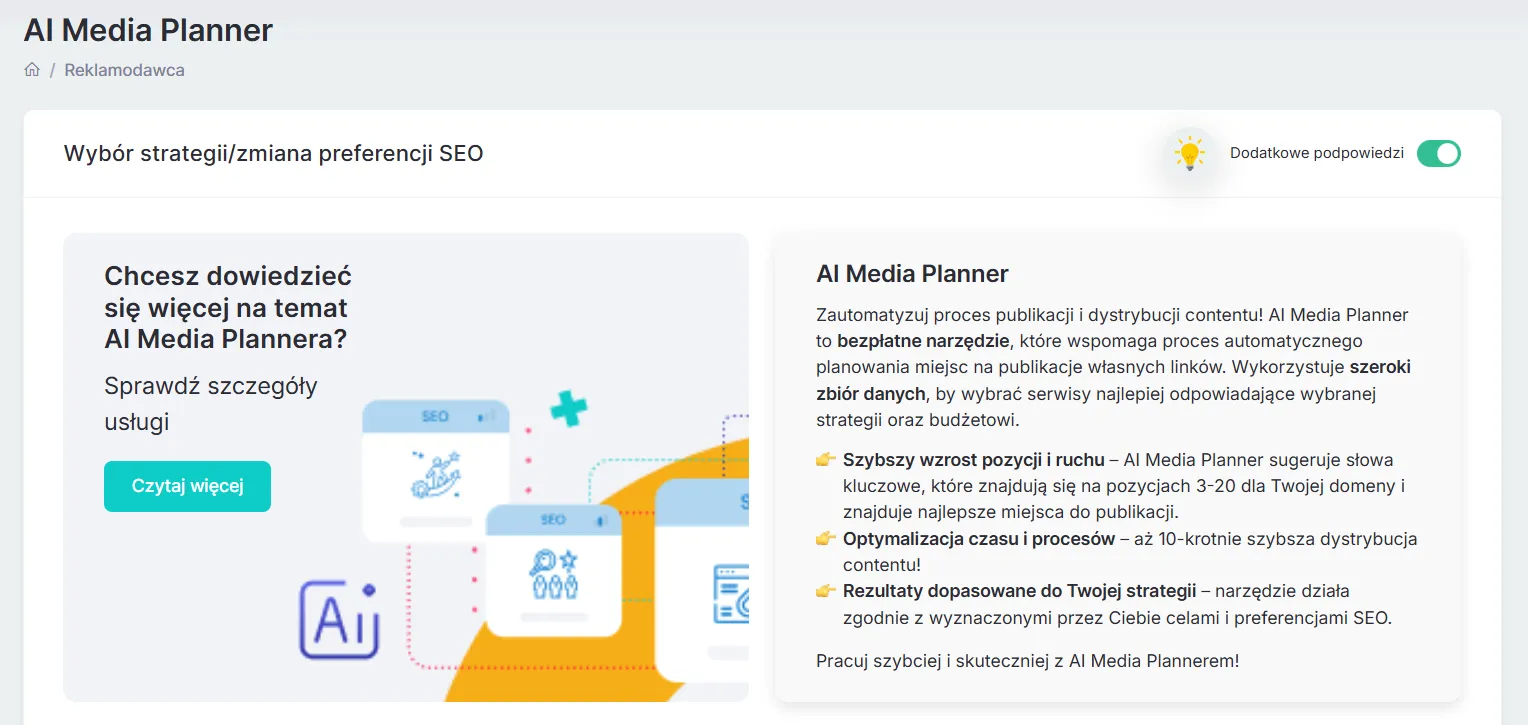
WhitePress has been on the market since 2013. Just a few years ago, the platform was mainly associated with ordering sponsored articles and straightforward link building. Today, the platform positions itself more broadly - as a solution connecting SEO, link building, content marketing, and Digital PR, with an increasing emphasis on brand visibility in AI systems and large language models, including AI Search.
WhitePress supports several roles at once, tailored to different stages of the publishing process. The advertiser orders the article and defines its guidelines; the publisher registers on the platform, makes space available on their portal, sets the publication price, and earns money on each accepted post; the journalist or copywriter is responsible for crafting text that aligns with the brief; and the influencer participates in campaigns that go beyond a standard sponsored article, such as product reviews. A distinct role belongs to the PR specialist, who turns to WhitePress to build brand awareness across industry media.
Operating model, escrow security, and the role of partner agencies
Financial transaction security is based on an escrow mechanism, in which the publisher receives payment only after the correct publication of the post is verified. The advertiser pays for the order using their account balance or via online transfer, and the deposited amount goes into escrow, remaining frozen until it is confirmed that the text was published according to guidelines - the link is active, and the content matches the brief. Only after this approval are the funds transferred to the publisher's account. This model protects the interests of both parties involved in the transaction.
An additional layer of security is the standard 36-month link visibility guarantee, combined with daily monitoring of its presence on the publisher's website. If the link disappears or the publication is removed during this period, WhitePress flags it and allows for a complaint or a replacement post.
SEO agencies use the WhitePress escrow mechanism to optimize client budgets while providing the service of selecting and continuously monitoring portals. Throughout this process, the team verifies the history and metrics of the site before placing an order, which reduces the risk of choosing a portal with unsustainable traffic or artificially inflated metrics. This kind of agency partnership makes sense especially across multiple concurrent SEO campaigns.
Key Features and Capabilities in Link Building
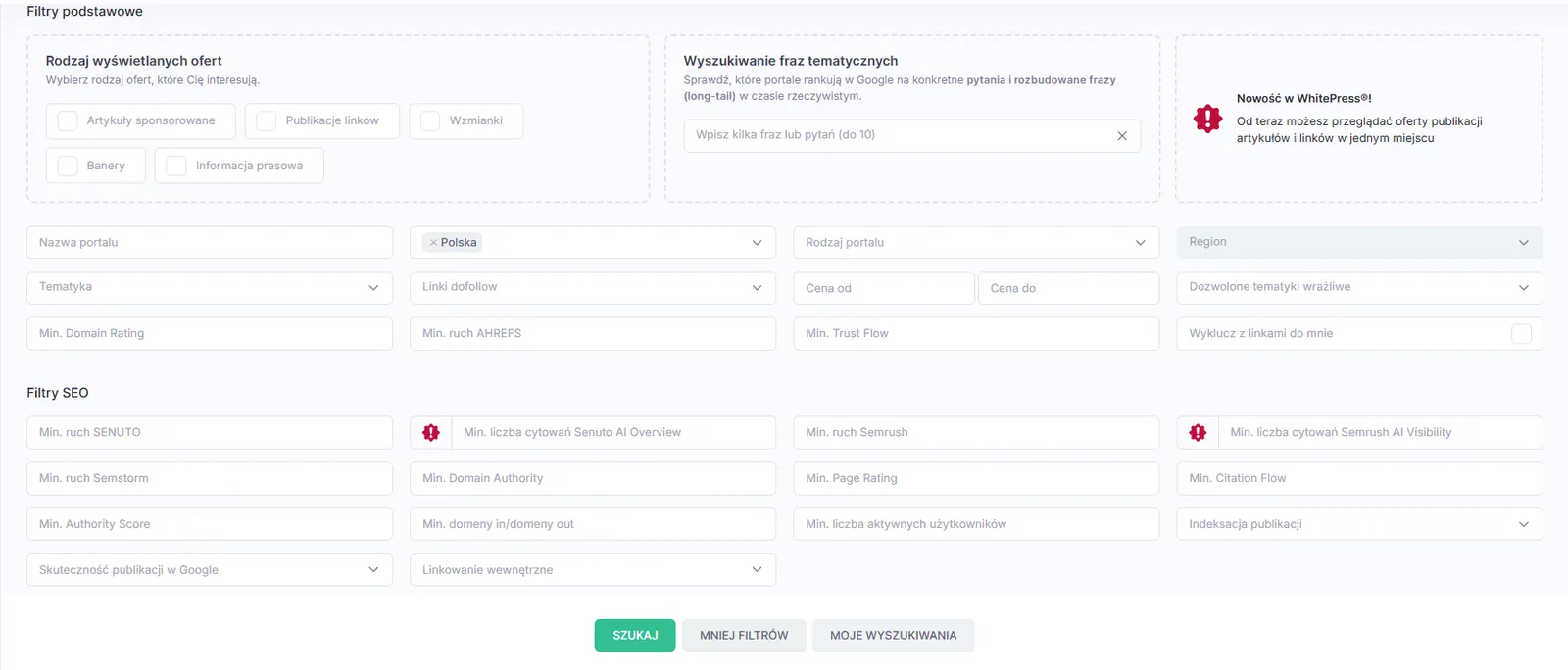
The ecosystem provides a database of over 100,000 portals, with access to more than 130,000 verified publishers upon registration, integrating data from external analytics tools. When selecting a specific website, WhitePress's advanced portal search engine displays available metrics and statistics, while filters allow you to narrow down the catalog by price, topic, and quality indicators that practically determine a publication's SEO value:
- Trust Flow and Citation Flow - Majestic metrics that determine the strength and number of backlinks pointing to a given site.
- Domain Rating and Ahrefs Rank - Ahrefs metrics showing a website's standing across the entire index.
- Authority Score - A Semrush metric combining domain authority with the quality of its backlink profile.
- Estimated Organic Traffic - An estimate calculated based on data from Senuto, Semrush, and Google.
- Link Type (dofollow) - Verification of whether the backlink actually passes link equity.
These SEO parameters filter the catalog faster than manually checking each website individually, as they let you immediately filter out options that offer no real benefit to the client's Google rankings.
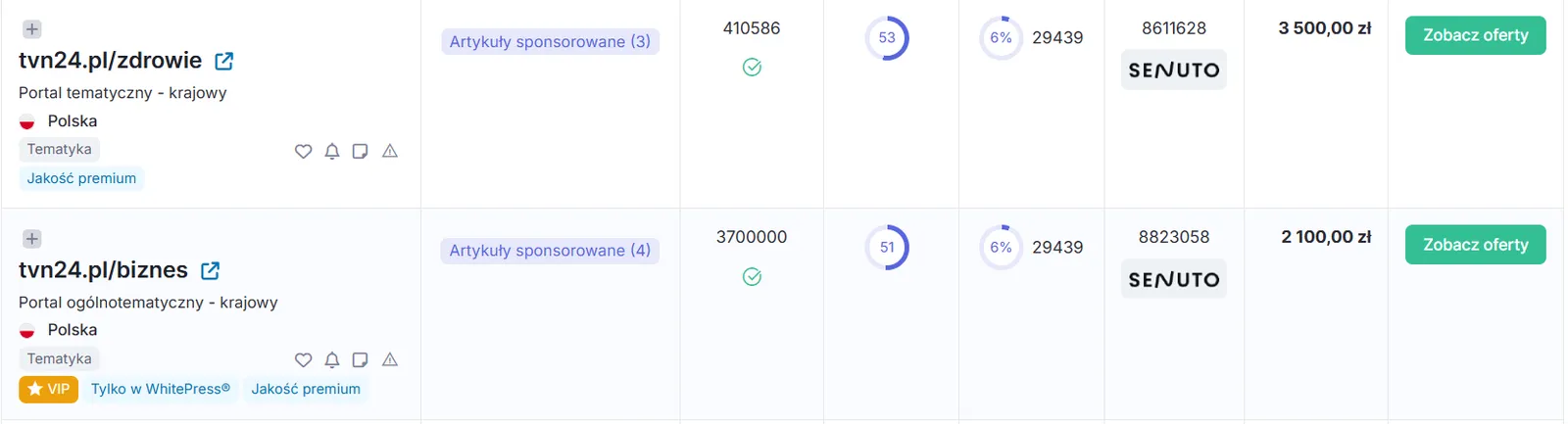
Publishers set the prices for their websites themselves, which is why the price range for publications across individual portals can vary widely - from a dozen or so PLN per 1,000 characters on small niche sites to significantly higher rates on large, general-interest portals with high traffic. Before publishing, each such service also has the right to review and approve the submitted material, which further protects it from content that does not align with its editorial policy.
Beyond traditional link building, WhitePress runs an influencer marketing module, available since 2016, with a minimum threshold of 1,000 unique monthly visitors on a blog, connecting advertisers with online creators for product reviews, coverage, and promotional campaigns on social media. It organizes the nationwide SEO & Content Camp conference, bringing the industry together around the topic of building online visibility and advancing content marketing, and runs an affiliate program as a form of referral marketing - the person referring the platform receives a 5% commission on the amount spent on orders by the invited user.
Ordering Content Through the Content Premium Module and Supporting AI Visibility
Content Premium functions as an internal module for ordering articles from a database of over 400 verified creators across 40 topical categories, although registration for new copywriters was suspended as of May 2026.
You can select an author in Content Premium in three ways:
- choosing a specific person from the list of available creators,
- posting an assignment on the job board and waiting for applications from interested copywriters,
- letting the system match a writer using algorithmic scoring.
This last mechanism is a relatively new tool in the module that evaluates copywriters' past work based on subject matter and text quality - it is a service covering copywriting in the broad sense, not just individual sponsored articles. There are 15 content templates to choose from, and 40 topical categories make it possible to match a creator to the client's specific industry niche, instead of assigning the copy to a general copywriter with no experience in the subject. For recurring orders, you can purchase additional characters or images without filling out a new form.
The role of Content Premium goes beyond traditional content marketing. High-quality articles also reduce SEO risks - texts that genuinely address user needs are less likely to be treated as low-value content by search engine algorithms.
Articles on reputable media outlets build brand authority recognized not only by users and Google's search engine, but also by large language models, which increasingly draw on sources with an established online presence when generating answers in AI Search. From a Digital PR perspective, the value of content is no longer limited strictly to a link - what also matters is whether a given website has sufficient authority to become a source cited by LLM-powered systems - which is already an element of broader brand marketing and AI search optimization.
Step-by-Step Guide: How to Order a Publication with a Link
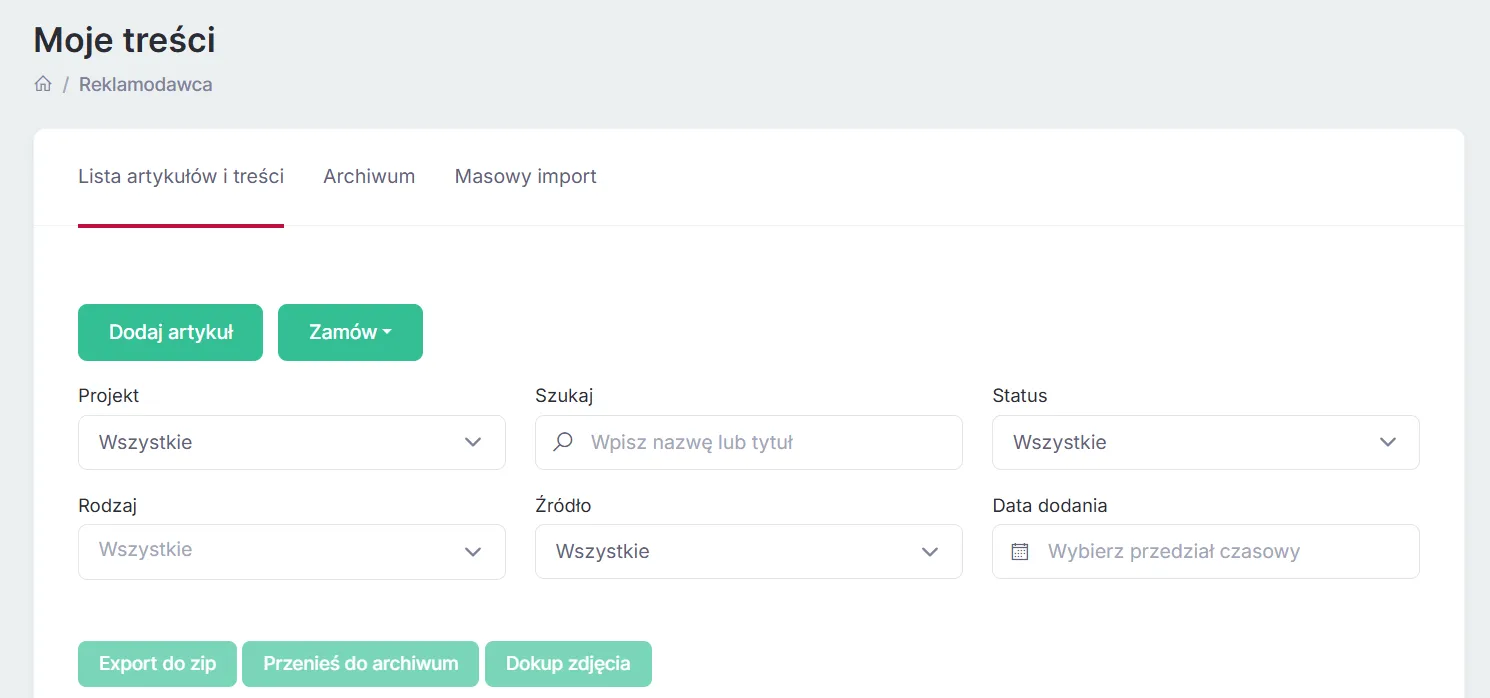
Ordering a publication comes down to precisely matching editorial guidelines, selecting a website, and automated order settlement. If you are using the WhitePress dashboard for the first time, you start the process by configuring a project - defining the campaign goal and order budget. Further stages of the process include:
- website selection and content preparation - from the website catalog or the Content Premium module,
- payment and freezing funds in escrow - until the publication is confirmed,
- technical verification of the post - checking the link, content, and website functionality,
- launching monitoring - daily verification of the link's presence.
The user can see the order status in the WhitePress dashboard in real time throughout the entire process - from the moment the brief is approved to the publication confirmation, which makes it easier to manage a larger campaign.
Preparing the Brief and Adding Content to the System
The user can upload a finished article, order its writing from the website's editorial team, or submit guidelines to the creators module. The editorial brief includes:
- publication title,
- links leading to the landing page,
- keywords to include in the text,
- expected length of the material,
- detailed editorial guidelines,
- tone of voice the article should maintain, so that the text provides real value to the reader rather than serving purely as an advertisement.
The way the post is labeled depends on the specific website, not the advertiser - some websites publish content without any labeling, while others require a note such as "sponsored article" or "partner article." This information is already visible when selecting a specific website in the catalog, allowing you to tailor the text to expectations regarding its nature. Meanwhile, the WhitePress editorial team verifies whether the submitted website actually operates in accordance with its declared niche before approving it for the offer. You can attach a comment for the publisher with additional notes, and any revisions are arranged directly with the website's editorial team via the built-in chat inside the WhitePress dashboard.
Finalizing the Order, Payment, and Verifying Publication
Publication fulfillment usually takes from a few hours to several business days, after which the system performs a technical verification. After placing the order, the funds are placed in the previously described escrow, and the client receives a notification once the article appears on the website.
The system verifies whether the content meets the order requirements - presence and type of link, compliance with the brief, proper website operation - and launches link monitoring only after this check passes successfully. The final report displays the website's metrics and statistics at the time of publication, which facilitates campaign settlement with the client and proves useful for further campaign performance analysis in Google Analytics.
Let's check your website's potential
Share your website and email - we'll get back to you with a real analysis, no strings attached.
Best Practices and Portal Selection Criteria
Effective media selection requires verifying websites beyond basic tool metrics, eliminating portals with artificially generated profiles. Portal selection is a service that demands up-to-date market knowledge, as every topic and SEO initiative has different priorities - different for a nationwide campaign, and different for local SEO, where the portal's traffic geography carries greater weight. Links in published articles should be placed on portals with genuine authority - it is these, not the sheer volume of publications, that determine a campaign's impact on a client's visibility. We treat platform metrics as a starting point, not the final criterion. A high Domain Rating or Authority Score does not guarantee real traffic, which is why our team checks the organic traffic trend over time, rather than just its current value on the day the article is ordered.
If you have used WhitePress for a long time and have experience working with other link marketplaces, you have likely encountered a website with strong tool metrics but zero real traffic. Such a scenario is eliminated by an additional verification of the site's link profile, which shows whether links pointing to the given website originate from natural sources or from a link exchange network built solely to sell backlinks. Portal diversity across the campaign is also crucial - an assessment relying entirely on a narrow group of similar sites can be easier to detect than a natural, diverse backlink profile.
Advanced Quality Filters and Domain Authenticity Audit
Technical site selection should account for the HTTPS protocol requirement, the exclusion of subdomains, and the rejection of multi-topic portals. In the Neadoo.pl methodology, a domain authenticity audit includes:
- HTTPS protocol - its absence automatically disqualifies a portal from further consideration,
- exclusion of subdomains - content should be published on the root domain, not on its subdomain,
- rejection of multi-topic portals - a site combining a dozen unrelated industries raises doubts regarding content quality,
- proprietary exclusion lists - built based on the agency's previous campaigns,
- guarantee of minimum traffic on the published article - confirmation that the piece will actually reach readers,
- domain traffic geography - alignment between the declared market and the actual origin of visits,
- social media promotion, such as sharing the article on the company's Facebook profile.
This is a multi-factor approach - none of these criteria operates in isolation from the others; only the combination of strong tool metrics with real, declared traffic makes a domain worth publishing on. This also applies to the client's landing pages that the links point to - their ranking potential determines the overall impact of the campaign in search results.
Scaling Campaigns and Managing Bulk Orders
The bulk purchase feature allows for simultaneous ordering of publications across dozens of portals within a single integrated budget. For larger campaigns, it becomes essential to schedule orders over time so that articles do not go live all on the same day, and to control anchor texts so they do not repeat in the exact same format across consecutive backlinks. Efficient scaling also requires continuous collaboration with the agency team on brief approvals.
If you use bulk purchases across dozens of orders, the budget for campaigns targeting international markets is divided by language and the local prominence of a given website - a leading portal in one market may be completely unknown in a neighboring one. The dashboard displays the status of each order individually, which, when managing dozens of parallel orders, makes it easy to spot delays or rejected briefs. The return on investment in a long-term SEO campaign is evaluated not on the basis of a single article, but on the cumulative impact of the entire initiative on the client's website visibility over time.