
Long-Tail SEO and Broad Optimization - Long-Tail Keyword Strategy
Broad SEO is a strategy where a website captures traffic from hundreds or thousands of specific, low-volume queries (long-tail keywords) instead of just a few generic terms. A single long-tail keyword brings in a few or a few dozen visits per month. Competition for it is usually lower, and the person typing it knows exactly what they are looking for.
We plan long-tail content for online stores and service businesses, and one thing repeats across every project we do: finding the keywords isn't the hardest part - mapping them to subpages to avoid keyword cannibalization takes the most work. Along the way, we also checked where the popular claim that the long tail accounts for "70-92% of traffic" comes from. It turned out differently.
Knowledge state: October 22, 2026. Keyword search volumes are from Ahrefs (Poland, October 2026); search query distribution data comes from the studies cited alongside the numbers.
What is broad SEO and where did the long tail come from?
The long tail is the part of the demand distribution curve containing queries that are searched infrequently, but exist in huge numbers. The term was popularized by Chris Anderson in his article "The Long Tail" in Wired magazine (October 2004), and later in his 2006 book of the same title. Anderson was describing retail: an e-commerce store can profit from thousands of niche products that a brick-and-mortar store could never fit on its shelves. The long-tail concept later spread to SEO and search advertising.
In SEO, long-tail SEO (also known as broad SEO) means that instead of competing for generic keywords like "coffee maker", you build pages that answer specific queries: "quiet coffee maker", "coffee maker for a small kitchen", "how to descale a coffee maker". Each of these keywords has a low search volume, but together they drive steady traffic. It is still standard Google SEO, just spread across many precise keywords instead of a handful of head terms.
Head terms, the chunky middle, and the long tail
Search queries are usually divided into three groups. The search volumes in the table are Ahrefs data for Poland from October 2026.
| Keyword Type | Volume | Intent Characteristics | Example (monthly searches) |
|---|---|---|---|
| Broad keywords (head, generic terms) | very high | ambiguous, user is just beginning their search | "coffee maker" - 155,000 |
| Chunky middle | medium | narrowed category, comparison | "espresso machine" - 4,300 |
| Long tail | low | specific need, problem, or purchase decision | "quiet coffee maker" - 250, "coffee maker under 2,000 PLN" - 90 |
Broad phrases and generic keywords generate a lot of impressions, but users at this stage often do not yet know what they want. Chunky middle phrases represent the center of the distribution: less popular than generic terms, but still broad. Long-tail phrases are less competitive and reflect more precisely what the user is looking for.
Phrase length does not define the long tail
We often read that long-tail keywords are phrases made up of three or more words. That is an oversimplification. Whether a phrase belongs to the long tail is determined by its volume, not its word count. Ahrefs explicitly states that long-tail keywords are defined by volume, and defining them by length is a mistake. According to Ahrefs, there is no single volume threshold above which a keyword becomes long tail.
This is clearly visible in our examples. "Ranking ekspresów ciśnieniowych" (espresso machine ranking) consists of three words and has 150 monthly searches, but its Ahrefs keyword difficulty (KD) is 52 because comparison sites and large retailers are competing for it. On the other hand, "cichy ekspres do kawy" (quiet coffee machine) has four words, 250 searches, and a KD of 0. A long query does not always mean lower competition.
How much traffic does the long tail really drive?
Across the search distribution, the long tail wins by the sheer number of phrases, not by aggregate volume. A claim circulating on the web suggests that long-tail keywords drive "70-92% of traffic on Google." We have found no study that confirms this, and the available data indicates something quite different:
- Backlinko analyzed 306 million keywords in the US (DataForSEO data, published in 2020). They classified phrases with 1-100 monthly searches as long tail. Such phrases accounted for 91.8% of all analyzed keywords, but combined for only 3.3% of total search volume.
- Ahrefs reports (updated May 27, 2026) that keywords with fewer than 10 monthly searches make up almost 93% of its US keyword database.
- Google stated during the rollout of the BERT model in 2019 that 15% of queries it sees every day are new, never searched before.
These numbers indicate that the "92%" figure in the popular slogan refers to the share of phrases in a database rather than their share of traffic. Why, then, is broad SEO worth the effort? Because volume in tools does not reflect all traffic: a single good page attracts visits from many similar queries at once, including those that no tool shows because they are being typed for the first time.
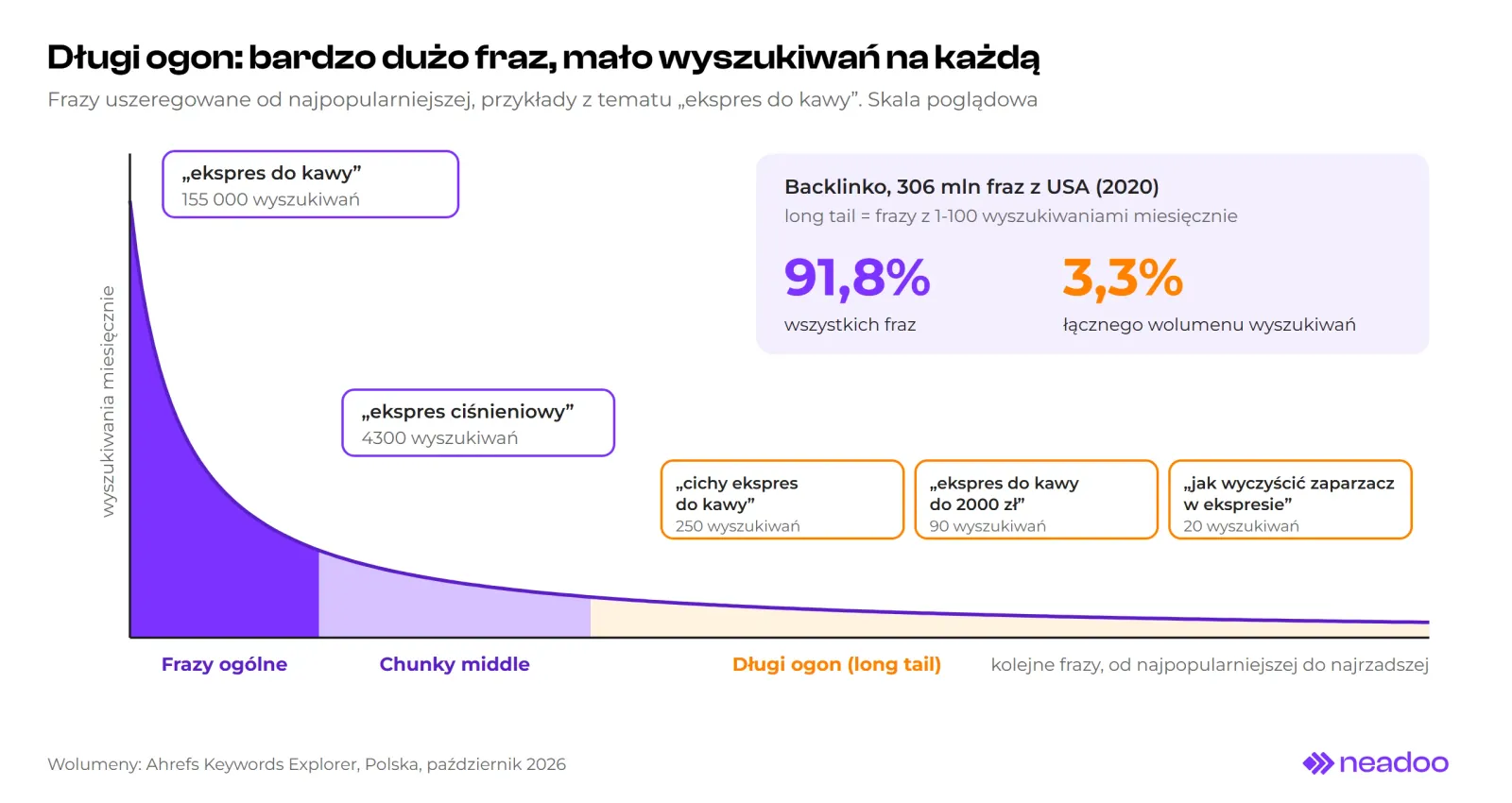
Fig. 1. The long tail is long, but flat. Success here is achieved through the sheer number of pages that answer specific queries.
What are the benefits of long-tail SEO?
Long-tail SEO provides traffic that is easier to acquire and easier to convert into sales leads or purchases. We are not citing specific conversion growth percentages here because we know of no study that has reliably measured this across multiple industries. However, the mechanism is straightforward.
Someone typing "ekspres do kawy do 2000 zł" (coffee machine under 2000 PLN) already has a budget and a product category in mind. A page that answers this exact query has a much higher chance of conversion than a generic category page displaying a hundred coffee machines.
Secondly, lower competition in search results is immediately apparent. Large websites focus on generic phrases, so for many long-tail queries, the top 10 search results are occupied by forums, random blog posts, and pages that answer the question only partially. A new domain has a real chance of ranking high here without a massive link-building budget.
In addition, there are two points that are easy to overlook:
- Diversified risk. When traffic comes from hundreds of phrases across dozens of pages, a single drop in ranking following an algorithm update will not wipe out half your visitors.
- Fewer accidental ad clicks. Many guides claim that long tail means cheaper advertising. Our examples do not support this: according to Ahrefs, "ekspres do kawy" and "cichy ekspres do kawy" share the same estimated CPC of $0.20. The real gain in Google Ads lies elsewhere: a precise phrase is far less likely to attract clicks from people looking for something else entirely. You can check the rates for your industry in the Google Keyword Planner.
Let's check your website's potential
Share your website and email - we'll get back to you with a real analysis, no strings attached.
How to find long-tail keywords?
Keyword research for the long tail starts with customer questions, and only then moves to search volumes in tools. Search volume shows what many people are searching for. Questions from sales conversations, emails, and reviews show what actual buyers are searching for.
Free Google tools
Free tools are enough to build your initial keyword list:
- Google autocomplete. Type your core phrase and append consecutive letters of the alphabet. Suggestions depend on what other users are searching for and your location.
- The "People Also Ask" section. The questions Google shows in search results make ready-to-use H2 and H3 headings for guide articles.
- Related searches at the bottom of the SERP. These show how users refine their queries.
- Google Trends. Track seasonality and regional differences.
- Google Keyword Planner. Search volumes and bid estimates from Google Ads. Without an active campaign, it shows volume ranges rather than exact numbers.
- Google Search Console. The "Performance" report shows the queries your site already ranks for. Long queries ranking in positions 8-20 are often the fastest route to new traffic: simply add the missing answer to the existing page.
You can also get a quick start with our online keyword generator, which gathers variations of a phrase in one place.
Paid tools for long-tail keyword research
Paid tools display search volume, difficulty, and the keywords your competitors are ranking for:
- Ahrefs and Semrush. Matching phrases and question reports, along with filtering by volume and difficulty. The most valuable insight comes from analyzing the phrases your competitors rank for and you do not.
- Senuto. A Polish keyword database and visibility analysis tool, useful for the Polish market.
- AnswerThePublic (Answer the Public). Questions and phrases with prepositions ("for", "without", "can") centered around a single topic.
Conversational phrases and zero-volume queries
Tools show some long-tail queries as having 0 volume, or they fail to display them entirely. Citing Seer Interactive, Ahrefs notes that over 95% of conversational long-tail queries have no measurable volume. That does not mean nobody is searching for them. You can find these questions on forums, in discussion groups, in product reviews, and among the questions customers ask sales representatives.
How to match long-tail phrases t
about intent and avoid cannibalization?
One page should address one search intent. If two pages compete for the same query in Google rankings, the search engine chooses one of them, while the other takes away its links and signals. We write about how to identify this in our article on keyword cannibalization.
Long-tail phrases are grouped by user intent:
- Informational phrases, e.g., "how to descale a coffee maker" (450 searches) - a guide, step-by-step instructions, knowledge base.
- Commercial phrases, e.g., "espresso machine ranking" (150) - a roundup, spec comparison, reviews.
- Transactional phrases and product phrases, e.g., "espresso machine with grinder" (450) - a category page or product detail page with a clear purchase path.
Rule of thumb: before you write a new page, enter the phrase into Google search and look at what is in the top 10. If the results for two phrases mostly overlap, it is the same query and a single page should cover it. If the results differ, each phrase gets a separate page.
How to build topic clusters for long tail?
A topic cluster is a pillar page covering a broad topic along with related articles, each answering one specific query. The pillar page targets a broad or chunky middle phrase, while satellite articles target long-tail phrases. Most of the long-tail SEO projects we manage are based on this structure. Thanks to links between them, search engines see that the website covers the topic comprehensively. We describe the same structure from a content planning perspective in our article on content hubs.
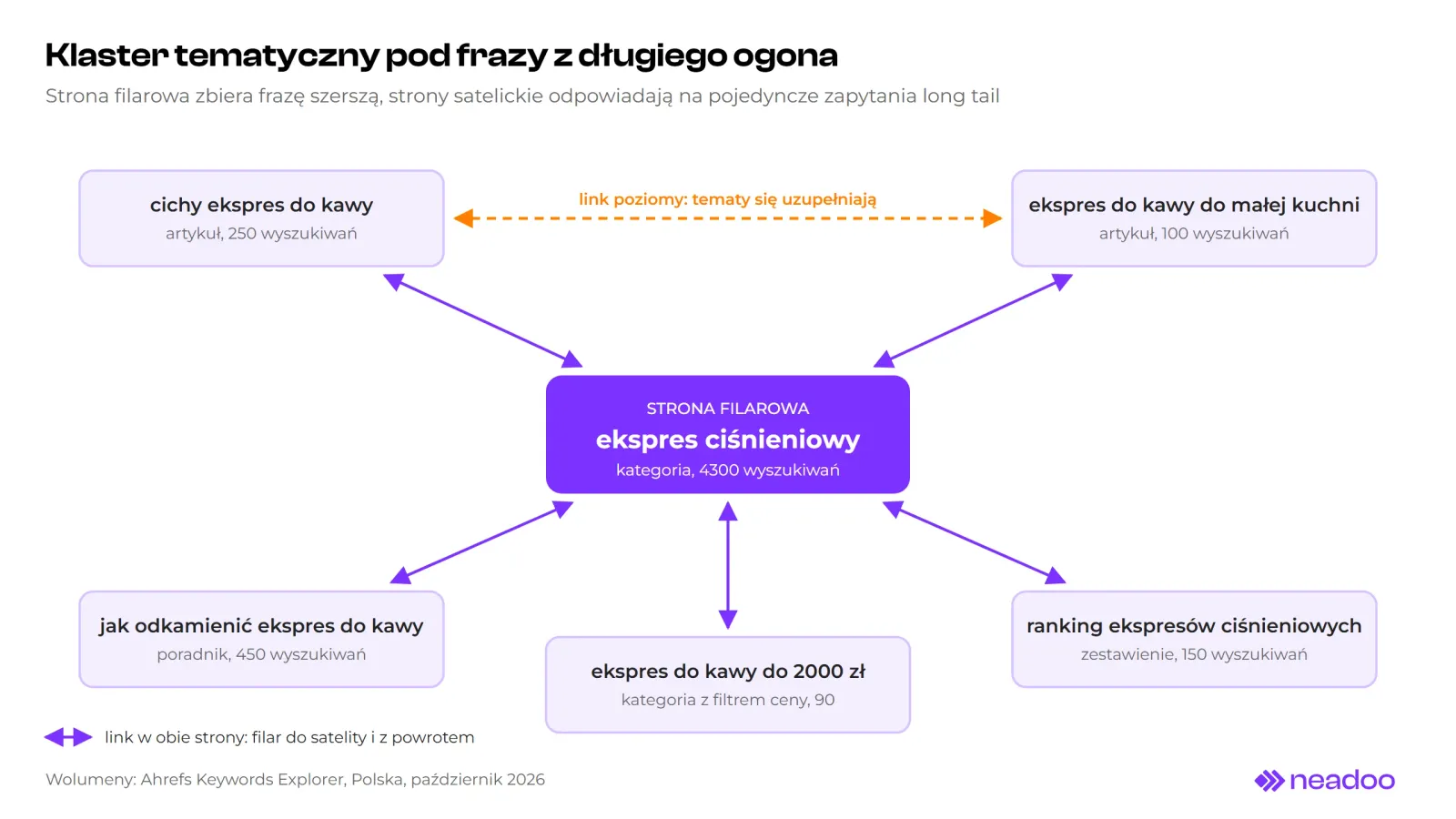
Fig. 2. The pillar captures the broader phrase, while satellites capture long-tail phrases. Two-way links help crawlers reach deep subpages.
Internal linking rules for long-tail pages
Internal linking within a cluster relies on three rules:
- Two-way links. Satellites link to the pillar page, and the pillar links to each satellite. A page without internal links may take a long time to get indexed.
- Horizontal links only when they make sense. An article on descaling can link to a guide on cleaning the brew group, but not to an espresso machine ranking.
- Descriptive anchor text. Instead of "click here," use a phrase that describes what is on the destination page, worded slightly differently each time.
Where should you place long-tail keywords on a page?
The target phrase for which the page is created goes into the title tag, H1 heading, first paragraph, and URL. Variations and related questions go into H2 and H3 headings, and the answer to each should be placed right beneath the heading, in the very first sentence. A section built this way also stands a chance of getting into a featured snippet, also known as position zero. When optimizing content for the long tail, repeating the phrase accomplishes nothing. What matters is that each section provides a complete answer, which increases the page's visibility for questions not found in any keyword tool as well.
Long-tail SEO for e-commerce and local businesses
In e-commerce stores, the long tail is built on product parameters; in service businesses, on location. The technical challenges differ in each case.
| Area | E-commerce stores | Local services and businesses |
|---|---|---|
| Keyword structure | brand, model, and specifications with intent modifiers ("price", "reviews", "under 2,000 PLN") | service and exact location: city, district, neighborhood |
| Page types | categories, product pages, selected filter pages | service pages, location pages, local projects |
| Risks | thousands of filter URLs, empty filter combinations, product variants cannibalizing each other | doorway pages, inconsistent NAP data |
In online stores, it is only worth letting combinations of filters into the index that have real demand. Google's documentation on faceted navigation (updated December 18, 2025) recommends blocking filter URLs that are not needed in search results, and returning a 404 code for empty combinations. An excess of such URLs also eats up the crawl budget. Filters and variants are usually the first thing we clean up during e-commerce SEO for product keywords.
For local businesses, local keywords make it tempting to set up a separate page for every single city. Google's spam policies cite having multiple pages targeting specific regions or cities that lead users to essentially the same page as an example of abuse. A location page makes sense only when it has unique content: pricing, completed projects, team members, directions. Plus consistent NAP data and schema.org LocalBusiness markup. Without this, city pages in local SEO for service businesses do more harm than good.
The long tail in voice search and AI
Voice queries and prompts in AI search engines are longer and more conversational than typed queries, so by nature they belong to the long tail. Someone asking a voice assistant or a chatbot rarely says "coffee maker." More often: "which coffee maker will be quiet in a small apartment."
Google's documentation on AI features in search (updated December 10, 2025) states that AI Overviews and AI mode may use a technique called "query fan-out": they break a question down into multiple detailed queries and combine the results into a single answer. In practice, these detailed queries are long-tail keywords. The same documentation states that there are no additional requirements or special optimizations needed to appear in these answers. A page that answers specific questions well simply has more touchpoints with such broken-down queries.
A cluster of long-tail pages therefore works twice over: in classic results and for visibility in generative search engines. We explained how to measure this in our article on AEO.
How do you measure the results of long-tail SEO?
The results of broad targeting SEO are evaluated by the sum of impressions and clicks across multiple keywords. The ranking of a single term tells you very little here. Traffic is distributed across hundreds of queries, so a rank tracker tracking ten keywords will only show a fraction of the picture.
- Google Search Console. The "Performance" report filtered by the blog directory or a group of pages. Look at the number of queries the pages appear for and total clicks. A growing number of queries with a stable number of pages is a sign that the long tail is working.
- Google Analytics 4. Engagement and conversions on pages targeting long-tail keywords. A visit from a guide rarely leads to an immediate purchase, so it is also worth looking at paths where the page was an intermediate step.
- Content cost vs. traffic. Compare the cost of producing the cluster with the traffic and inquiries it brought in. This is a metric every business must calculate for itself, as it depends on the industry and rates.
Frequently asked questions about broad targeting SEO
1. How does broad targeting SEO differ from short-tail SEO?
Short-tail SEO focuses on a few high-volume, highly competitive general keywords, e.g., "coffee maker." Broad targeting SEO targets many specific, low-volume queries. In practice, both approaches are combined: general keywords are handled by the homepage and category pages, while long-tail keywords are covered by guides and detailed subpages. We describe the basics of both in our guide on what SEO is.
2. What does long tail mean?
The long tail refers to less popular search queries that are searched infrequently but are extremely numerous. The name comes from the shape of the demand distribution curve: on the left are a few very popular keywords, and on the right is a long, flat "tail" of niche queries.
3. What is an example of a long-tail keyword?
"Quiet coffee maker" (250 searches per month in Poland according to Ahrefs) is a long-tail keyword compared to "coffee maker" (155,000). Other examples: "how to descale a coffee maker," "coffee maker under $500."
4. How many words does a long-tail keyword have?
There is no strict rule. Usually it is three words or more, but membership in the long tail is determined by search volume. A three-word phrase can have high competition, while a two-word phrase can be niche.
5. How long does it take to see results from long-tail SEO?
We cannot give a fixed timeframe, as it depends on the domain, competition, and how quickly Google indexes new pages. The first sign is usually the appearance of new queries in the Search Console "Performance" report before the clicks start coming in.
6. Does broad targeting SEO make sense in the age of AI?
Yes. AI search engines break questions down into multiple detailed queries and search for pages that answer them. A page that precisely answers a specific question has a real chance of being used as a source for such an answer.
7. Is it worth investing in long-tail SEO for a new website?
Yes, it is usually the most sensible place to start. A new domain has few backlinks, so competing for head terms is difficult, but it can achieve high rankings for specific queries much sooner. Initial traffic from the long tail also reveals which topics attract customers, helping guide future investments.
Sources
- Chris Anderson, "The Long Tail," Wired, October 2004
- Ahrefs, Long-tail Keywords: What They Are and How to Get Search Traffic From Them, Tim Soulo, updated May 27, 2026
- Backlinko, We Analyzed 306M Keywords. Here's What We Learned, Brian Dean, 2020
- Google, Understanding searches better than ever before, 2019
- Google Search Central, AI features and your website, updated
December 10, 2025
- Google Search Central, Spam policies for Google web search
- Google Search Central, Managing crawling of faceted navigation URLs, updated December 18, 2025
- Ahrefs Keywords Explorer, keyword search volumes for Poland, October 2026