
What Is SEO? Definition, Core Principles, and Optimization Techniques
Why does one website appear on the first page of Google, while a competitor with identical content gets lost somewhere on page five? The answer is SEO (Search Engine Optimization), or website positioning. This is the process of optimizing a site aimed at increasing website visibility, improving indexing, and ranking as high as possible in organic search results and in AI-generated answers.
SEO is based on three pillars: on-page optimization (content, headings, meta tags), off-page activities (link building), and technical SEO (speed, HTTPS, indexing). The principles of SEO in Poland differ slightly from international standards. Locally, SEO includes both an audit with on-site fixes and acquiring links, while in foreign markets the term more often points strictly to technical optimization. The result, however, is the same: free, high-value traffic from search engines, greater brand recognition, and increased sales.
Below you will find specific SEO techniques, an action plan, and answers to questions about where to start and how much website positioning actually costs in practice. We will start with the basics - how search engines work.
SEO Definition and How the Google Search Engine Works
What SEO Means in Practice
When someone types "what is SEO" into Google, they are usually not looking for a textbook definition. They want to understand why they should do it at all. SEO is the work done to make search engines understand what your website is about, consider it credible, and show it to people who happen to be looking for what you offer.
What does SEO mean for a business? Every time someone enters a phrase related to your offer, you have a chance to appear in search results without paying per click. However, spots in the organic search results on the first page are limited, so the winner is the one who better answers user intent and takes greater care of website quality.
Search engine optimization is not about tricking the algorithm. It is rather about organizing the website so that search engines have no reason to skip you: search engine bots need to reach the content, the content must be useful, and other sites should recommend it with links. All of this adds up to an increase in site visibility.
It sounds simple, but in practice, it takes months.
How Google Search Works: Indexing and Ranking
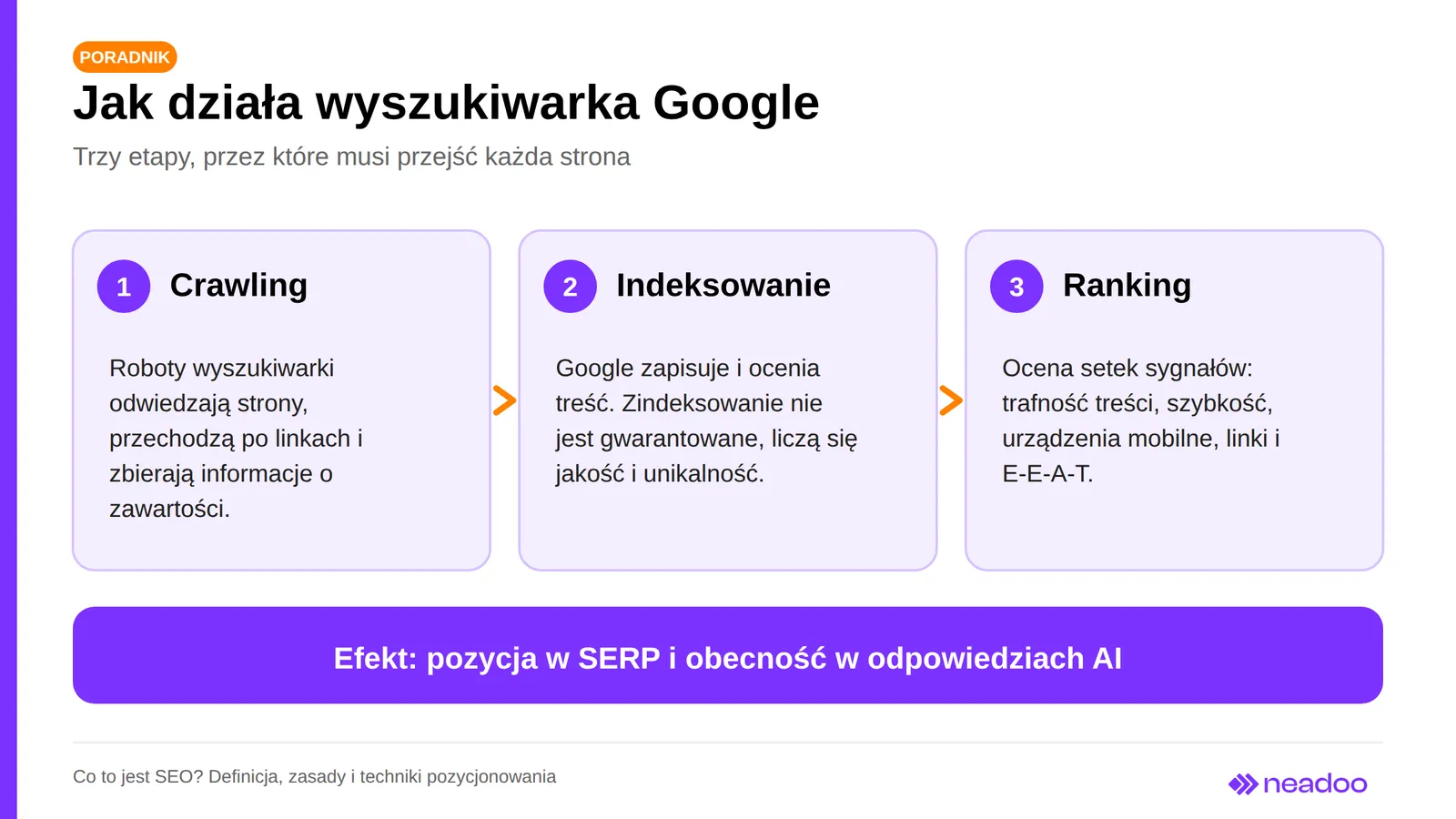
The Google search engine operates in three stages: crawling, indexing, and ranking. Crawling involves Google search engine bots, or Googlebots, visiting pages, moving between them via links, and gathering information about their content. Without this stage, no website will appear in search results. After crawling comes indexing: Google saves and categorizes the collected data (content, images, website structure) in its database. Indexing is not guaranteed. Google evaluates the quality, uniqueness, and value of the content and only then decides whether a given URL will enter the Google index.
A sitemap points bots to important URLs and makes them easier to discover, but it does not force anything. Google also crawls URLs outside the sitemap, and it may skip some pages specified in it. Similarly with the robots.txt file: it controls which sections can be scanned, but does not exclude pages from the index. For that, you use the noindex directive or authentication requirements.
The final stage is ranking, which is the evaluation of indexed pages against hundreds of signals: content relevance to the query, website loading speed, mobile friendliness, domain authority (links), and quality within the meaning of E-E-A-T. The result is the order in the organic search results, and increasingly also in answers generated by AI features. The entire results page is known in the industry as a SERP, short for search engine results page, and a spot on it is a ranking position.
The same fundamental optimization principles apply to generative features. Google has not introduced separate technical requirements, special files, or dedicated structured data that would guarantee an appearance in such responses.
Semantic Differences: SEO vs. Website Positioning in Poland and Globally
On the Polish market, "SEO" and "pozycjonowanie stron internetowych" (website positioning) function as synonyms and encompass the full scope of activities: technical audit, on-page content optimization, and off-site link building. Agencies usually sell this as a single package, combining website structure fixes with building a backlink profile.
In English-language terminology, the emphasis falls more often on the technical dimension of Search Engine Optimization, although there, too, SEO covers content quality, user experience, and domain authority built through links. The difference lies in communication nuances and how agencies package their services, rather than the actual scope of work required to rank high. If you are looking for someone to handle this comprehensively, check out the SEO positioning service, which in Polish practice combines all these elements into a single process.
Google Algorithms and Updates That Changed SEO
A Brief History of Algorithms
Google algorithms change hundreds of times a year, but a few updates shifted the industry for good. Panda (2011) targeted low-quality content, and Penguin (2012) tackled unnatural link profiles. Hummingbird (2013) taught the search engine to understand entire queries rather than individual words, while RankBrain (2015) and BERT (2019) took this to the level of context and natural language.
The takeaway is similar every time: Google penalized what used to work as shortcuts. Anyone who built visibility on purchased links or duplicated text went back to square one. Today's Google algorithms handle such tricks much better than in the past, so it pays to invest in what remains effective regardless of the next update.
Core and Spam Updates in 2026
In 2026, Google has already rolled out two major core updates (core update), in March and May. Spam updates appeared between them and after them, including in the summer and early fall. Google does not disclose details and simply repeats the advice to create helpful, reliable content written for people. Since March 2024, the helpful content system has not been a separate update, but part of the core ranking systems. The assessment of content usefulness is therefore continuous. There is no single moment after which you can "undo" something and return to your old position.
What should you do when page rankings drop after such an update? Check Search Console to see if the drop started during the rollout days, which usually takes up to two weeks. Start with the pages that lost the most, and compare them with what is currently ranking higher. The worst thing we see is mass rewriting of an entire site within a week after a drop, because after that it is impossible to evaluate what actually helped.
The Three Pillars of Modern SEO
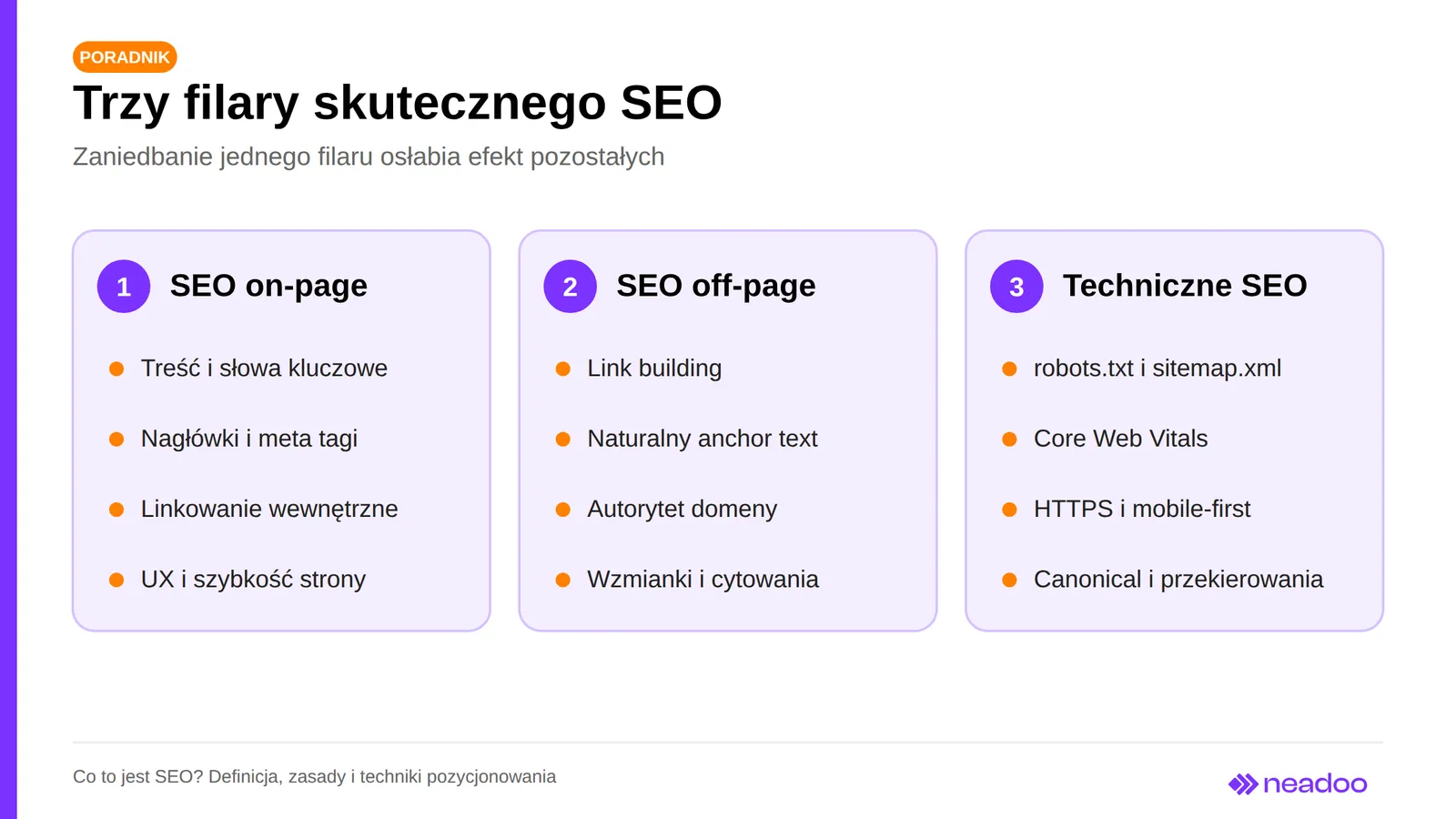
Website optimization requires working across three pillars simultaneously: content and code optimization (on-page SEO), building a link profile (off-page SEO), and technical infrastructure (technical SEO). Neglecting one limits the impact of the others.
| Pillar | Scope of Activities | Key Elements |
|---|---|---|
| On-page SEO (on-site) | Optimization of content and code within the website | Keywords, meta tags (meta title, meta description), H1-H6 headings, content optimization, UX, speed, and responsiveness |
| Off-page SEO (off-site) | Activities outside the website | Link building, link profile, anchor text, external domain authority |
| Technical SEO | Infrastructure and crawlability for bots | robots.txt, sitemap (sitemap.xml), structured data, canonical tags, 301 redirects, Core Web Vitals, mobile-first indexing, JavaScript SEO |
On-Page SEO: Content, Headings, and Meta Tags
On-page SEO begins with selecting keywords that match search intent and creating unique content that genuinely helps someone. The meta title and meta description influence CTR in Google search results. The H1-H6 heading structure organizes the copy, and a well-thought-out site architecture helps crawlers understand the topic. This pillar also includes improving website code, UX design, as well as optimizing speed and responsiveness. These factors determine how much time a user spends on a website and whether they submit their contact details.
Off-Page SEO: Links and Authority
Off-page SEO, or activities outside the website, focuses on link building: acquiring backlinks from third-party sites with high authority and topical relevance to your industry. The link profile is one of the signals that Google algorithms consider when evaluating website visibility. Anchor text matters as well. The more natural and diverse it is in inbound links, the lower the risk that the profile will be perceived as manipulative. Twenty links with the identical text "cheap sports shoes" look suspicious, even if every one of them is on a good website.
Technical SEO: Crawlability and Accessibility
Technical SEO prepares a website to work with search engines: it allows them to index and evaluate it. It covers website loading speed measured by Core Web Vitals metrics, mobile friendliness (mobile-first indexing), and the HTTPS protocol as a security standard. A slow site loses users before they even get to read anything. Technical SEO is usually the first stage of work, because without technical site optimization, even the best content falls into a void.
Core Web Vitals consist of three metrics: LCP (largest contentful paint time), INP (responsiveness to interaction), and CLS (layout stability). Good scores are considered up to 2.5 seconds, up to 200 milliseconds, and below 0.1, respectively. In March 2024, INP replaced the earlier FID metric.
Robots.txt additionally controls the crawl budget, which is the limit of resources search engine bots allocate to scanning a domain. For a small website, this is rarely an issue, but for an online store with thousands of URLs, it becomes a real concern. Canonical tags (canonical URLs) point Google to the preferred version of a web page and prevent duplication, while 301 redirects are used when changing URL structures or consolidating content.
Structured data can qualify a page for rich search results, but it does not guarantee they will be displayed. Furthermore, Google has heavily restricted the types of such results in recent years, such as FAQ and HowTo. A separate issue is JavaScript SEO: ensuring that content generated dynamically by scripts is properly rendered and indexed. Google bots are getting better at handling JavaScript, but rendering requires more time from them, making indexing delays common on websites built on SPA frameworks.
Let's check your website's potential
Share your website and email - we'll get back to you with a real analysis, no strings attached.
Keyword Selection and Search Intent as the Strategy's Foundation
An SEO strategy starts with asking what people are actually searching for, not what a company would like to say about itself. Keywords are the answer to that question. Without well-chosen phrases, even a technically flawless website will not attract the right traffic.
How to Choose Keywords: Methods and Tools
Keywords are the queries that users type into a search engine, and selecting them involves matching your website to them. The starting point is research tools: Google Keyword Planner shows search volume and seasonality, while Polish tools like Senuto and Semstorm offer data tailored to the local market. Keyword research does not end with tools alone: add Google autocomplete suggestions and the "Related searches" section.
Competitor analysis also reveals a great deal. When you check which keywords businesses in your industry rank for, you will quickly spot content gaps and topics that no one has covered thoroughly yet. From that list, first select the keywords where you stand a realistic chance, and only then go after the high-prestige ones.
The final step is topical segmentation. You group keywords by meaning and stage in the buyer's journey: separate informational ones ("how to get started with SEO") from transactional ones ("ecommerce SEO pricing"). This immediately shows how many offer subpages and how many articles need to be prepared, and which specific keywords fit which page.
Long-Tail Keywords
Long-tail keywords are multi-word queries that generate less traffic than generic terms, but convert better because they precisely reflect what the user needs. Someone typing "SEO audit for an online clothing store" already knows what they are looking for. For a new website, this is usually the best place to start. With a broad term like "SEO", you compete against the entire market. Choose specific long-tail keywords, and you will often face just a few pages. Once you secure top positions in search results for them, winning the next ones gets easier. These are keywords that rarely spark excitement, yet often bring in the first inquiries.
The Importance of Search Intent in Modern SEO
Success in SEO depends on aligning keywords with search intent, not on driving random traffic. Intent can be informational, navigational, or transactional, and the website's content must satisfy it. Google does not confirm that bounce rate or session duration are direct ranking factors, but a page that fails to match intent will still lose users and conversions.
Keywords in the text alone are not enough. A page targeting an informational query should provide comprehensive knowledge, while a page for a transactional query should enable a purchase or contact. When search results for a given query are dominated by how-to guides, trying to rank for that phrase with a sales page rarely succeeds. That is why, before writing content, you should check what Google is currently showing on the first page. The type of pages, content length, and structure are the best clues about what the algorithm expects.
SEO Audit: Where to Begin Working on a Website
An SEO audit is a comprehensive review of a website from a search engine perspective that shows what is blocking website visibility before you change anything. Without it, website optimization is like treating an illness blindly, and it is easy to invest in content that Google will not even index anyway. A professional SEO audit covers three layers: technical setup, content, and links. A good way to start is by gathering data: traffic, indexed URLs, and the keywords the website already ranks for.
Technical Audit: Crawlers, Indexing, and Speed
A technical audit checks whether Google's crawlers can reach important URLs in the first place. You review robots.txt, the sitemap, response codes (404, 301, 5xx), duplicate meta tags, canonicals, and the indexing report in Google Search Console. You evaluate website loading speed and Core Web Vitals separately, ideally using real-user data rather than just lab tools.
The entire site is scanned by a crawler, such as Screaming Frog or the audit module in Senuto or Ahrefs. It reveals things you cannot spot manually: redirect chains, orphaned subpages without internal links, and pages with noindex set by mistake. It is usually the website's technical aspects that explain why good content fails to rank.
Content and Link Audit
In a content audit, you evaluate subpages from an SEO perspective to see which ones drive traffic, which are thin, and which compete against each other for the same keywords. A common finding: ten articles about almost the same topic, with none ranking high. You merge them into one strong piece of content and redirect the old URLs.
On top of that comes a link audit: where links originate, whether they are topically relevant, and whether any spam directory links have slipped in. You also examine the quality of internal linking - whether important subpages receive links from other pages across the site. When you outsource a professional SEO audit, you should not receive a report with two hundred bullet points. You should get a prioritized action list with estimated impact and effort.
Content Optimization and Content Marketing
Content is the part of SEO that is easiest to mess up. Writing strictly for search engines ends up as text no one wants to read, while writing purely for the reader, without a plan, results in text no one will ever find. Content optimization is about finding the middle ground, and content marketing ensures that this middle ground is produced consistently.
How to Write Content That Ranks
Start with the answer. A user who typed a query wants to get it in the first few sentences, and a crawler extracts it more easily from the beginning of a section. Then, expand on the topic: examples, numbers, exceptions - things that cannot be found on just any random page in search results. Place the main keywords in the title, the H1 heading, and the first paragraph, and leave the rest for synonyms.
Creating valuable content does not come down to length. A text of six thousand characters can beat a text of twenty thousand if it answers directly and does not drag on. Check how many and what types of headings top-ranking pages have, but do not copy the page structure one-to-one. Add what is missing there: your own data, photos, hands-on implementation experience. This is precisely the valuable content that cannot be recreated with a single prompt.
Do not generate articles in bulk using AI tools without editorial review. Google does not prohibit AI-assisted content, but since 2024 it explicitly treats the mass production of pages offering no value to the reader as spam (scaled content abuse). A tool will speed up the draft. Facts, examples, and tone are things you must oversee yourself.
Content marketing broadens this into an entire process: planning topics, publishing, distribution, and refreshing. Well-executed content marketing builds traffic from phrases you might not care about today, but which start converting a year from now because you reach potential customers at an earlier decision-making stage. Social media promotion does not provide ranking value like links from websites do, because social media links usually carry the nofollow attribute. However, it helps reach people who will later link to the content on their own sites.
Meta Title, Meta Description, and Headings
A meta title is about 50-60 characters long, contains the main keywords, and promises something specific. A meta description (up to about 155 characters) does not directly affect rankings, but it determines whether someone clicks your link in search results. Every subpage should have its own unique one rather than a duplicate. Keep in mind that Google can rewrite both elements if it decides they better match the query. Meta tag optimization is done thoroughly once, and then revisited when CTR drops in Search Console. Look for pages with high impressions and low CTR, because that is where tweaking the title yields the fastest results.
In headings: one H1 per page, followed by a logical hierarchy of H2 and H3 tags. Headings serve as a table of contents for both the crawler and a human scanning the text. If you cannot tell what the article is about just by reading the headings, something is wrong.
Site Structure and Internal Linking
Website Architecture and Sitemap
Website architecture is the layout of subpages and the relationships between them. A good website structure is flat: every important subpage can be reached within three to four clicks from the homepage. When designing website architecture, start with logical categories. They help users and crawlers, which use them to understand what is a parent topic and what is a subtopic.
Creating an XML sitemap takes twenty minutes of work, and it makes it easier for Google bots to discover new URLs. It is enough for it to contain only those pages that should be indexed: no redirects, 404 errors, or noindex pages. In addition, ensure readable URLs - short, parameter-free, and including the primary phrase. Changing URLs and site structure on a live website requires 301 redirects and a good reason.
Internal Linking in Practice
The rules of internal linking are simple. Every new article links to several older ones, and several older ones get a link to the new one. The anchor text should describe what is behind the link, so "click here" is off the table. Thanks to this, authority spreads across the website, and Google gets a clear signal about which pages are the most important. Linking from strong subpages - those with a high number of external backlinks - to pages you want to boost also works well. The most common mistake is an important offering page that is linked only from the main navigation menu and nowhere else.
E-E-A-T Quality Standards in SEO Practice
E-E-A-T (Experience, Expertise, Authoritativeness, Trustworthiness) influences page rankings in Google search results, although it is not a single ranking factor. It is a set of signals outlined in the Search Quality Rater Guidelines, which the Google search algorithm tries to reflect by analyzing content, authors, and the context of the entire domain.
Experience refers to the author's first-hand contact with the subject: a review from someone who actually tested the product carries more weight than a compilation of other people's opinions. Expertise is especially important in YMYL (Your Money or Your Life) categories - finance, health, and law - where an error can harm the user. Authoritativeness is built through citations, mentions, and links from credible industry websites. Trustworthiness relies on clear contact details, privacy policies, transaction security, and factual accuracy.
In practice, this translates into specific website elements: author bios with links to professional profiles, publication and update dates, cited sources, and an "About Us" page with company registration details. If you run a company blog and there is not a single author name under the articles, start right there.
White Hat and Black Hat SEO
SEO is divided into two opposing approaches. White hat SEO aligns with Google guidelines and builds domain credibility through valuable content and a natural link profile. This is what drives tangible business results: organic traffic, brand awareness, sales growth. White hat SEO takes longer, but its results are not wiped out by a single algorithm update.
Black hat SEO consists of manipulative techniques: cloaking, buying low-quality mass links, and automated text generation without editorial supervision. These may provide a brief spike in visibility, but once detected, they lead to an algorithmic filter or a manual penalty - meaning a drastic drop in rankings or complete removal of the domain from search results. Many offers promising a "guaranteed ranking within a week" rely precisely on black hat methods. That is why, in any serious collaboration, white hat SEO is the baseline, not an option.
Link Building and Off-Page Activities
Link building is the process of acquiring links from other websites to yours. To Google, every such link is a type of recommendation, but not all recommendations carry the same weight. A single link from a respected industry website can do more than a hundred entries in directories that nobody reads.
Natural sources include guest posts, expert articles, reports with original data, media mentions, partnerships, and product reviews. A good link also drives potential customers, and social media mentions can trigger further coverage. Content that naturally earns links also works well because it offers something found nowhere else: a study, a calculator, a compilation. Mark paid links with the rel="sponsored" attribute, just as Google recommends.
What to Avoid in External Linking
Stay away from packages like "1,000 links for a few dozen dollars," link farms, and private blog networks built solely to link out. Such practices violate guidelines and lead to a manual penalty or simply zero results. Diversity and topical relevance are more important than the raw number of links. A natural profile includes links with branded anchor text, naked URLs, descriptive phrases, and generic text like "here." If your report shows that nearly all links use your primary money keyword as anchor text, that is a red flag.
SEO for an Online Store
An e-commerce store is a special case: thousands of pages, repetitive descriptions, faceted navigation, out-of-stock products. What does SEO mean in e-commerce? Above all, it means an orderly site structure and discipline in content, because scale works both ways here. An error in a category template multiplies across hundreds of URLs, and store optimization relies heavily on working with templates.
An online store set up for SEO features clear categories, unique descriptions for categories and key products, accurate product data, and fast loading on mobile devices. An SEO strategy for an online store relies heavily on categories rather than product detail pages. When ranking an e-commerce store, categories drive most of the visibility, so start your work there and plan the site architecture first.
Categories, Product Pages, and Content Duplication
Assign broad keywords and commercial phrases ("women's hiking boots") to categories, and specific ones ("model X size 7") to product pages. A category description should help users make a choice rather than merely repeat product names. Add unique descriptions, specifications, photos, and customer reviews to product pages instead of copying text from the manufacturer.
The biggest challenge for stores is duplication and URL bloat caused by filters. Filter combinations can generate thousands of nearly identical pages on which search engine crawlers waste time and crawl budget. You can restrict them using the canonical tag, noindex, or blocks in robots.txt, depending on the case. Out-of-stock products are usually kept online with an availability notice and a link to similar items, rather than deleting the page. Product structured data containing price, availability, and ratings helps Google understand the offering and may qualify the page for a rich result. There is no guarantee, but without this data, the chances are slimmer. Online store owners often put this off for later.
Local SEO and Google Business Profile
Local SEO focuses on a business's visibility in search results tied to a specific location: "service + city" queries and the local pack beneath the Google map. The foundation is a Google Business Profile, formerly known as Google My Business. Accurate address details, business hours, and the right business category are the bare minimum. Google profiles often determine whether a customer calls before they even visit your website.
Any mismatch between this data and the information on your website (NAP: Name, Address, Phone) reduces the company's credibility in the eyes of the algorithm. Local SEO also requires citations in local business directories, gathering customer reviews, and actively maintaining Google profiles on a regular basis. These signals influence rankings in the local pack independently of your position in standard organic search results. Search engines factor in the user's location, so when it comes to local optimization, every minor inconsistency counts.
Businesses operating in multiple locations should create a separate page for each city or region, rather than relying on a single generic contact page. This aligns much more closely with location-specific search intent. Each of these subpages must contain unique elements, such as photos of completed projects, rather than just swapping out the city name.
Evolution Toward SXO and Tackling the "Zero-Click Search" Phenomenon
SXO as the Union of SEO and UX
SXO (Search Experience Optimization) combines traditional search engine optimization techniques with user experience design. Ranking and conversion are the results of a single process, not two separate initiatives. The mere presence of a keyword in the content is not enough, because what the user does after landing on the page matters just as much. Google does not disclose how it uses user behavior for ranking, but a website that frustrates visitors will lose conversions anyway.
Four factors usually deliver the quickest results. The first is speed and stability: Core Web Vitals measure real-world user experience, and slow loading times along with layout shifts increase bounce rates regardless of content quality. The second is clear information architecture, since transparent navigation and a logical heading hierarchy shorten the path to the answer. The third is conversion-oriented design: the placement of calls to action, forms, and purchase funnels determines whether traffic turns into business results. The fourth is mobile-first, because most traffic comes from smartphones, making responsiveness and touch element testing an integral part of SEO, not an afterthought.
In practice, an SEO audit should include usability testing, heatmaps, and path analysis alongside the technical and content audit. A website can rank highly and not make a single dollar if its form does not work on a phone.
Strategy for Handling Zero-Click Searches
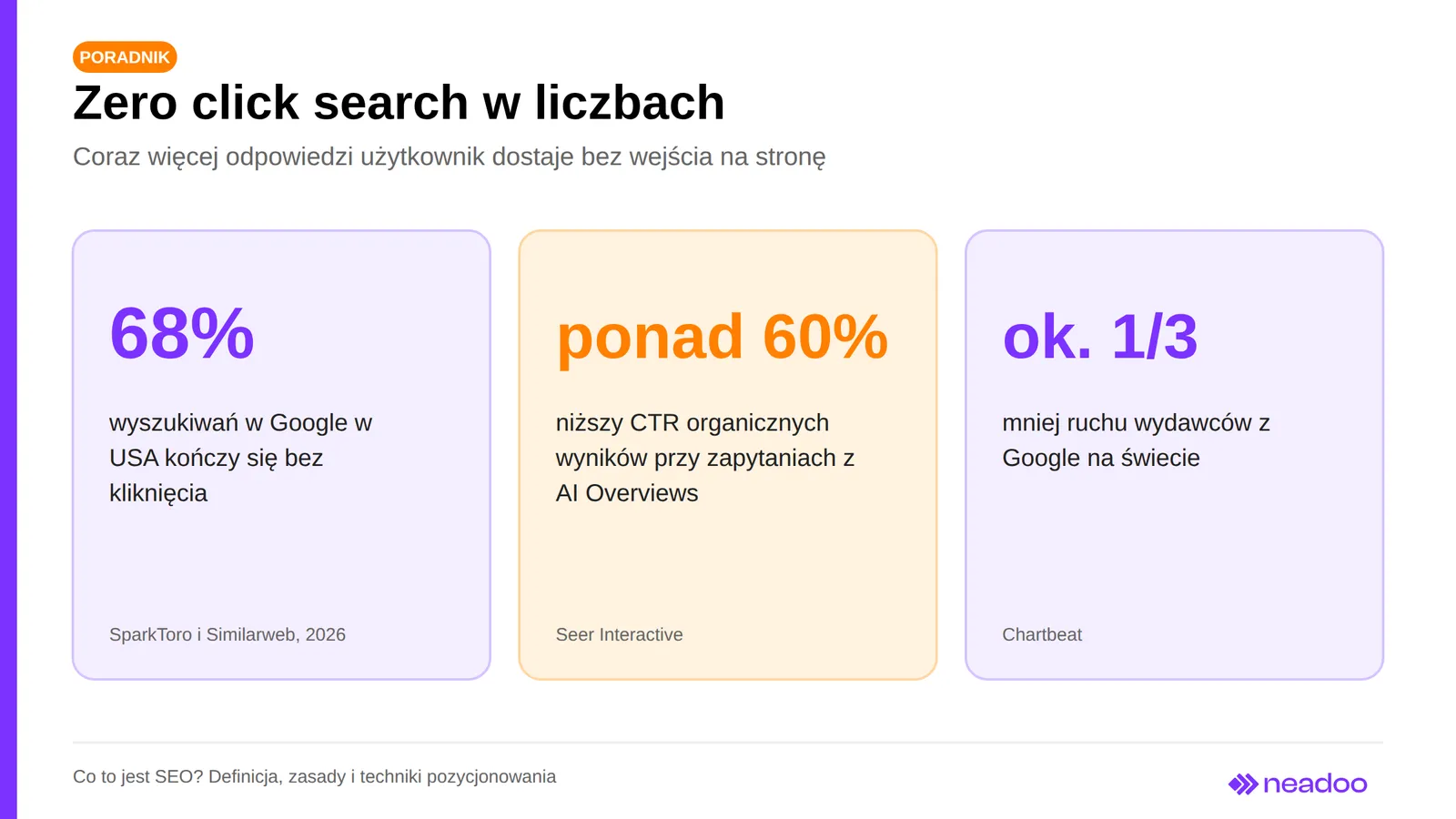
Zero-click searches are queries where the user gets an answer directly in the search results (in a featured snippet, knowledge panel, or AI summary) and clicks on no website at all. According to a 2026 study by SparkToro and Similarweb, this applies to roughly 68 percent of Google searches in the United States. This lowers website CTR even when a page ranks high in organic search results.
The scale of the loss depends on the type of content. An analysis by Seer Interactive showed that for queries where Google displays AI Overviews, the CTR of organic results dropped by over 60 percent, as search engines increasingly provide answers themselves. According to Chartbeat data, publisher traffic from Google has dropped globally by about one-third. On the other hand, Gartner predicted a 25 percent drop in traffic from traditional search engines by 2026, yet Google still commands about 90 percent of the global market.
A forecast on that scale did not pan out. News sites are suffering the most.
Instead of avoiding such formats, it is better to optimize the site to capture them. Structured data qualifies a page for rich snippets, though without guaranteed display. A concise, direct answer at the beginning of a section increases the chance of securing a snippet, even if it results in no click. A brand presence in a rich snippet or knowledge panel builds brand recognition and can translate into subsequent branded search queries. Optimize your site concurrently for transactional queries, because there a click is necessary to purchase, contact, or sign up, and the number of clicks from organic search results for such queries usually drops more slowly.
The number of clicks from organic results is no longer the sole measure of success. The impact on brand awareness and traffic quality matters too. A drop in CTR on informational queries can be acceptable if the number of conversions from later stages of the purchase funnel is growing.
The Future of SEO: GEO (Generative Engine Optimization) and AI Integration
What does SEO mean today, in the era of AI-generated answers? Still the same thing, just broader. An SEO strategy does not require a new, standalone version, but an extension of the existing one. Google has introduced AI Overviews and conversational AI Mode, meaning users increasingly get their answers without visiting a specific website. In an official 2026 guide, Google recognizes that so-called AEO (Answer Engine Optimization) and GEO are still SEO.
What Is GEO and How Does the Grounding Mechanism Work?
GEO (Generative Engine Optimization) is an informal industry term for actions that increase the likelihood of a website being cited in generative responses, rather than an official Google technical category. The same foundational SEO principles apply to these features as before. There are no separate technical requirements, special files, or dedicated structured data needed to appear in responses.
The grounding mechanism means that the AI model bases its answer on real, indexed web pages, rather than solely on training data. The system searches for sources relevant to the query, retrieves facts from them, and cites or links to them. Therefore, classic website indexability (a valid robots.txt, a URL in the sitemap) remains a prerequisite for being cited, just as in organic search results.
How to Optimize Content for LLMs?
Optimizing for LLMs relies on the same fundamentals as organic visibility, without a separate set of tricks. The website must be crawlable by bots, and the content must be unambiguous, well-structured, and directly address the search intent. A clear heading structure allows the model to quickly find the excerpt with the answer, while short, factual definitions and lists near the beginning of a section are easier to parse than rambling paragraphs. E-E-A-T signals - authorship, sources, and freshness - matter just as much in organic search results as they do in an AI response.
A technically sound, credible, and well-structured website stands an equal chance in organic search results, AI Overviews, and conversational mode.
Do not fall for services promising to "get you into ChatGPT." No such service exists.
Generative AI Reports in Google Search Console
On June 3, 2026, Google launched separate generative feature performance reports in Search Console. They show impressions of your URLs in AI Overviews and AI Mode, as well as in generative features within Discover, broken down by pages, countries, devices, and dates. As of August 31, 2026, they are available to all websites globally. There are two caveats. The report shows impressions, not clicks, so you cannot measure AI traffic from it. The data begins on May 18, 2026, with no retroactive backfill. These impressions were previously included in the standard performance report, but could not be isolated.
Save your baseline measurements as a reference point.
SEO Analytics and Free Tools
SEO requires ongoing measurement, not a one-time audit, because website optimization is a process. Without data, you cannot assess which actions actually led to an increase in your website's visibility. Search Console shows indexing status, organic traffic, and technical errors. The performance report includes queries, clicks from organic results, impressions, and average position, so it is also used for monitoring website rankings for specific phrases, and starting this year, it also includes a separate view for generative features. This is the first tool that needs to be configured.
Google Analytics (currently GA4) tracks traffic sources, user paths, conversions, and user behavior on the site. Combined with Search Console, it will show that someone entered from organic search results and what they did afterward. The third tool is a crawler for technical website auditing, which supplements the data with details at the level of individual URLs.
To get started, free tools are enough: Search Console and Analytics are a complete set that allows you to get quite a lot done.
Paid Tools and When to Use Them
Paid tools, such as Senuto, Semstorm, Ahrefs, or Semrush, are mainly useful for tracking rankings and checking backlink profiles. Keyword research in Senuto or Ahrefs reveals the keywords that drive traffic to competitors. Senuto and Semstorm offer good data for the Polish market, while Ahrefs stands out with its link database. They are not a prerequisite for starting work on your website's visibility. Buy them when you run out of data from free sources, not just in case. A tool that no one looks at is purely an expense.
Step-by-Step SEO Strategy
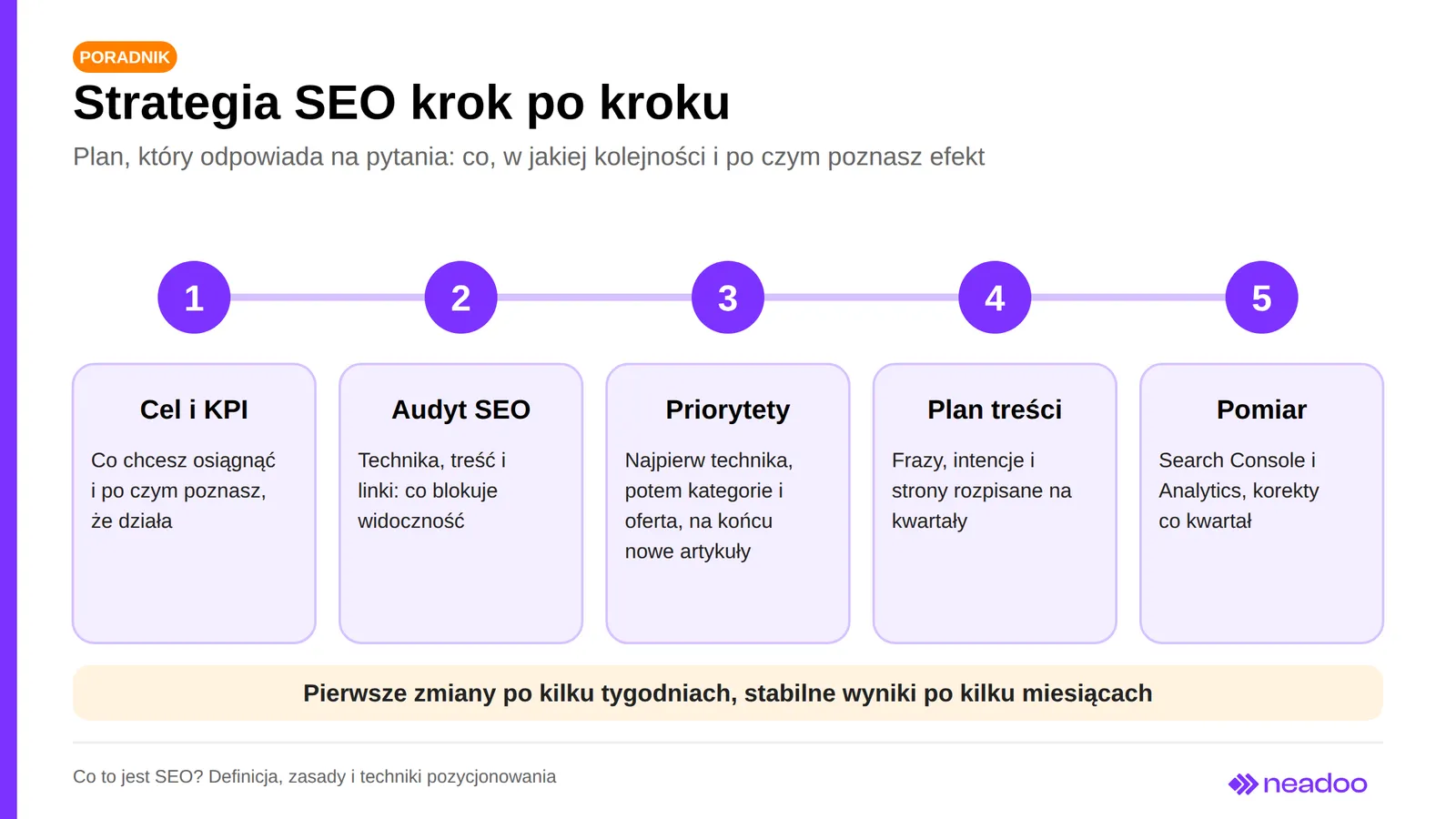
SEO without a plan is a collection of random tweaks. An SEO strategy is a plan that answers three questions: what you want to achieve, in what order you will do it, and how you will know it is working. Without it, SEO turns into a series of actions, none of which have a chance of delivering a major impact. A good SEO strategy starts narrow and expands only when the first elements begin to work.
Goals, KPIs, and the Starting Point
Every SEO strategy starts with a business goal, not keywords. Do you want more quote requests, higher online sales, or brand awareness? The answer determines which keywords you choose and what pages need to be built. Sometimes it is simply about improving website rankings for a few key phrases, and sometimes it is about building traffic from scratch.
Next comes the starting point: current organic traffic, the number of indexed pages, the phrases the website already ranks for, and the results of your website audit. From this, you select several metrics (KPIs): traffic from organic results, the number of phrases in the top 10 results, and the number of inquiries or purchases from SEO. An increase in a page's ranking in search results is a secondary metric. Nobody pays the bills with rankings.
Content Plan and Schedule
An SEO strategy is based on priorities. You start with technical fixes that unlock visibility, then you improve service/offer pages and categories along with adjustments to internal linking, and only then do you add new articles. This way, the first results appear where the website is already close to success, for example on pages ranking in positions 8-15. Map out your content plan by quarters: key phrases, search intent, assigned pages, and responsible team members. Leave room in it for refreshing existing content, because an update often yields more than a new article.
The first noticeable changes usually appear after a few weeks, and stable results come after a few months, depending on the competition and the condition of the website. An SEO strategy is not a document to put on a shelf. Return to it every quarter and remove what does not work instead of piling on more things.
SEO Costs and Return on Investment (ROI)
For a budget, SEO means an expense spread out over time. How much SEO costs depends on the competitiveness of the industry, the number of keywords, the technical condition of the website, and the scope of work needed to catch up. For an online store with thousands of products, the cost of SEO is usually higher than for a business card site with a dozen pages. There is no single universal market rate. Unlike paid ads (PPC), SEO is a long-term investment: it generates stable, free traffic even after intensive work ends, although without ongoing optimization, rankings will fade over time.
A cheaper offer is not necessarily worse, and an expensive one is not necessarily better. Ask what exactly is included in the price: audit, content, links, reports, working hours. The SEO strategy described in the proposal should tie expenses to the business goal. Activities aimed solely at improving website rankings, with no connection to sales, are a cost, not an investment.
SEO vs. SEM and Paid Advertising
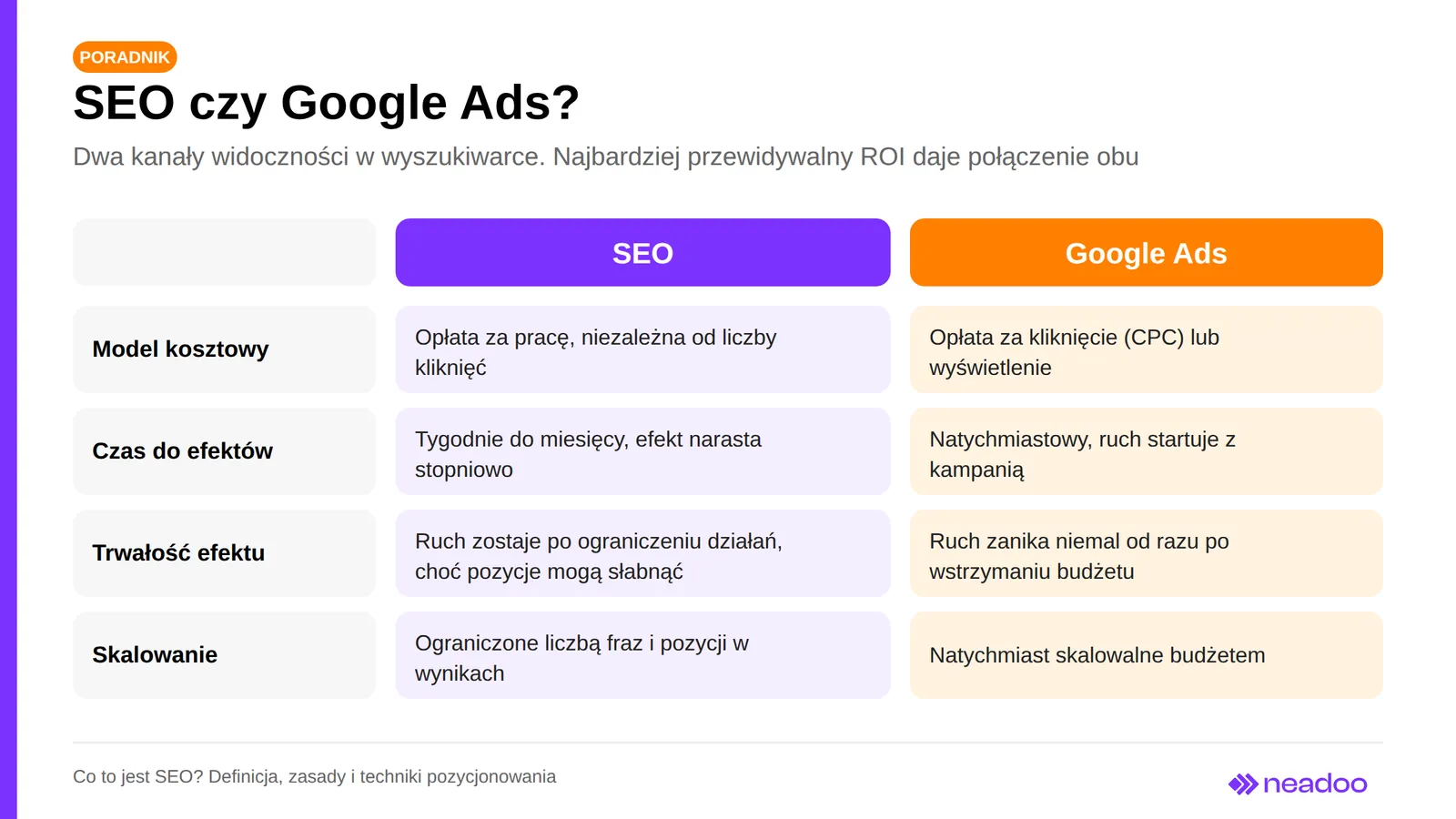
SEO and paid search ads are two components of search engine marketing, known as SEM (Search Engine Marketing). SEM includes unpaid activities (SEO) and sponsored results purchased through an auction model, such as Google Ads. Search engines show both types of results on the same page, but the channels differ in their financing model, time to results, and lasting impact.
| Criterion | SEO (organic efforts) | Google Ads / sponsored results |
|---|---|---|
| Cost model | Fee for work or service, independent of the number of clicks | Pay-per-click (CPC) or pay-per-impression, dependent on auction bids |
| Time to results | Weeks to months, results build up gradually | Immediate, traffic starts once the campaign is launched |
| Longevity of results | Traffic remains after reducing efforts, though rankings may decline without optimization | Traffic disappears almost immediately once the budget is stopped |
| Scalability | Limited by the number of available keywords and positions in organic results | Immediately scalable by increasing the budget |
| Nature of investment | Cumulative, site value (content, links, authority) grows over time | Linear, each click requires a new expense |
This distinction directly affects how ROI is calculated. In Google Ads, the cost is tied to the number of clicks, so the return can be measured over a short period. In SEO, you incur the cost of work (audit, content, link building) upfront, and the effect spreads out over months and years. This makes simple month-over-month comparisons difficult, but it usually lowers the cost of acquiring a visitor from organic results over a longer horizon. The most predictable ROI comes from companies that combine both channels: SEO builds lasting organic visibility, while Google Ads quickly fills in traffic while the SEO results are still building up. Paid campaigns can also serve as a testing ground. You see which keywords convert, and only then move them into your SEO plan.
Most Common SEO Mistakes and Myths
What Mistakes Should You Avoid?
Most SEO mistakes stem from flawed assumptions about what search engines actually require. The most common ones include:
- Treating SEO purely as technical work, which leads to neglecting on-page content and external signals, namely link building.
- Believing that a sitemap guarantees indexing, even though it only makes it easier to discover URLs.
- Using robots.txt to exclude pages from the index, even though the file only blocks crawling; noindex is used to remove pages.
- Ignoring Google Search Console data, which means technical issues surface with a delay, after visibility has already been lost.
- Overlooking local nuances: a national content strategy without local SEO means missing out on the local pack, despite ranking well for broad queries.
- Expecting guarantees from structured data, which only qualifies a page for rich snippets without guaranteeing they will actually display.
On top of that comes the mistake we see most often: an SEO strategy without measurement. Actions are taken, no one checks the impact, and a year later nobody knows what actually worked.
Myths That Still Circulate
"SEO is dead because we have AI". It is not. AI Overviews and other generative answers draw from the very same indexed pages, and Google explicitly refers to optimizing for them as part of SEO. What is shifting instead is how we measure search performance, because click-through traffic is no longer the sole objective.
"You only need to do SEO once". Not enough. An SEO strategy ages right along with the algorithms: competitors publish new content, Google updates its guidelines, and existing content becomes outdated. The results of SEO efforts fade without ongoing attention, because website optimization is a process, not a project with an end date.
"The more keywords in the text, the higher the ranking". Keyword stuffing has been treated as spam for years. Specific keywords should appear naturally where they make sense, while synonyms and context take care of the rest.
"Good SEO means buying links". That is the fastest route to a manual action penalty. You cannot build anything on black hat SEO that will survive the next core update.
FAQ
What is SEO and what does an SEO specialist do?
SEO (Search Engine Optimization) is the process of optimizing a website for search engines to increase its visibility in organic search results and AI-generated answers. SEO specialists handle technical aspects (indexing, speed), content (keywords, headings, meta tags), and links. Their work usually begins with an audit.
How do I start optimizing a website on my own?
Start with free tools: set up Google Search Console and Analytics to monitor indexing and traffic. Then tackle the three core pillars: on-page SEO (content, title tags, meta descriptions, headings), technical SEO (speed, mobile-friendliness, HTTPS, sitemap.xml), and basic link building.
How long does it take to see the first results of SEO efforts?
Results build up gradually, taking anywhere from several weeks to a few months, depending on industry competitiveness and the technical state of the website. This sets SEO apart from Google Ads, where traffic appears immediately once a campaign launches, but stops as soon as it is paused.
What is the difference between SEO and SEM?
SEM is a broader term that encompasses both organic SEO and paid sponsored results (such as Google Ads) purchased through an auction model. SEO builds long-term organic visibility without cost-per-click fees, while SEM as a whole combines that lasting impact with immediate, scalable paid traffic.