
SEO Copywriting - How to Write Content for SEO

Modern SEO Copywriting and Creating Content for People and Search Engines
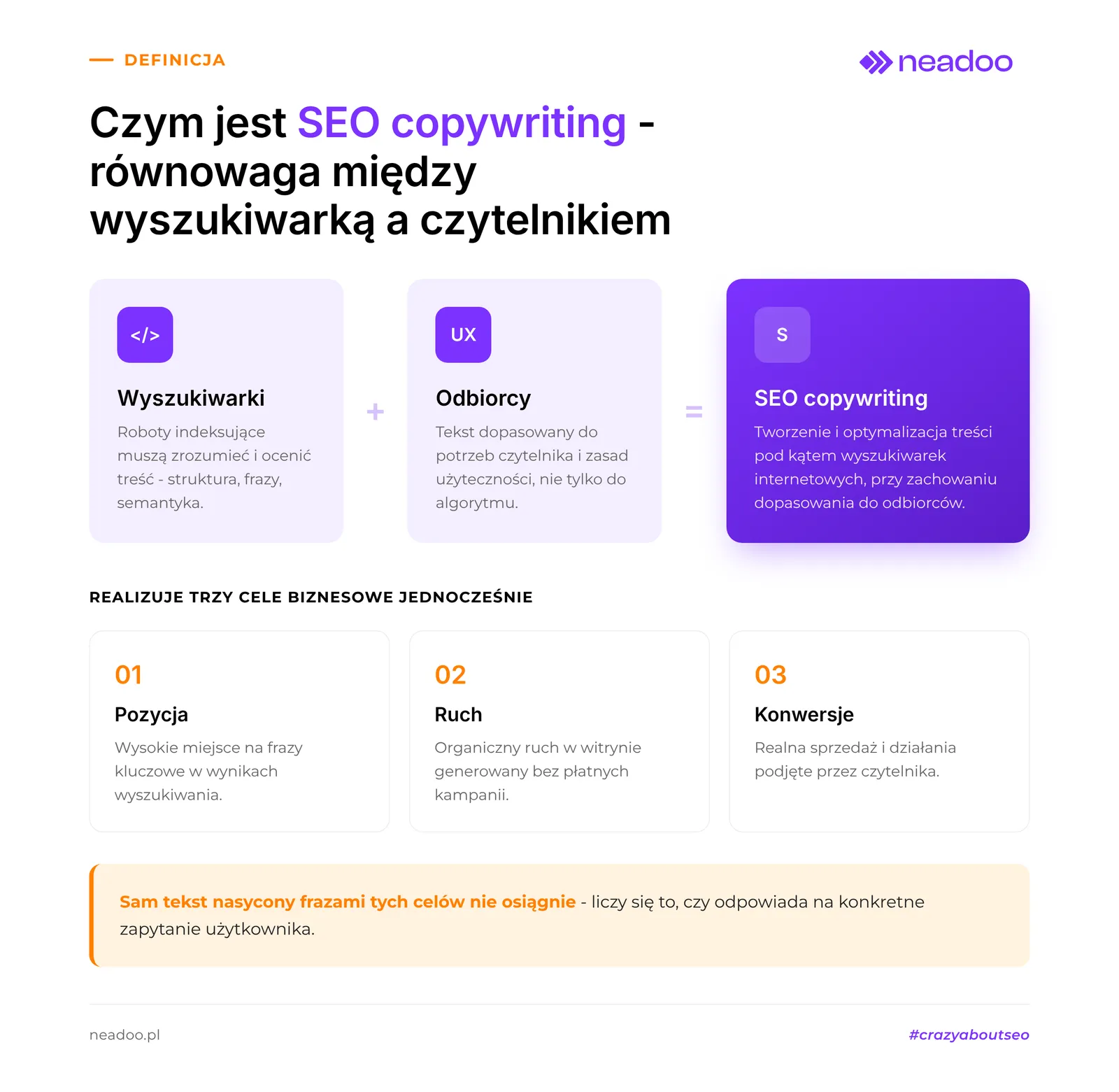
How do you write copy that ranks high in Google, gets cited in AI responses, and at the same time drives readers to take action? SEO copywriting is the process of creating and optimizing content for search engines so that indexing crawlers can understand and evaluate it, while ensuring it meets audience needs and adheres to UX principles. It has three business goals: ranking for target keywords, generating organic website traffic, and driving conversions and sales. Keyword-stuffed copy alone will not achieve these goals, because what matters is whether it answers the user's specific query.
In practice, SEO copywriting is a complete process, not a one-off task. It includes keyword research, competitor analysis, heading structure, internal linking, multimedia selection, and regular content updates. The foundation is solid research and analysis of top-ranking pages. Only on this basis do you build a copywriter brief, followed by SEO articles, website copy, or the expansion of subpages and blogs. At the same time, SEO copywriting is one of the key tools of content marketing: it addresses individual search queries, while in the long run building the visibility of the entire website. In broader online marketing, SEO copywriting works alongside social media promotion and advertising campaigns, but it works the longest toward brand awareness, because a well-written piece of content stays in search results for years. Below, you will find how to organize this, from preliminary steps to regular publishing.
Among the types of copywriting - alongside SEO writing - you will also find technical, advertising, and creative copywriting:
- technical copywriting describes a product or service using specialized industry language,
- advertising copywriting focuses on slogans and emotions,
- creative copywriting builds the brand's story.
In e-commerce and affiliate marketing, there is also the presell page, which is a page that prepares the reader to click an affiliate link before heading to the store. An SEO copywriter combines elements of each of these approaches and adds the requirement of matching target keywords and website structure. Good websites need this combination: valuable content alone is not enough if it does not lead to action. A good copywriter identifies what type of content a given project needs before sitting down to write.
How Does a Copywriter Collaborate with an SEO Specialist?
The SEO specialist is responsible for keyword strategy and website architecture, while the copywriter is responsible for fulfilling search intent, providing substantive value, and optimizing the conversion rate. The SEO specialist provides guidelines regarding content needs and keywords, and the copywriter delivers the finished copy. This SEO synergy determines whether creating SEO content will actually translate into results: website copywriting detached from keyword strategy does not rank as effectively as copy written in collaboration with an SEO specialist.
Division of Roles Based on an SEO Brief
A good copywriter brief includes: topic, primary keyword, secondary keywords, searcher intent, target audience, word count, list of questions, sources, content goal, and competitor analysis from the SERPs (search engine results pages). Based on this, the roles are divided as follows:
| Stage | SEO Specialist | Copywriter |
|---|---|---|
| Keywords and gaps | Selects keywords, identifies content gaps (topic gaps compared to competitors) | Verifies whether the topic can be fully covered in a single piece of content |
| Brief | Provides keywords and SERP examples | Adds questions, sources, and the target audience |
| Content | Approves alignment with the strategy | Writes the copy for intent and conversions |
| On-page SEO | Approves website structure | Adds headings and internal links |
| Beyond content | Builds external links, oversees loading speed | Not responsible for these tasks |
Content is only one part of search engine optimization: results are also driven by website architecture and loading speed. Copy cannot replace technical optimizations or backlinks.
Analytical Tools in Content Creation
In the work of an SEO copywriter, knowledge of SEO copywriting principles, keyword research skills, and familiarity with the following tools are essential:
- Ahrefs - keyword analysis and content gap identification.
- Senuto - competitor tracking.
- Semrush - comprehensive SEO analysis and optimization.
- Surfer SEO - SERP analysis, keyword recommendations, and structure; the results are guidelines, not universal keyword density rules.
- AnswerThePublic - user questions and queries.
- Ubersuggest - broad keyword database.
- Google Trends - trends and seasonality.
- Google Search Console - monitoring Google search rankings and indexing errors.
- Google Keyword Planner - estimating search volume.
Copy written exclusively for search crawlers, such as keyword-stuffed articles or private blog network content, has fallen out of common use. This was forced by the Panda algorithm, launched in 2011 and focused on content quality; since 2015, its signals have operated as part of Google's core algorithm rather than as a separate update. Black Hat SEO is a broader set of practices that violate Google's guidelines regarding spam and ranking manipulation, not just the content quality issues Panda targeted. Understanding search engine requirements and the logic of algorithms like Panda helps avoid mistakes that are immediately obvious to Google's bots.
How to Plan Content Structure and Topic Clusters?
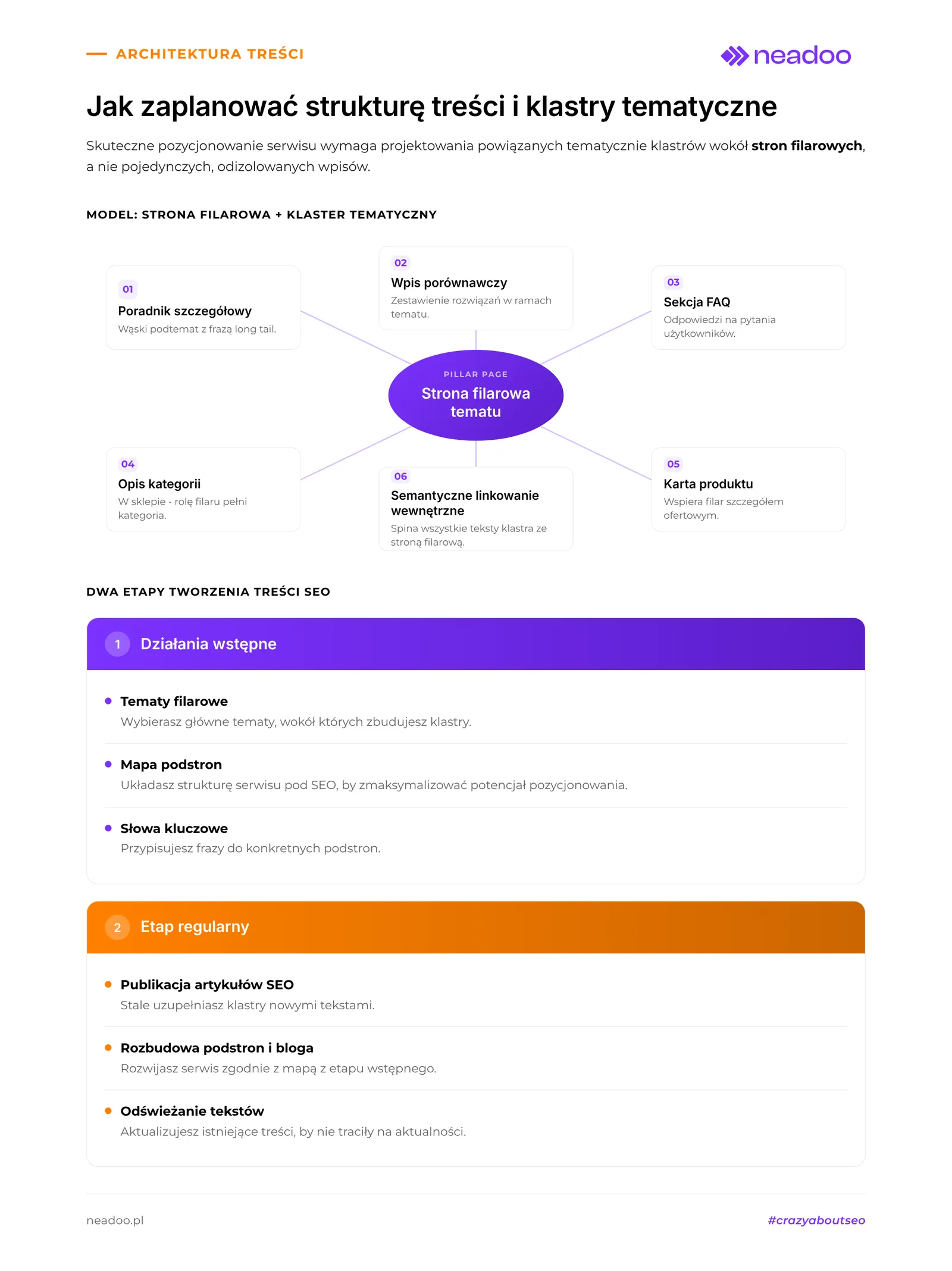
Effective website SEO requires designing thematically related clusters around pillar pages, rather than individual, isolated posts. It is best to divide SEO content creation into two stages:
- Initial actions. You build the SEO structure to maximize ranking potential: you select pillar topics, map out subpages, and assign keywords to them.
- Ongoing stage. You publish SEO articles and continuously grow the site: you expand subpages, run a blog, and refresh existing content.
Building Pillar Pages and Internal Linking
A pillar page is a comprehensive page covering a broad topic, while topic clusters are detailed pieces of content that link back to it. Implementing topic clusters relies on linking multiple detailed articles to the pillar page using semantic internal links. Covering an entire topic builds topical authority - the perception of a site as competent in a given field - and in the long run increases page visibility for dozens of related queries. In this setup, SEO content optimization covers not just an individual article, but the entire cluster around the pillar page.
A cluster can include blog posts, service descriptions, FAQ sections, and in an online store, category descriptions and product descriptions as well. In e-commerce SEO, the pillar role is typically played by a category page, while guides and product cards support it.
The rules for links are simple:
- the anchor text includes the keyword of the related subpage, rather than generic phrases like "click here" or "check this out";
- you assign one keyword to one URL to avoid keyword cannibalization - your own subpages competing for the same search query;
- within your website, every link should lead to a page that actually expands on the topic, not to a random subpage.
Finished website copy is added to the site as a file or published directly in the CMS.
Recurring Audits and Refreshing Old Articles
Regularly refreshing and updating outdated articles and descriptions - also known as content recycling - positively impacts website SEO. Content refreshing starts with reviewing the publication list: you flag texts with outdated data, names, or offerings, as well as posts that duplicate the topic of another subpage. Blog posts age especially fast, which is why a recurring review of them deserves a permanent spot in the editorial calendar.
For each of them, you check alignment with current user intent, add missing questions to the FAQ, and add links to newer texts in the cluster. You merge or separate texts that duplicate a topic so that each targets a different query.
Let's check your website's potential
Share your website and email - we'll get back to you with a real analysis, no strings attached.
Rules for Writing Effective SEO Content
SEO content combines natural saturation with semantic phrases, high scannability, and unique value backed by experience. There is no single rule to answer how to write for SEO, but the order of priorities today is reversed compared to old guides: user intent comes first, keywords second.
Semantic SEO is the optimization of content, structure, and metadata around understanding the topic, context, and intent, rather than simply matching individual keywords. Since the Hummingbird update (2013), the Google search engine has been interpreting entire queries, while the earlier Knowledge Graph (2012) connects entities in results - people, places, products, and concepts - instead of mere strings of characters. In practice, this means writing about a topic through the lens of entities and their attributes, as well as covering questions semantically related to the primary keyword, not just its grammatical variations. You can find more on the mechanics of semantic search and how they translate into content in our article on semantic search and semantic SEO.
Formatting Rules and Natural Keyword Saturation
Writing SEO copy at the sentence level begins with moderation. Google algorithms penalize keyword stuffing, so incorporate primary and inflected keywords in moderation: in the title, H2-H3 headings, and body text. Instead of calculating density (Surfer SEO suggests terms, but does not set a universal benchmark), add LSI keywords - meaning related terms - and long-tail queries.
- Hierarchy. H1, H2, and H3 headings in a logical hierarchy: one H1 per page, with the content beneath it structured in blocks of 5-10 lines, with bold text and bulleted lists. For longer texts, it is worth adding a table of contents at the beginning so readers can immediately see the scope of the article.
- Meta title and meta description. The primary keyword in both tags; the description encourages clicks.
- ALT attributes (image alternative text). Descriptive, containing the keyword only where it fits the image.
- Style and length. Simple language, complex words replaced with simpler ones, tailored to user expectations in a given industry. Length is determined by exhausting the topic and the page's role, not by a character count limit.
- Call to action. A single call tailored to intent and phrased using benefit-driven language rather than pure functionality: for purchase queries, "check our offer" or "view pricing" works, while for informational queries, "download the checklist" or "sign up for a consultation" performs better - a CTA that leads from reading to contact, not just another click on your site. This approach is SXO, or combining SEO with user experience.
- Duplicate content. Copied content is automatically downgraded in rankings, so write your copy yourself.
Proper formatting alone is not enough if the copy does not drive action. Good ad copy and good sales copy share a common denominator: tailor the message to the stage the reader is in, rather than writing a single version for everyone. Hooking the reader's attention is helped by being specific in the first sentence, while encouraging the audience to take a specific action requires presenting your offer in the context of their problem, not just as a list of features. Use transition words - SEO articles without them are harder to read because ideas stop flowing smoothly into one another.
Audience trust is built by specific elements, not generic promises: short slogans, case studies, and references to how potential customers think.
Implementing the E-E-A-T Standard and Information Gain
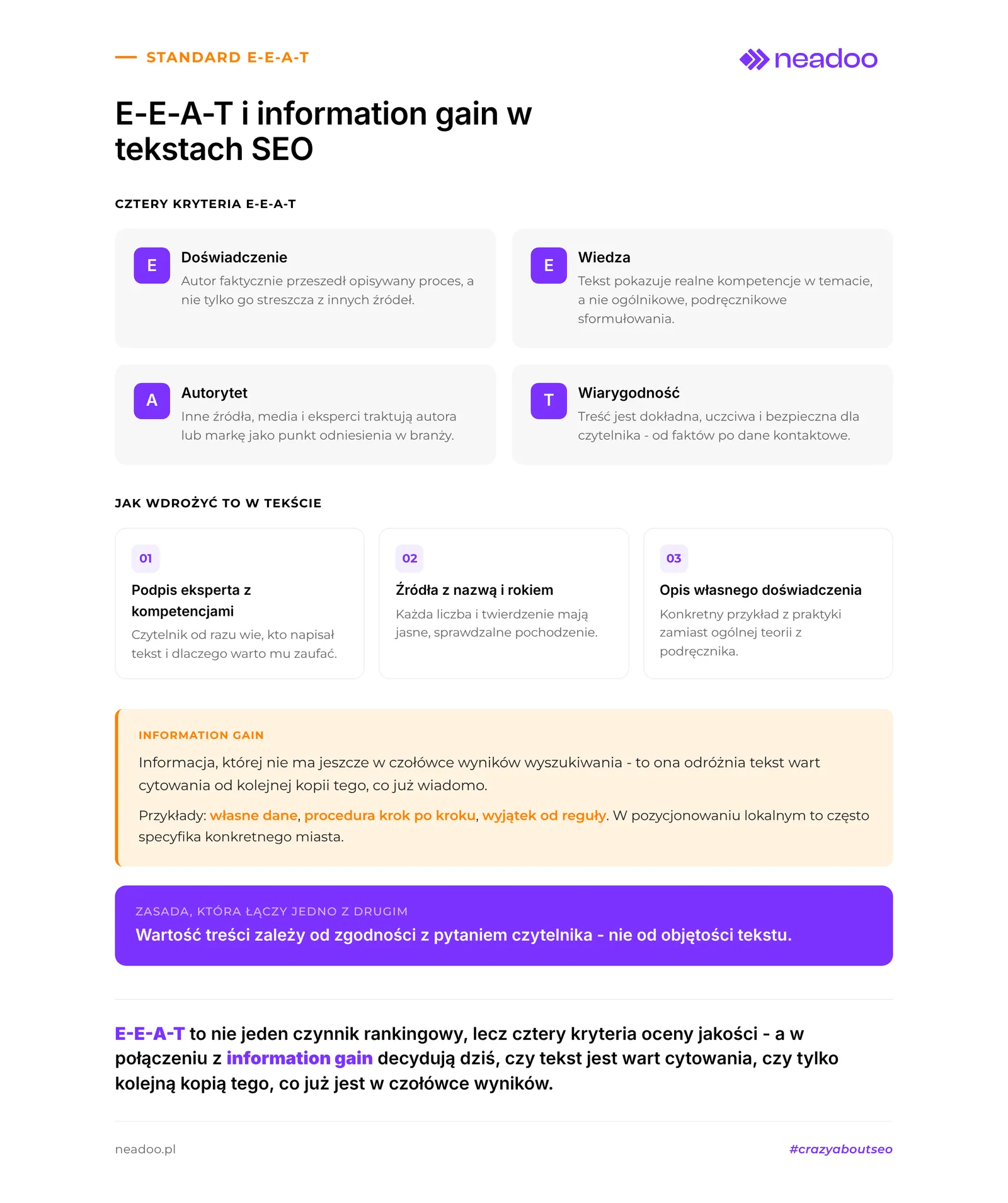
Google's ranking systems prioritize helpful, reliable content created for people. In March 2024, the Helpful Content System was incorporated into the core systems and no longer operates separately. E-E-A-T (Experience, Expertise, Authoritativeness, Trustworthiness) is not a single ranking factor, but a set of quality evaluation criteria.
The answer to how to write SEO content aligned with E-E-A-T comes down to a few specifics: an expert byline with credentials, sources with their name and publication year, and descriptions of firsthand experience with the topic.
Information gain is information not yet found at the top of the SERP: proprietary data, a step-by-step procedure, or an exception to the rule. In local SEO, this could be, for example, the specifics of a particular city. In an era of mass AI-generated content, E-E-A-T and information gain are precisely what distinguish a piece worth citing from yet another copy of the same information.
Valuable content in practice does not mean longer copy. Content only becomes valuable when its alignment with the reader's question increases, not its volume. The usefulness of content, even for complex topics, grows when the text explains the subject more simply than the competition. When creating original sections, it is worth asking what sets a given piece apart from competitors - only this reveals whether AI-generated text requires a thorough overhaul or just cosmetic edits.
How to Create Content for AI Search Engines?
Getting cited in Google AI Overviews and Perplexity relies on three elements: a direct answer at the beginning of the section, a clear structure, and human editorial review. None of these guarantees an appearance in an AI summary, but without them, the content loses its chance of being cited. LLMs (large language models) select an answer based on its match with search intent, which is why visibility in Google and citations in AI responses require the same writing discipline today.
The Direct Answer Principle
To earn a citation in AI Overviews, the text must deliver a precise, synthetic answer in the first paragraph under a problem-focused heading. This is the BLUF (bottom line up front) principle: conclusion first, justification second. In practice, meaning in GEO (Generative Engine Optimization) and AI search optimization:
- frame the heading as a specific problem or long-tail query, e.g., "how to refresh an old blog post";
- provide a 1-2 sentence answer right below the heading, and only then add context;
- write each section so that it is understandable without the rest of the text, because generative engines extract individual snippets;
- organize data in lists and tables, and cite sources with their name and year.
Quality Verification of Content Generated by Language Models
In the generative search engine era, artificial intelligence serves to generate ideas, outlines, drafts, and headings, but the ultimate success depends on fact-checking and enriching the content with practical, real-world examples by a human. In SEO copywriting, as with any text created for SEO using AI, the ROI depends on whether the material answers the query, not on the number of generated drafts. An SEO copywriter, even when using AI, remains responsible for the final version of the text and its factual accuracy.
The choice of tool matters here: the ranking of AI writing tools for copywriters for 2026 shows that no generator works universally, and platforms combining writing with sales process automation, like Copy.ai, make sense only at high scale with continuous human oversight.
Checklist for AI-assisted content (key points):
- Intent: does the text answer the reader's goal defined before generating the draft?
- Keywords: does the keyword selection come from research and competitor analysis, rather than model suggestions?
- Facts: does every number, name, and date have a verified source?
- Generalities: have sentences that add no new information been removed?
- Experience: have proprietary examples from the company's own practice been added that are absent from top-ranking results?
- E-E-A-T: is there an expert byline, sources, and a description of the author's experience?
- Direct answer: does the first paragraph under every heading contain the core takeaway?
| DOWNLOAD THE FULL A4 CHECKLIST: https://drive.google.com/file/d/1hZyGSO4IcMXJ8Gbfv1UVtqDl4YG8-ijq/ |
|---|
Frequently Asked Questions
How does SEO copywriting differ from traditional copywriting?
The difference lies not in the writing craft itself, but in the goal and the time frame for seeing results. A standard promotional copy is judged by its catchiness right after publication, whereas an SEO copywriter is additionally evaluated by its ranking in search results, which usually appears several weeks to a few months after indexing. That is why working on such content requires steady communication with an SEO specialist, not just good writing skills.
How many characters or words should an effective SEO text have?
There is no single correct number, but there is a specific way to estimate it: check the median length of the top 5 ranking pages for a given keyword (shown, for example, by Ahrefs or Surfer SEO) and treat it as a benchmark, not a target to beat. A shorter, but substantively richer, effective SEO text regularly beats a longer, yet shallow article, because rankings are determined by intent matching, not word count.
Do AI-written texts hurt SEO rankings?
Using AI itself is not penalized - Google explicitly states that it evaluates the quality and helpfulness of content, not how it was produced. A penalty can only be triggered by so-called scaled content abuse, which means mass, automated publishing of text that provides no value to the user. Content drafted by a language model and then verified by a human, enriched with first-hand experience and examples, is indistinguishable to a search engine from text written from scratch.
What is keyword stuffing and how do you check if a text is over-optimized?
Keyword stuffing is the unnatural repetition of the same keywords, which disrupts readability and looks like an attempt to manipulate rankings. The practical test is simple: read the paragraph aloud - if the phrase sounds forced, it is better to stay below the upper limit of the recommended range than to spoil the flow of the sentence. Grammatical variation, a synonym, or a long-tail variation almost always does a better job than an exact repetition.
What are SEO texts and how do you start writing them?
These are materials written for a specific keyword and search intent, while remaining as readable as a standard article. And how do you write for SEO in practice if you are doing it for the first time? Do not look for a generic template - ask for a brief and read the top 3-5 ranking pages before writing your own text; the writing process itself (research, structure, and keyword density) was described step by step above. The best SEO text examples can be found right at the top of the search engine results for your chosen keyword. Writing content for SEO then becomes much easier, because you have a ready-made model for structure and length.
What is an SEO copywriter and what do they do on a daily basis?
An SEO copywriter is a person who writes content based on an SEO brief: they combine keyword knowledge with the ability to write copy that reads naturally. A copywriter's job also involves selecting target keywords alongside an SEO specialist, adjusting text length to the role of the page, and ensuring that every paragraph brings fresh information. What sets them apart from a traditional copywriter is that they are evaluated not only by the client, but also by search engine performance.
SEO texts - what are they and what does SEO writing look like in practice?
SEO texts are written for a specific keyword and search intent, not just for a marketing message. When searching for "SEO text examples," you will mainly find pieces where the first sentence under a heading answers the query before the text elaborates on the topic. Good SEO content and good SEO writing differ from traditional copywriting in one main way: every paragraph must be able to stand on its own out of context and still make sense, because that is how search engines and AI models read it today.