
Semantic Search and Semantic SEO
Semantic SEO - How to Optimize Your Website in the Era of Entities and Artificial Intelligence?
Is merely repeating a keyword in headings and body text enough for a website to win in Google and get cited by AI search engines? Not anymore. Semantic SEO is an approach where you optimize content, structure, and metadata for understanding the topic, context, and search intent, rather than the literal lexical matching of individual keywords. Instead of asking how many times to use a phrase, you ask whether the page answers the question comprehensively and whether the search engine can unambiguously recognize what you are writing about. The starting point is semantics, the study of meaning in words and sentences: search engines no longer compare just the words themselves, but their meanings.
In practice, this comes down to three pillars. The first is entity SEO: identifying key entities (people, places, products, concepts) and their attributes within your industry - meaning units that form the foundation of semantic search and the Google Knowledge Graph. The second is topical authority built through topic clusters, meaning pillar pages and related articles that collectively cover a subject comprehensively. The third is Schema.org structured data (JSON-LD or Microdata), which helps crawlers understand relationships between entities on the page and gives you a chance to earn rich snippets. Later in this article, you will learn how to combine these elements into a unified semantic optimization strategy, how it differs from the traditional keyword-based approach, and how it translates into search engine visibility.
What Is Semantic SEO?
Semantic SEO is the optimization of content, structure, and structured data for meaning, context, and search intent rather than individual keywords. In short: the search engine should understand which entities and relationships the page is about, and the user should receive a complete answer to their question. Semantics - the meaning of expressions - is the starting point, while keywords remain just one of its elements.
How Does Semantic SEO Differ from Traditional SEO?
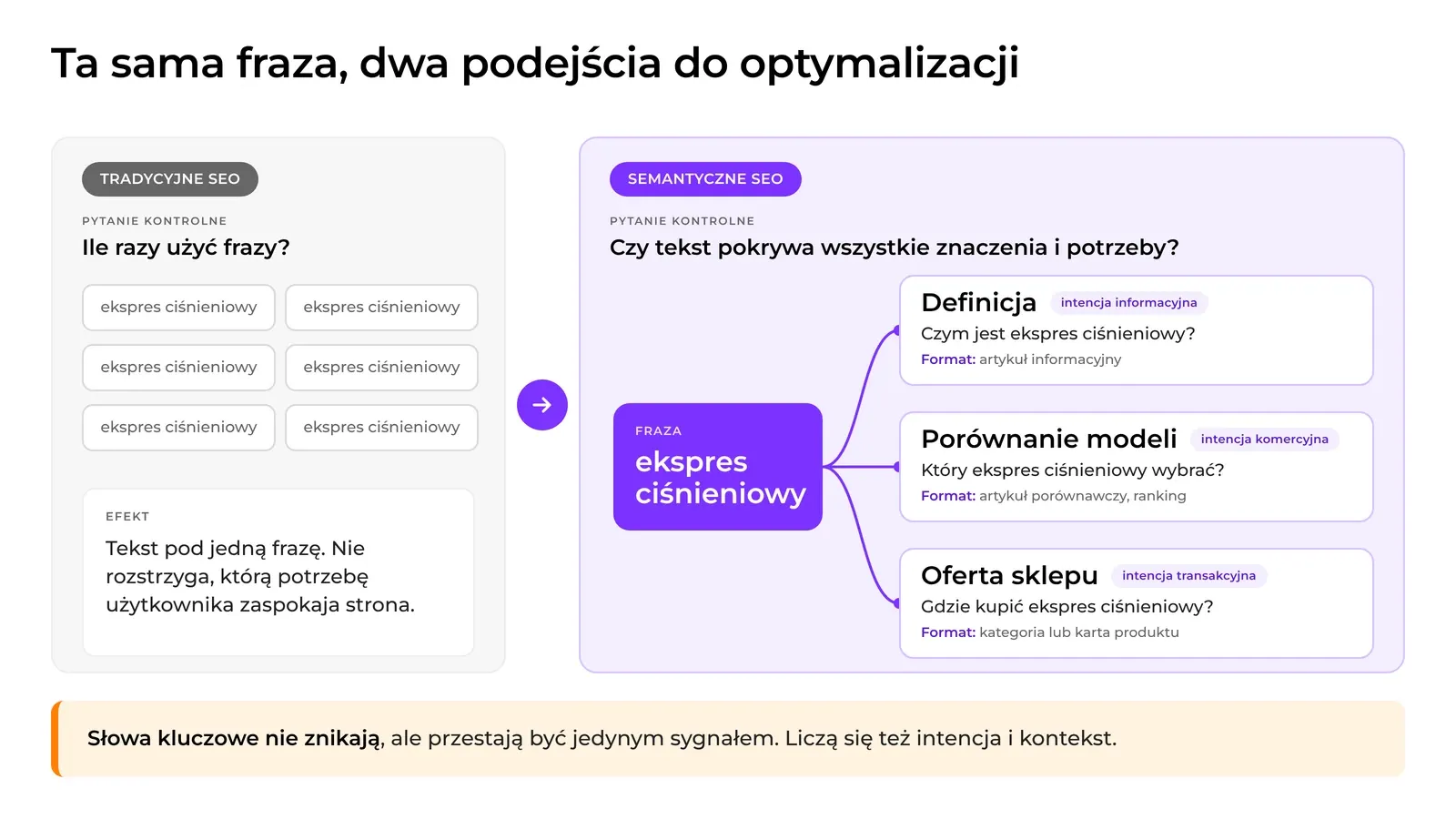
Semantic SEO moves away from rigid keyword matching in favor of analyzing user intent, context, and relationships between concepts in the Knowledge Graph. Keywords do not disappear, but they are no longer the sole signal.
The crucial importance of understanding user intent stems from the fact that the same phrase in different contexts signifies different needs. A person searching online for "espresso machine" might be looking for a definition, model comparisons, or store offers. Optimizing for a single phrase does not resolve which of these needs the page fulfills, which is why analyzing user queries and their intent is an essential starting point. Semantics also changes the baseline question: instead of counting keyword repetitions, you check whether the text covers all meanings and needs related to the topic.
Keyword Density Balance and Spam Prevention
Traditional SEO relied on lexical matching, specifically exact-match keywords and keyword stuffing. In a semantic approach, a keyword density of around 0.5-2% is considered roughly safe, which minimizes the risk of algorithmic penalties. Instead of adding more repetitions, it is better to incorporate synonyms, related concepts, and an information hierarchy that showcases the full scope of the topic. Optimizing for a single keyword leads to repetitive phrasing, whereas semantically related terms allow you to describe the topic more broadly and naturally. It is important to treat keyword density as a benchmark metric rather than a primary goal.
What is semantics and how does it relate to SEO?
Semantics is a branch of linguistics that studies the meaning of words, phrases, and sentences, and semantic SEO applies this perspective to search engine optimization.
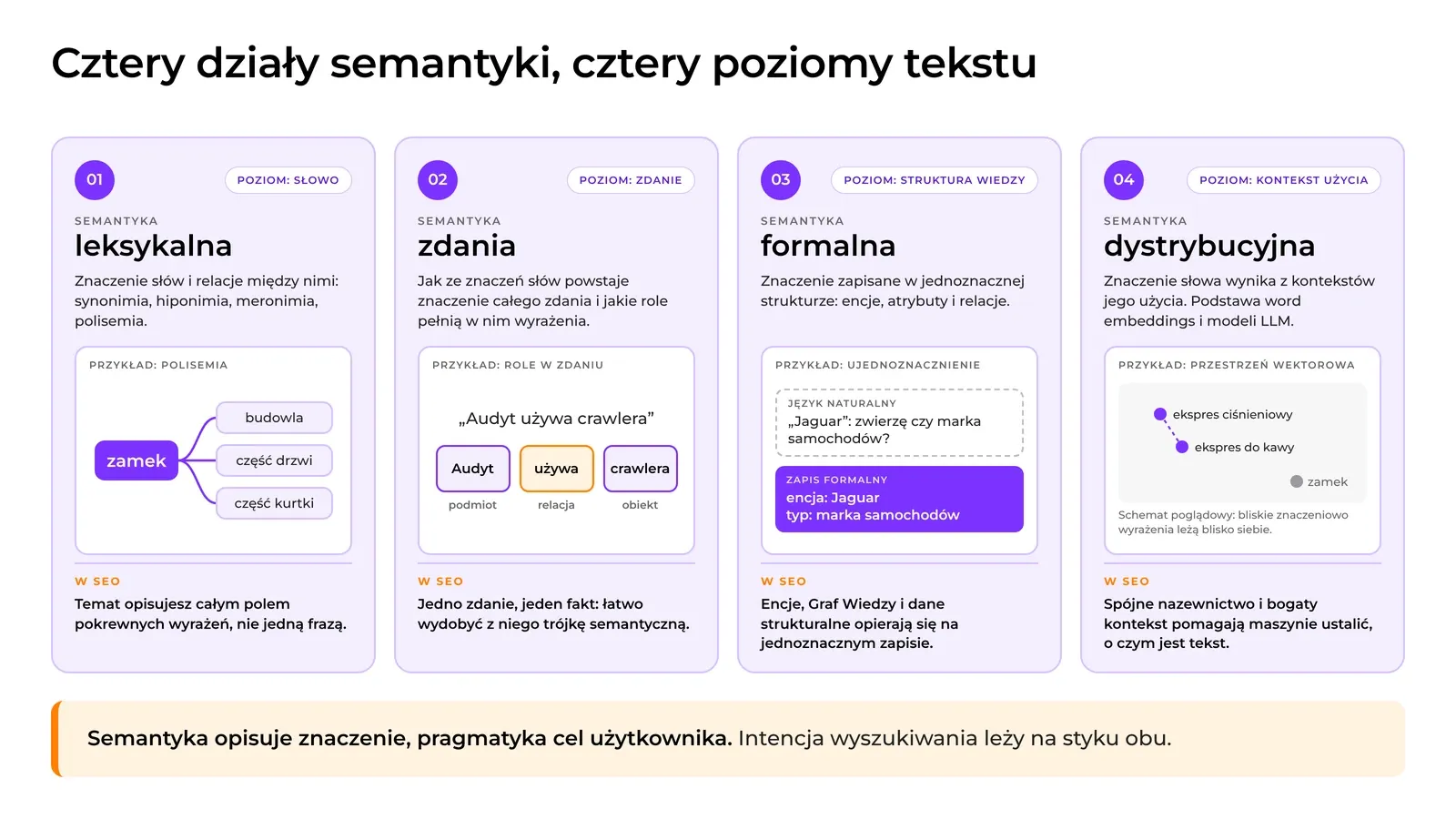
What exactly does semantics deal with? The definition is short: semantics deals with the meaning of linguistic expressions, that is, what words, phrases, and entire sentences signify. The goal of semantics is to understand how meaning emerges in natural language - the kind people use - rather than in an artificial programming language. In other words, semantics answers the question of what a given expression means in a given context, not just how it is written. Semantics also examines relationships between meanings, for example, when two different words describe the same thing. Linguistics distinguishes many branches of semantics, and for semantic SEO, four are of the greatest importance: lexical semantics, sentence semantics, formal semantics, and distributional semantics. Each refers to a different level of text: word, sentence, knowledge structure, and context of use.
Lexical semantics: word meanings and relationships between them
Lexical semantics describes the meaning of words and the relationships they form in language. The most important of these include synonymy (different words with similar meanings), hyponymy and hypernymy (the relationship between a specific concept and a general one, e.g., "espresso machine" and "coffee maker"), meronymy (part and whole, e.g., "filter" and "coffee maker"), and polysemy, which is the ambiguity of a single word. The same word in different contexts can have different meanings: for example, the Polish word "zamek" can mean a castle, a door lock, or a zipper. Lexical semantics shows that word meaning depends on the surrounding environment, and its meaning must be resolved based on context.
Context is the foundation for understanding relationships between words, and knowing them helps us better understand why a search engine groups different phrasings into a single intent. Polish inflection works similarly: a single word has many forms in Polish, which is why text analysis tools reduce them to their base form (lemmatization). For SEO, this yields a simple rule: a topic is described using an entire field of related expressions, not just a single phrase. Synonyms, broader and more specific terms, and constituent parts create semantic keywords, allowing a page to appear in search results even for queries that it does not literally contain.
Sentence semantics: semantic structures and roles
Sentence semantics describes how the meaning of an entire sentence is formed from the meanings of individual words. Sentence structures assign roles to expressions: who performs an action, what the action consists of, and what it affects. The sentence "An audit uses a crawler" has a subject - relation - object structure, which is the same structure as the semantic triples described below. That is why sentence semantics matters for content written for generative search engines: it is easy to extract a triple from a sentence with a single fact, whereas a sentence overloaded with multiple threads is harder to interpret. The rule is simple: one sentence, one fact.
Formal semantics: meaning recorded in knowledge structures
Formal semantics describes meaning using the tools of logic so that it can be captured in an unambiguous structure. A formal approach to meaning is close to what ontologies and knowledge bases do: natural language expressions are transformed into entities, attributes, and relationships - that is, into triples known from the EAV model. Expressing meaning in the language of logic eliminates the ambiguity of natural language, and the formal definition of a concept indicates its properties and place in the hierarchy. As a result, a machine does not have to guess whether "Jaguar" means an animal or a car brand. A prerequisite for understanding connections between entities is their unambiguous representation. Formal semantics is therefore the theoretical foundation for entities, the Knowledge Graph, and structured data.
Distributional semantics: meaning stems from context
Distributional semantics posits that the meaning of a word stems from the contexts in which it is used: words that appear in similar environments have similar meanings. Word embeddings and large language models (LLMs), trained on massive text corpora including those available on the web, are based on this premise. They are part of natural language processing (NLP). Vector representation of meaning allows comparing the intent of queries and content passages, rather than just their wording, which helps search engines understand the meaning of a query even when the user used different words than those on the page. In practice, distributional semantics explains why consistent terminology and rich context around key concepts help machines determine what a text is about.
Semantics vs. pragmatics: user intent
Semantics describes the meaning of expressions, while pragmatics refers to what the user intended to achieve by using them in a given situation. Search intent lies at the intersection of semantics and pragmatics: semantics provides the tools to describe concepts, but by itself does not determine which need a page satisfies. Understanding intent therefore requires both perspectives. That is why semantic SEO combines meaning analysis with intent analysis, tailoring the content format to the type of user queries: informational, navigational, commercial, and transactional.
Code semantics: screen readers and user experience
Semantics also applies to website code. HTML5 tags such as header, nav, main, or article describe the role of elements, allowing screen readers and crawlers to recognize the document structure. This improves the user experience for those using assistive technologies, but it does not replace content and does not guarantee better rankings in search results. A clear H1-H3 heading structure also helps regular readers find answers faster.
From linguistics to semantic SEO
The beginning of semantic SEO is usually dated to 2012-2013, with the rollout of the Knowledge Graph and the Hummingbird algorithm. In the SEO industry, this approach is called semantic SEO (in Polish, both semantyczne SEO and SEO semantyczne are used). Both terms describe the same thing: designing content around entities, intent, and relationships instead of a list of keywords. An SEO specialist who applies this approach starts with the question of what meanings and needs lie behind user queries, formulated in their own language.
Generally speaking, for someone creating content, semantics provides three practical rules:
- Describe a topic using multiple related expressions, not just a single word.
- State relationships between concepts in complete sentences and within a clear heading structure.
- Resolve ambiguity by adding context to proper names and terms that might mean something else in another industry.
Let's check your website's potential
Share your website and email - we'll get back to you with a real analysis, no strings attached.
How Google Algorithms and Generative AI Search Engines Work
Modern NLP algorithms analyze the semantic meaning of entire queries, while generative search engines synthesize answers from multiple sources. Query semantics - the meaning of the entire sentence rather than isolated words - has become their starting point.
The Evolution of Algorithms from Character Matching to Natural Language Processing
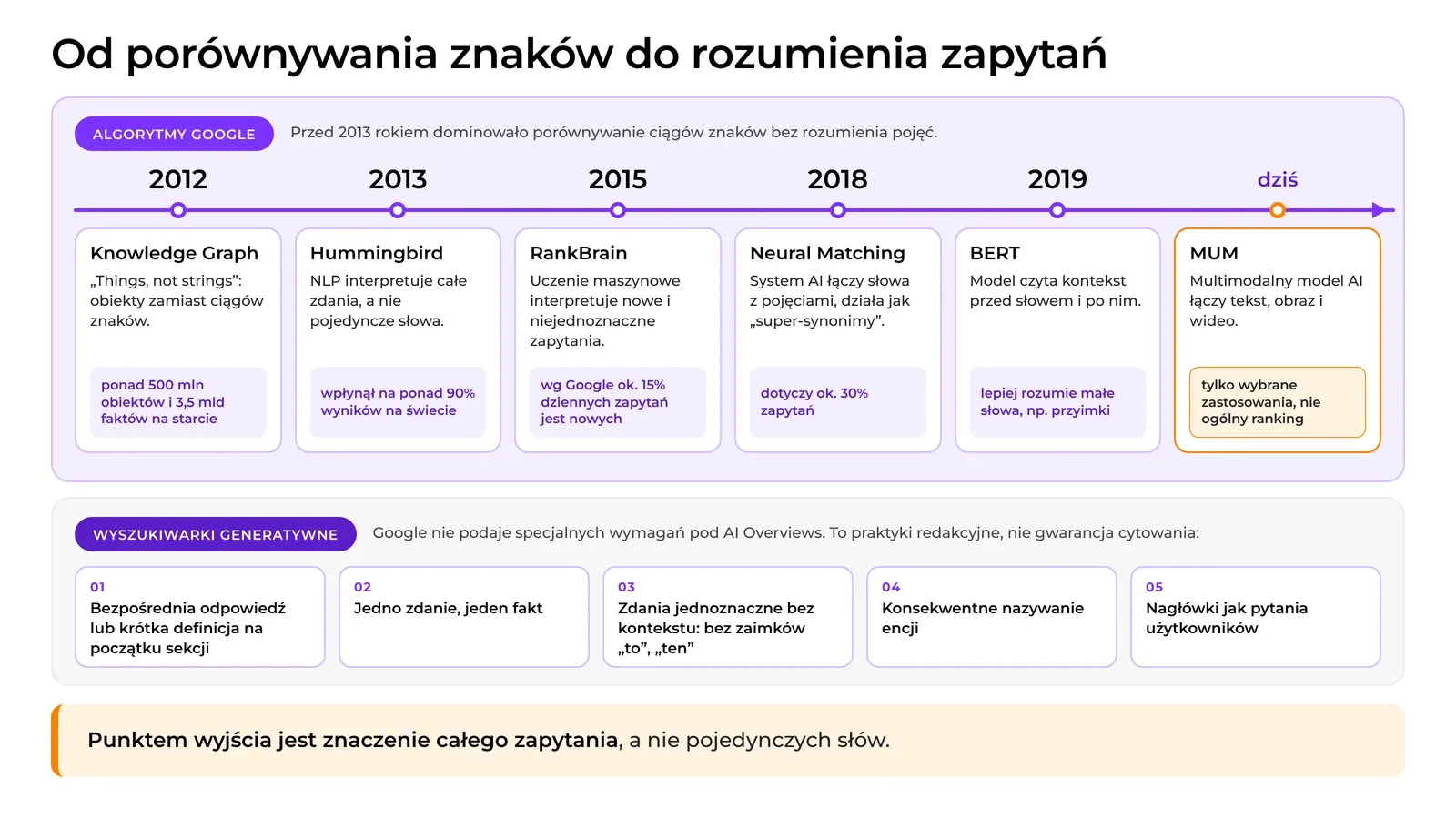
Before 2013, lexical search dominated, comparing strings of characters without understanding concepts. The shift began in May 2012 with the Google Knowledge Graph ("things, not strings"), which launched with over 500 million entities and more than 3.5 billion related facts. The Hummingbird algorithm from 2013 used NLP (natural language processing) to interpret entire sentences and, according to Google, affected over 90% of searches worldwide.
| Belief | Fact |
|---|---|
| Schema.org guarantees rich results and high rankings | Structured data helps understand content and may qualify a page for rich results, but does not guarantee they will be displayed |
| RankBrain is driven by Dwell Time and CTR | Google representatives have denied the direct impact of these metrics |
| MUM determines the entire ranking | According to Google, MUM is not used to rank search results (as of 2022) |
| Semantics excludes keywords | A semantic approach complements them with context and relationships between concepts |
The Role of BERT, MUM, and RankBrain
Google's RankBrain (2015) is a machine learning system that helps interpret new and ambiguous queries; according to Google, about 15% of daily queries have never been seen before. It connects different formulations of the same intent into a single concept, which is why a page can rank for phrases it does not literally contain. Neural Matching (2018) is an AI system that maps words to concepts and acts like "super-synonyms"; according to Google, it affects about 30% of queries. Context plays a major role here: BERT (2019) is a bidirectional transformer model that analyzes the full context of natural language words before and after a given word, enabling a better understanding of the meaning of small words, such as prepositions, in a query. MUM is a multimodal AI model that can combine information from text, images, and video, but according to Google (as of 2022), it is not used for ranking search results. The term latent semantic indexing does not describe how these systems work. For a content creator, the practical takeaway is simple: write in natural language and address the reader's specific problem.
Editorial Practices for AI Overviews
In generative engines (GEO, generative engine optimization), including Google Search Generative Experience (SGE) mechanisms, there is no separate tag or checklist of requirements. Google states that no extra optimizations or Schema.org structured data are needed for AI Overviews, and that a page simply must be indexed and eligible for a snippet in standard results. Therefore, the following editorial practices are not Google requirements, but they make it easier to extract standalone answers from text: start a section with a direct answer or a short definition of the concept, and base each sentence on a single fact. The semantics of each sentence should be unambiguous without context: avoid pronouns like "it" or "this" that refer back to the preceding paragraph. Name entities consistently and phrase headings like user questions, using the language customers actually use. None of these practices guarantee a citation.
What Are Entities and How to Connect Them in Content?
Entities are uniquely identified objects and concepts in the Google Knowledge Graph (people, places, products, concepts). They are optimized by describing their attributes and logical relationships in content. In entity SEO, whether a crawler recognizes which entity you mean is more important than keyword repetition. In formal semantics, objects correspond to entities, and properties correspond to attributes, which is why formal semantics provides the theoretical foundation for the model described below. Every entity needs an unambiguous definition in the content, and semantically related entities, such as a product and its brand, should be described alongside one another.
Entity Modeling Using the Entity-Attribute-Value Standard
Entities are described using the EAV model: entity (e.g., "online store"), attribute (e.g., "platform"), and value (e.g., "WooCommerce"). Each triplet can be expressed as a single sentence, known as semantic triples. How to connect entities in website content:
- List the key industry entities and their attributes.
- Assign semantic keywords to them: synonyms, near-synonyms, and related terms (LSI).
- Resolve ambiguity (disambiguation), for example, by adding context to the name.
- Place entities in the URL, Title tag, meta Description, H1-H3 headings, alt attributes, and paragraphs.
Hypothetical example: for local SEO, the entity is a "business profile" and the attribute is "business category"; for online stores - "product page" with the attribute "variant".
Formal Taxonomy of Semantic Relationships
A collection of entities and the relationships between them forms a domain ontology - an organized description of what entities exist in your industry and how they relate to one another. In linguistics, similar sets of concepts and relationships are described by lexical semantics, and in computer science, by ontologies. You express ontological relationships in content through specific verbs, and ten types are commonly used to connect entities:
| Relation | Example (hypothetical) |
|---|---|
| uses | audit uses a crawler |
| contains | cluster contains articles |
| produces | analysis produces a report |
| requires | schema requires valid syntax |
| measures | tool measures visibility |
| implements | website implements structured data |
| contrasts | entity contrasts with a phrase |
| feeds_into | audit feeds into a content plan |
| optimizes | editorial team optimizes headings |
| complements | FAQ complements a pillar page |
Tools Supporting Entity Identification
The Google Natural Language API and IBM Watson NLU perform named entity recognition, automatically extracting entities, logical relationships, and sentiment from text. Compare the results with your own list of entities: missing entities point to topical gaps. In addition, AI search engines convert natural language text into vectors (text vectorization), so consistent entity naming makes it easier to match a snippet to a query.
How to Build Topical Authority Using Content Clusters?
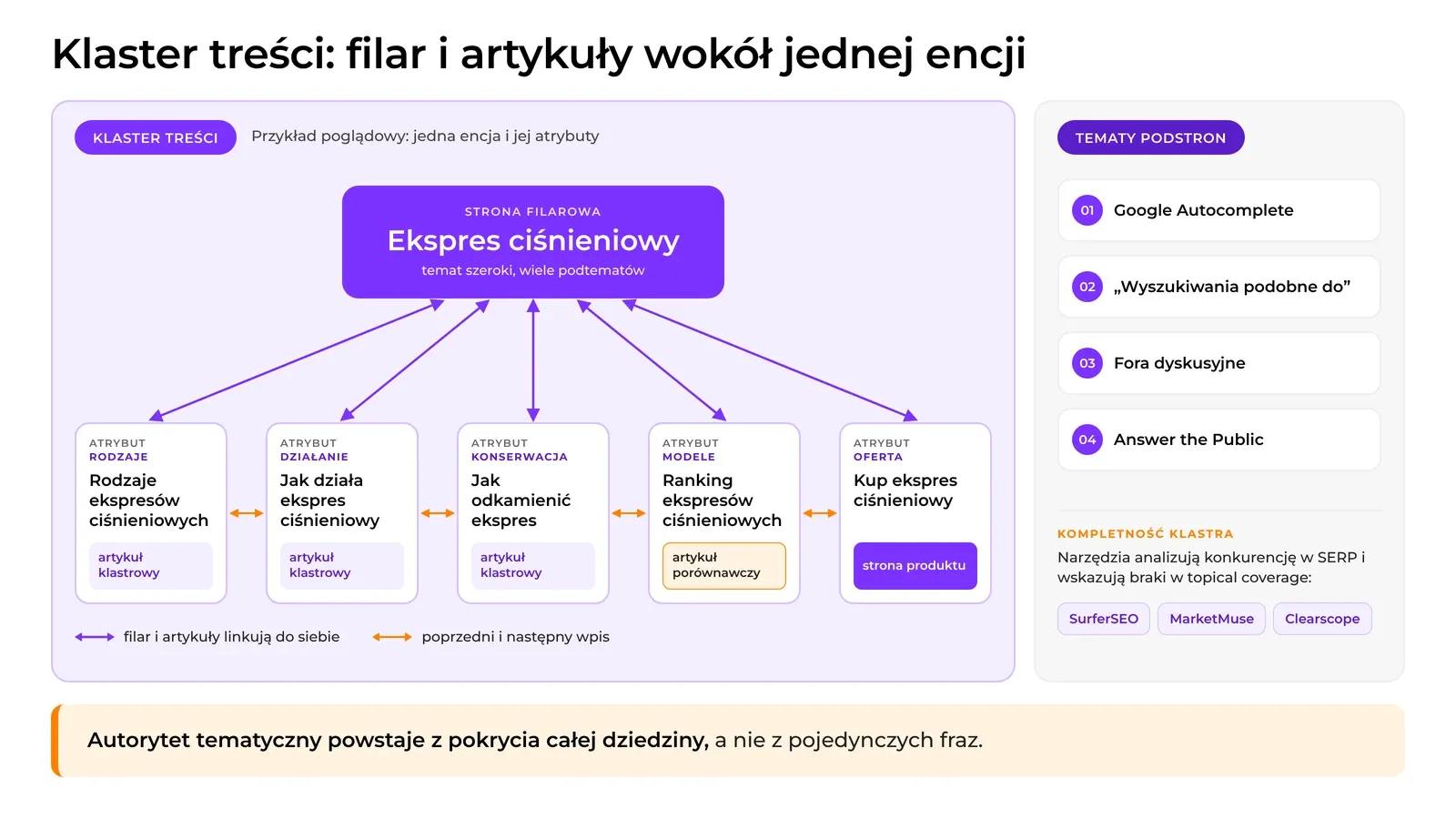
Topical authority is established when a pillar page and its internally linked cluster articles exhaustively cover an entire domain of knowledge, rather than isolated keywords. Domain coverage means that the cluster describes all key entities, attributes, and user questions in a given area. The semantics of the entire cluster should be consistent: semantically related articles expand on different attributes of the same entity.
Architecture of the Pillar Page and Cluster Subpages
The pillar page covers the topic broadly and links to subpages, while each cluster article expands on a single issue and links back to the pillar. This structure improves crawling and indexing by search bots and builds visibility for long-tail queries. Link not only to the pillar, but also to adjacent posts: the previous and next articles in the reader's journey create a logical sequence. You can find subpage topics by analyzing user search queries: in Google Autocomplete, the "Searches related to" section, discussion forums, and tools like Answer the Public, which reveal real audience questions. Grouping closely related queries is made easier by word embeddings - vector representations of word meaning. You can check completeness using SurferSEO, MarketMuse, or Clearscope, which analyze competitors in the SERPs, point out gaps in topical coverage, and suggest semantic keywords to add.
Publication Formats for Four Search Intents
Search intent can be informational, navigational, commercial, or transactional. Around 45% of Google searches have local intent and trigger the Local Pack, so for local queries, it is worth building part of the cluster on local landing pages, following the principles of local SEO. Decision rules:
| Situation | Format |
|---|---|
| Broad topic, multiple subtopics | Pillar page |
| Narrow informational or long-tail query | Cluster article with a link to the pillar |
| Commercial query (comparison, ranking) | Comparison article linked to the offer |
| Transactional or local query | Service or product page |
| Content needs to qualify for rich results | Add Schema.org according to the documentation for the specific type |
How to Prepare a Website for AI Search Engines in Cooperation with an Agency?
Websites well-prepared for AI search engines feature consistent content, structure, and structured data that describe the same entities and relationships.
The Role of Schema.org Structured Data and Its Technical Limitations
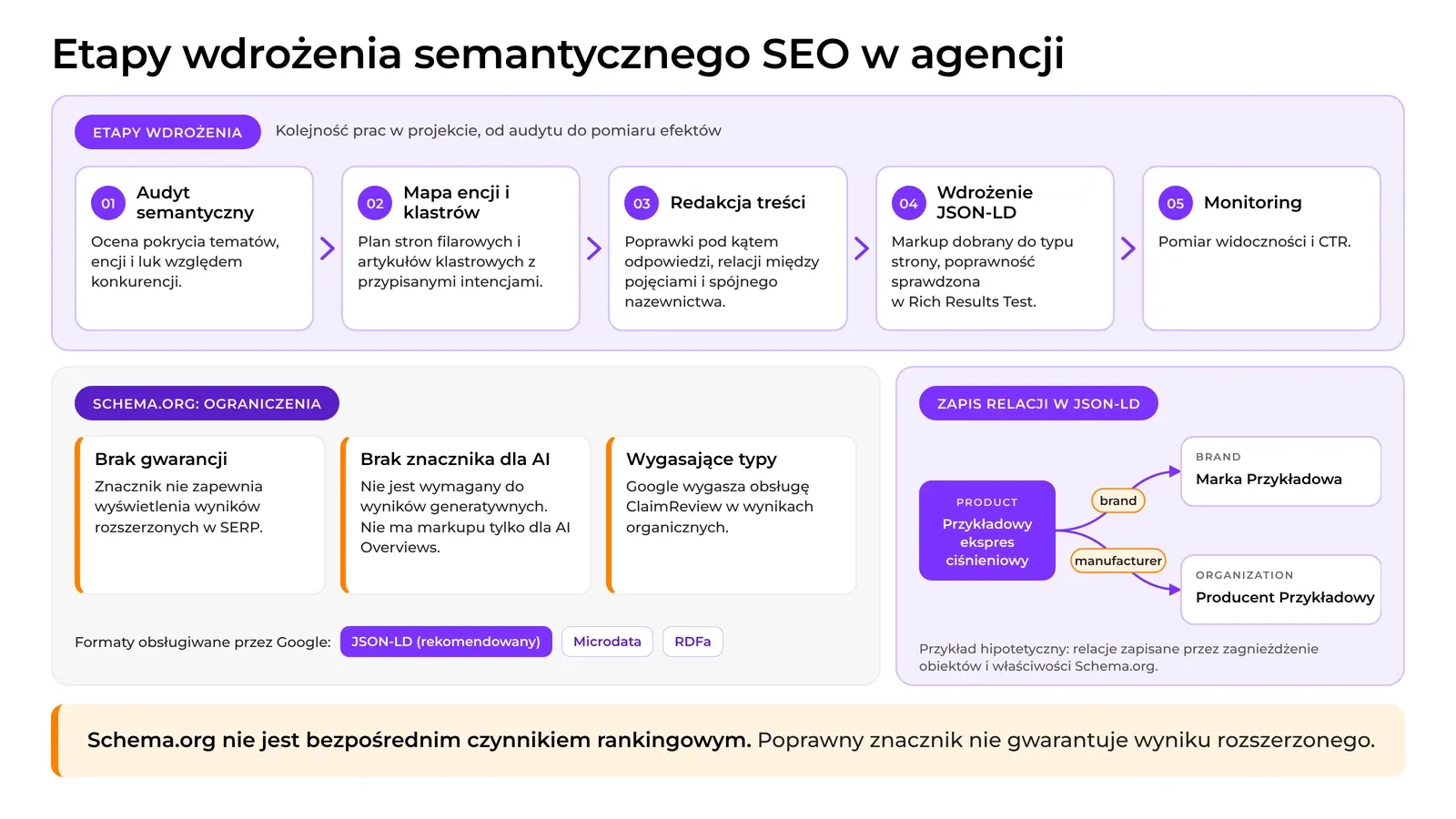
Schema.org structured data is not a direct Google ranking factor. It makes it possible to qualify for rich results, which can increase CTR. By itself, it does not boost a page's rankings. The standard was created in 2011 on the initiative of Google, Bing, and Yahoo!. Google supports JSON-LD, Microdata, and RDFa, but officially recommends JSON-LD because it is easier to implement and maintain. Limitations:
- No guarantee. Implementation does not guarantee that rich results will appear in the SERP.
- No specific markup for AI. Structured data is not required to appear in generative results, and there is no markup dedicated exclusively to AI Overviews.
- Deprecated types. Google is phasing out support for ClaimReview in organic results.
Hypothetical example: in JSON-LD, you define relationships between entities (product, brand, manufacturer) by nesting Schema.org objects and properties.
{
  "@context": "https://schema.org",
  "@type": "Product",
  "name": "Sample Espresso Machine",
  "brand": {
    "@type": "Brand",
    "name": "Sample Brand"
  },
    "manufacturer": {
    "@type": "Organization",
    "name": "Sample Manufacturer",
    "url": "https://example.com"
  },
  "offers": {
    "@type": "Offer",
    "price": "1999.00",
    "priceCurrency": "PLN"
  }
}
The brand and manufacturer properties record the connections between three entities: the product, the brand, and the manufacturer. The crawler does not have to deduce them from the text alone. You can verify syntax validity in the Rich Results Test, bearing in mind that valid markup does not guarantee a rich result.
Stages of Semantic SEO Implementation by an Agency
- Semantic audit. The agency evaluates topic coverage, entities, and gaps compared to competitors.
- Entity and cluster map. A blueprint of pillar pages and cluster articles is created with assigned search intents.
- Content editing. Copy is refined to provide direct answers, map relationships between concepts, and ensure consistent naming conventions.
- JSON-LD implementation. Markup is selected to match the page type, and validity is verified in the Rich Results Test.
- Monitoring. Visibility and CTR are measured.
How to Evaluate the Competence of a Semantic Agency?
Knowing the implementation stages allows you to ask the agency specific questions before signing a contract for SEO services. A competent semantic agency should be able to answer "yes" to most of them:
- Does the audit cover entities, search intent, and topical gaps compared to competitors, rather than just a keyword list and backlink count?
- Do they present an entity and cluster map with assigned intents before writing content?
- Can the SEO specialist leading the project explain how they will link entities in the copy and in JSON-LD, and why structured data is not a direct ranking factor?
- Do they treat semantics as a method of working with entities and intents rather than a buzzword, and can they describe their step-by-step semantic SEO process?
- Do they show an understanding of the client's needs by connecting search intents with business goals?
- Do they avoid promising guaranteed rankings, rich results, or citations in AI Overviews? None of these can be guaranteed.
- Do they use semantic analysis tools such as SurferSEO, MarketMuse, Clearscope, or the Google Natural Language API, and interpret their results rather than blindly following tool suggestions?
- Do they report visibility, CTR, and conversions, rather than just rankings for selected keywords?
- Do they write in natural language rather than artificially stuffing text with exact match keywords?
Profitability of Investing in Semantic Content
For a decision-maker investing in online visibility, what matters is not the number of published articles, but whether the content moves customers closer to a purchase. Semantic SEO addresses this on several levels:
- Rankings. Topical authority delivers higher and more stable positions in organic search results than optimizing for a narrow set of keywords.
- Reach. Content clusters build visibility across a broad spectrum of long-tail queries, with a single structure serving questions across multiple variations of a topic.
- User behavior. Complete and clear answers can increase average time on page and reduce bounce rate, although this is neither a guaranteed nor a direct effect.
- Brand image. Positioning yourself as an industry expert makes it easier to sell higher-priced services and products. DA and DR metrics are third-party SEO tool scores, not official Google ranking factors, and semantic SEO does not guarantee their growth.
- Conversions. Traffic aligned with commercial and transactional intent is more likely to result in an inquiry or purchase.
In practice, this looks different depending on the business model (the examples below are general and not drawn from specific case studies). In B2B, where decision cycles are long, informational and comparative content guides the client through the successive stages of vendor selection. In e-commerce - that is, e-commerce SEO - the key elements are product pages and categories with clearly defined attributes. In the premium segment, expert content builds the credibility required to justify higher prices. Regardless of the model, websites should answer questions at every stage of the decision-making process.
Evaluate profitability by comparing the cost of building a cluster against the value of commercial and transactional intent traffic, and measure success by conversions, not rankings alone.
Frequently Asked Questions
What is semantics in SEO, and how does it differ from semantics in linguistics?
In linguistics, semantics studies the meaning of words, phrases, and sentences. In SEO - specifically semantic SEO - the same semantics is used to describe a topic through entities, relationships, and intent, referring to how a search engine understands content. Semantics in SEO is not a separate discipline, but an application of these concepts to optimization, and its dictionary definitions remain the point of reference.
Does semantic SEO replace keywords?
No. Keywords remain the starting point for analyzing user needs, but they are organized into topic clusters and mapped to intents and specific entities. Semantic keywords - synonyms and related terms - complement the main phrase rather than replace it.
How does semantic search differ from traditional search?
Traditional search relies on exact phrase matches with the query, and in extreme cases, on their excessive repetition (keyword stuffing). Semantic search analyzes the query's meaning, relationships between concepts, information hierarchy, and multifaceted intent. As a result, a page can also appear for queries that it does not contain verbatim.
Is Schema.org structured data a direct ranking factor?
No. Schema.org does not improve a page's rankings through the mere presence of markup. It helps crawlers interpret entities and the connections between them, and increases the chances of earning rich snippets, which can translate into a higher CTR. However, the display of rich results is never guaranteed.
How does Google identify entities on a website?
Google treats entities (people, places, products, concepts) as fundamental units of meaning and enters them into the Knowledge Graph. It identifies them based on content context, consistent naming, and relationships between concepts. Structured data can facilitate this, but it is not the sole source of information.
Does topical authority matter in the age of AI search?
Topical authority is neither a requirement nor a guarantee of citation in generative search engines. Google states that appearing in AI Overviews does not require additional optimizations; the same fundamentals as in standard search apply, including people-first content and internal links that make content easy to discover. An extensive content cluster around a pillar page still makes sense because it delivers on these basics: it covers many user questions and connects related articles with internal links.