
Search Engines - The Most Popular Engines and Alternatives to Google

The most popular search engines in Poland are Google (89.56% of queries) and Bing (7.38%), while worldwide Google handles 89.94% of searches according to StatCounter for September 2026. However, there are more alternatives than these numbers suggest: DuckDuckGo, Brave Search, Perplexity, Kagi, and abroad Baidu, Yandex, or Seznam.
Each of them sources its results from somewhere else. For a business that wants to be visible beyond Google, this matters more than market share alone. Current state of knowledge: October 19, 2026. Shares change monthly, so we provide the measurement period with each number.
How do search engines work and where do they get their results from?
Search engines fall into three groups: those with their own index, those that license someone else's index, and metasearch engines that query others. This determines whether results are independent and how quickly new content appears in them.
Proprietary crawler, syndication, and metasearch engines
Maintaining a proprietary index is an expensive undertaking. A bot (web crawler) downloads HTML code, renders JavaScript, and stores documents in an inverted index - a structure that, for every word, holds a list of pages where it appears. When someone enters a query, ranking algorithms select documents from the index and arrange them on the SERP, or search engine results page.
Most alternatives do not take this route. Ever since a 2009 deal, Yahoo! Search has relied on Microsoft Bing technology for its results (eWeek) - this is syndication, meaning the use of someone else's index. Metasearch engines, such as Dogpile and SearXNG, do not store documents at all: they send queries to several engines simultaneously, remove duplicates, and merge the answers into a single list.
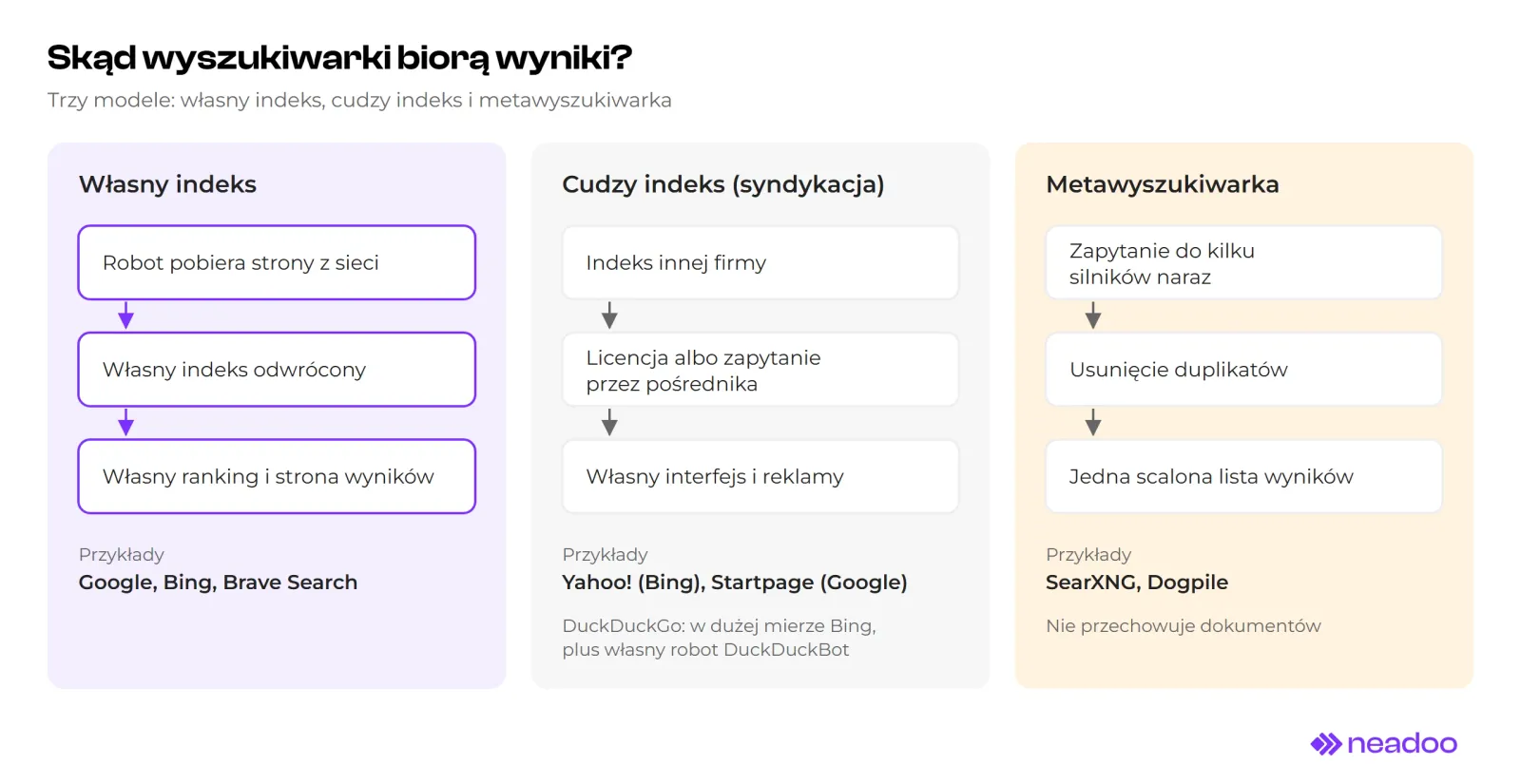
Fig. 1. Three search engine models. Only the first requires its own crawler and its own index of the entire web.
Search engine popularity statistics in Poland and worldwide
On phones, Google's lead is noticeably larger than on desktop computers. In Poland, Bing has 13.94% on desktop, but only 1.27% on smartphones.
| Search Engine | Type | Poland - Overall | Poland - Desktop | Poland - Mobile | Worldwide - Overall |
|---|---|---|---|---|---|
| proprietary crawler (Googlebot) | 89.56% | 82.83% | 95.83% | 89.94% | |
| Microsoft Bing | proprietary crawler (Bingbot) | 7.38% | 13.94% | 1.27% | 5.29% |
| Yahoo! Search | results powered by Bing technology | 0.51% | 1.00% | 0.06% | 1.36% |
Source: StatCounter Global Stats, September 2026 (Poland, Poland desktop, Poland mobile, worldwide). In the same breakdown for Poland, Yandex has 1.44%, and DuckDuckGo has 0.79%. StatCounter does not track metasearch engines separately.
Worldwide, the gap across devices is even wider. Google holds 78.12% on desktop and 95.68% on mobile phones, with Bing at 14.62% and 0.69% respectively (StatCounter, September 2026).
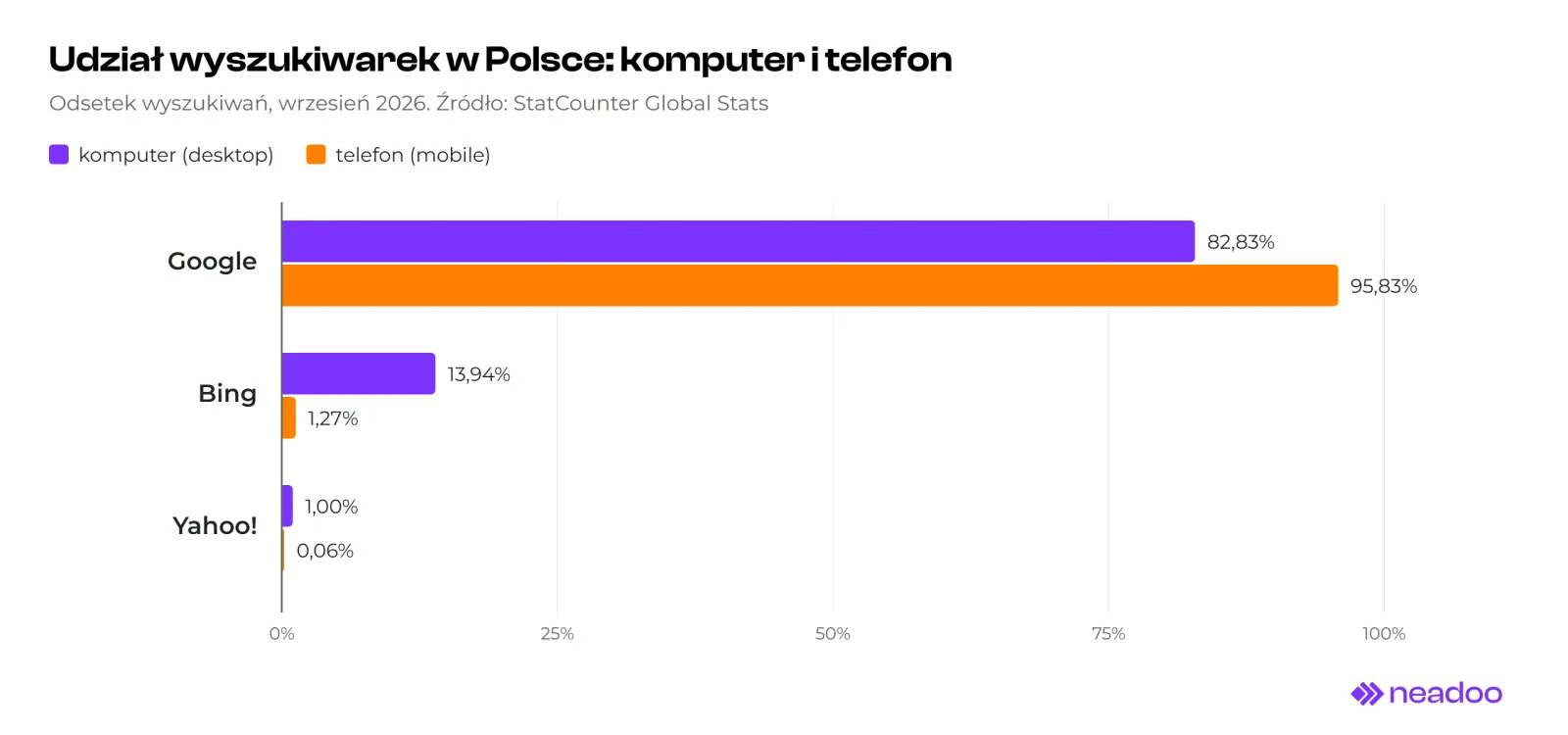
Fig. 2. Bing on desktop computers in Poland has a market share more than ten times higher than on mobile phones.
Microsoft Bing and AI Overview - the main commercial alternative to Google
Bing is the second-largest search engine in Poland, and on desktop computers its share (13.94%) is almost twice as high as its average across all devices. It is the default search engine in Microsoft Edge.
Above standard results, Bing displays an AI Overview block: an AI-generated answer with citations to the pages it drew from. Alongside Video and Image tabs, it also features a dedicated AI Mode tab. What matters, then, is not only your ranking position, but also whether your content can be cited in such an answer.
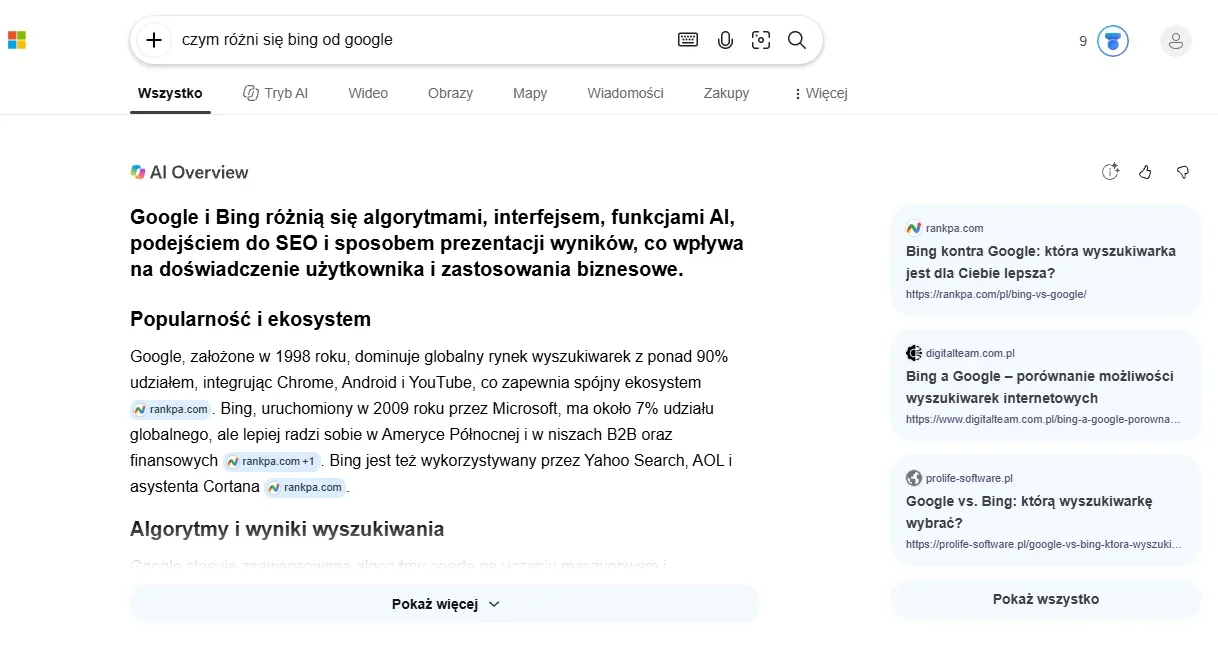
Fig. 3. AI Overview in Bing for a Polish query. The citations point to three Polish websites, and the answer repeats their numbers without citing the measurement date (screenshot from 10/20/2026).
These answers should be read critically. For the query "what is an inverted index", Bing based its answer on a single source and described the concept incorrectly, as "inverting index values" in databases. An inverted index is a structure that stores a list of documents where each word appears - the foundation of full-text search engines. When AI relies on a single weak source, an accurate and clear explanation on another page stands a real chance of winning visibility. Read more about this in our article on AEO, or Answer Engine Optimization.

Fig. 4. Bing AI answer based on a single source and factually incorrect (screenshot from 10/20/2026).
Microsoft Advertising as a complement to Google Ads
Ads from Microsoft Advertising do not appear exclusively on Bing. Microsoft lists Yahoo, DuckDuckGo, and Ecosia among its search network partners, among others (Microsoft Advertising). A single campaign therefore covers multiple search engines, and you can import an existing campaign from Google Ads instead of building it from scratch.
How much lower are CPC rates in Poland? We do not know. We have not found data measuring the Polish market, and benchmarks from other countries do not translate directly to Polish ad auctions. In our view, the only honest way is to test it on your own account: run the same set of keywords for a few weeks across both platforms.
Bing ranking factors vs. Google guidelines
Bing publishes a list of its primary ranking factors. In the order provided by Microsoft (How Bing delivers search results):
- Relevance - how closely the content matches the query.
- Quality and credibility - including author and site reputation, and discourse quality.
- User engagement - how people interact with the result.
- Freshness - how up-to-date the content is.
- Location and language of the user.
- Page load time - slow pages may lose rankings.
Polish guides about Bing often repeat three claims: that it favors exact match keywords, domain age, and social media signals. None of these appear in the current guidelines. Social signals were included in an older version of the document but have since been dropped (Search Engine Journal). We would not build a strategy around them.
Private search engines: DuckDuckGo, Brave Search, and Startpage
Privacy-focused search engines do not build user profiles and show results based solely on the query itself. What sets them apart is where they source their index.
DuckDuckGo and the Bing index
DuckDuckGo links and images largely come from Bing. Added to this is its own crawler, DuckDuckBot, along with specialized sources, such as Wikipedia for instant answers (DuckDuckGo). Ads also come from the Microsoft Advertising network, though they are not tailored to user history.
This is visible to the naked eye. On 10/20/2026, we typed the same query, "how a search engine works", into four search engines. DuckDuckGo showed the same top two results as Bing (webiteo.pl and Wikipedia) and almost the exact same list of related searches. Brave had different pages in its top two: Webmetric and Google documentation. Google and Brave led with an AI response, while Bing did not display one for this query.
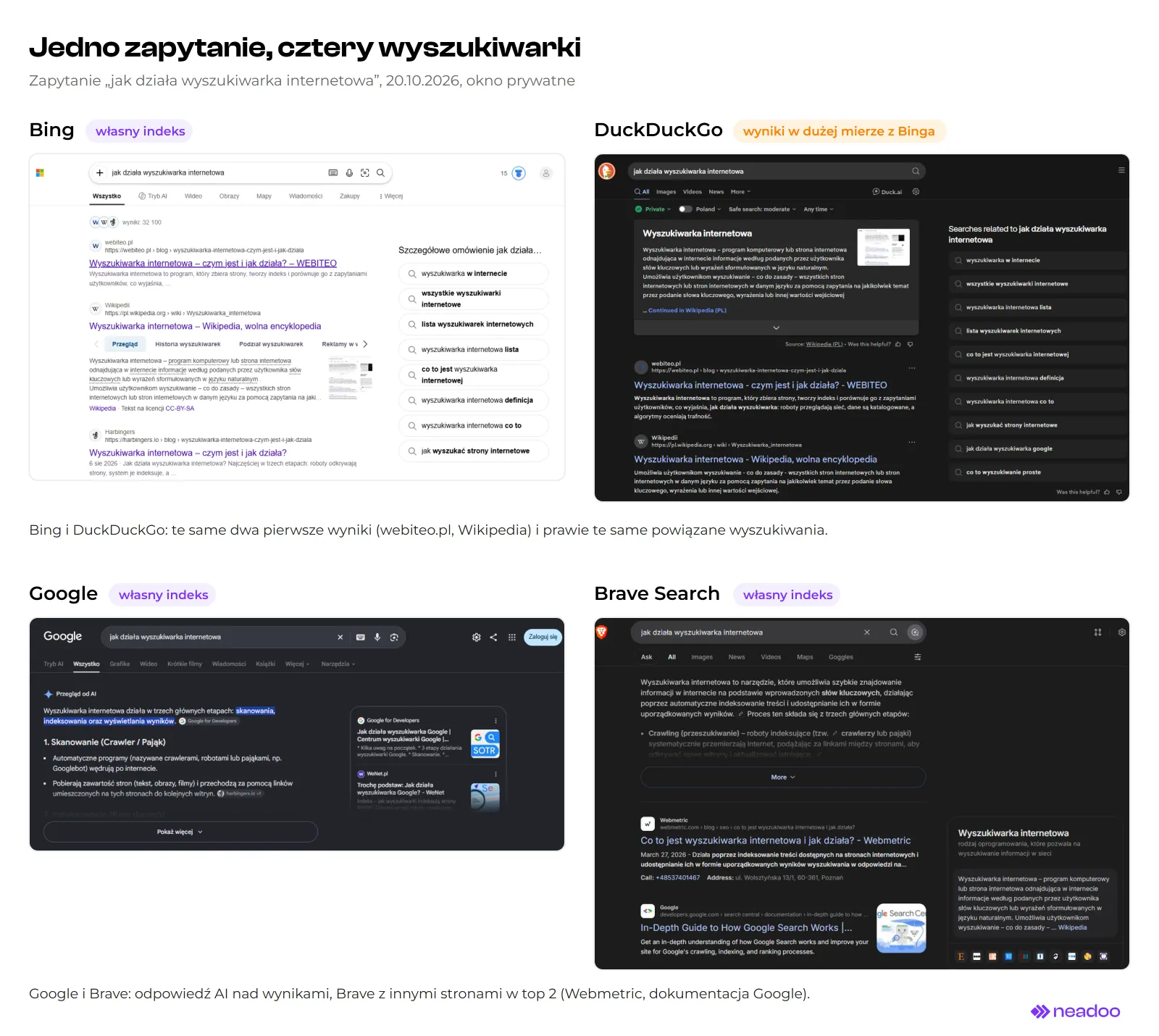
Fig. 5. A single query across Bing, DuckDuckGo, Google, and Brave. Bing and DuckDuckGo align closely because DuckDuckGo pulls its results largely from Bing (private window, 10/20/2026).
The weak point is local search. Without location tracking, "near me" type results are less accurate than on Google.
Brave Search and its independent index
Brave builds its own web index and does not repackage Google or Bing results (Brave Search). An interesting feature is Goggles: custom rules that allow users to change result rankings, for example, boosting tech blogs or hiding selected domains.
There is one caveat regarding privacy. Brave claims it does not profile search engine users, but the Brave browser does send anonymous usage reports (P3A), which can be turned off in the settings (Brave). Calling it "zero telemetry" would therefore be an exaggeration.
Startpage and Google results without tracking
Startpage sends queries to Google on its own behalf, without the user's IP address or cookies. The Anonymous View feature lets you open a discovered page via a proxy server that blocks its tracking scripts.
The company is based in the Netherlands, so it is subject to the GDPR. It is worth noting, however, that since 2019, a significant stake in Startpage has been held by Privacy One Group, a subsidiary of the US-based System1 (Wikipedia).
Let's check your website's potential
Share your website and email - we'll get back to you with a real analysis, no strings attached.
AI-powered search engines and computational engines
Instead of a list of links, AI search engines provide a ready-made answer with cited sources. Some users no longer click through to any result. What matters for a website then is whether it gets cited.
Perplexity AI and the RAG architecture
Perplexity AI operates on the RAG (Retrieval-Augmented Generation) model:
- The engine searches the web for up-to-date documents.
- It selects the excerpts that best match the question.
- Based on them, a language model writes an answer with citations.
You.com, frequently mentioned alongside Perplexity, has been pivoting toward enterprise AI for several years (The New Stack). As a search engine for everyday users, it is losing relevance.
Classic SEO is therefore joined by GEO (Generative Engine Optimization): working to ensure content is cited in model responses. This is what we focus on as part of our AI search engine optimization service.
WolframAlpha as a computational engine
WolframAlpha does not search the internet at all. It translates a natural language question into a computation in the Wolfram Language and processes it using its own structured data across mathematics, science, demographics, and finance. The same formula always yields the same result. However, this does not prevent errors if the engine misunderstands the query.
Wolfram also makes its engine available to AI models as a tool, including via MCP servers, so that calculations are handled by Wolfram rather than the model (Stephen Wolfram, February 2026). This serves as a solution to AI hallucinations in numerical tasks.
The paid search engine Kagi and the metasearch engine SearXNG
Kagi and SearXNG do not make money from ads. Kagi relies on subscriptions, while SearXNG is free, open-source software.
Kagi has no ads or tracking scripts. It combines results from external sources with its own indexes: Teclis covers non-commercial sites and blogs (the "small web"), and TinyGem covers news (Kagi). Its most useful feature is Personalized Results. You can block a domain, lower or raise its ranking, or pin it to the top of the results (Kagi).
SearXNG is installed on your own server, for instance, inside a Docker container. According to its documentation, it supports 264 engines, 81 of which are enabled by default (SearXNG, as of 10/19/2026). Whether query logs are kept is entirely up to the administrator.
Regional search engines: Baidu, Yandex, Seznam, and Naver
In several markets, a local search engine competes with Google on equal footing or outperforms it. Key factors include language, regulations, and the ecosystem of services built around the search engine. We covered Germany separately in our article on German internet search engines.
| Search Engine | Market | Share (StatCounter, September 2026) | What Sets It Apart |
|---|---|---|---|
| Baidu | China | 46.65% overall, 28.32% on desktop (where Bing is first at 41.27%) | Websites usually require hosting in China and an ICP license. The Great Firewall blocks access from China to many foreign services. |
| Yandex | Russia | 70.33% overall (Google 28.12%) | Extensive analysis of Russian inflection. Since 2020, the main ranking model has been the YATI neural network (Yandex). |
| Seznam | Czech Republic | 15.05% overall (Google 78.71%) | Linked to the Mapy.cz and Firmy.cz services. Operates in the EU, so it is subject to GDPR and the DSA. |
| Naver | South Korea | 43.06% overall (Google 47.97%) | Results are largely populated by Naver services: Blog, Cafe, Knowledge iN. |
Market share sources: StatCounter for China (desktop), Russia, the Czech Republic, and South Korea.
Is It Worth Optimizing a Website for Search Engines Other Than Google?
Being present across several search engines reduces dependency on a single algorithm, but it will not replace Google where Google holds nearly 90% of search queries.
Resilience to Google Algorithm Updates
When a website loses rankings after a Google update, traffic from Bing, DuckDuckGo, or AI search engines does not drop alongside it. These systems also evaluate different things: Bing emphasizes user engagement and freshness in its guidelines, while AI search engines check whether a snippet can be cited. We explain how to react to updates themselves in our guide on handling another algorithm update.
Limitations in Local Search
This is where alternatives fall short. Smaller private search engines lack a business database comparable to Google Business Profile, and without location tracking, it is difficult to tailor results to a specific neighborhood or zip code. For a local business, Google and its profile remain the priority, which we discuss in our guide Local SEO for Small Businesses.
Who Are the Users of Alternative Search Engines?
We are not aware of any reliable study comparing the purchasing power or conversion rates of DuckDuckGo, Brave, or Perplexity users with Google users. What we do see, however, is clear: people enter longer, descriptive queries into AI search engines. They ask questions instead of throwing in two words. This shifts how we approach search intent.
How Does Traffic from Alternative Search Engines Look in Google Analytics 4?
Traffic from other search engines appears in GA4, but without query data, and in some visits, without an accurate source.
Here is how it looks on our end. In GA4 for neadoo.pl over the past month (up to 10/20/2026), Google generated 91.9% of organic sessions, Bing 7.18%, DuckDuckGo 0.44%, Yahoo 0.24%, Ecosia 0.19%, and Yandex a single session. These proportions closely match StatCounter data for Poland. More interesting is the engagement rate: 41.34% of sessions from Google and 31.08% from Bing. With 148 sessions from Bing, however, that is not enough to draw definitive conclusions.
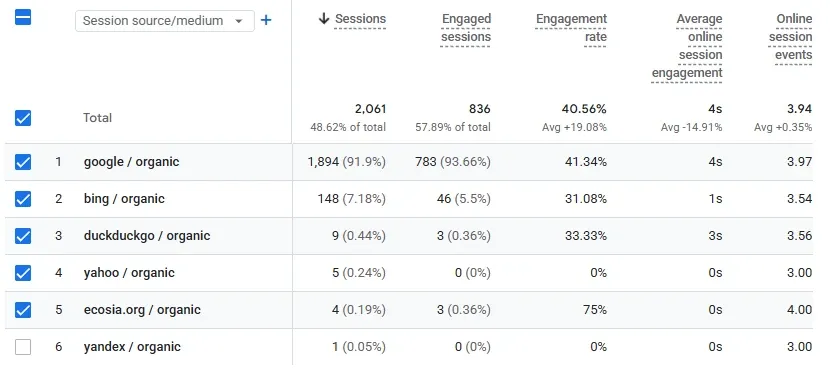
Fig. 6. Organic traffic to neadoo.pl by search engine in GA4, past month (screenshot from 10/20/2026). GA4 identifies DuckDuckGo, Ecosia, and Yandex as organic sources, but does not display search queries.
- No keywords. Search engines usually pass only the domain, not the full URL containing the query. GA4 will show "duckduckgo / organic," but it will not reveal what the user searched for. It is the exact same story with Google.
- Visits without a source. If a browser or extension strips the
Refererheader, the visit drops into the Direct channel, even though it originated from a search engine. - Broken paths. Browsers with strict privacy safeguards, such as Brave and Safari, restrict cookies, so the same person may be counted as a new user on their next visit. This is an issue with the browser, not the search engine.
It is worth supplementing GA4 with server logs and data from Bing Webmaster Tools. We explain how to isolate traffic from ChatGPT, Perplexity, and other assistants in GA4 in our article on traffic from AI assistants in Google Analytics.
Frequently Asked Questions About Search Engines
1. What is the most popular alternative to Google search?
Microsoft Bing. In Poland, it accounts for 7.38% of queries across all devices and 13.94% on desktops (StatCounter, September 2026). Bing's technology is also utilized by Yahoo! Search and, to a large extent, DuckDuckGo.
2. Does DuckDuckGo use Google results?
No. Links and images on DuckDuckGo largely originate from Bing, supplemented by results from its own DuckDuckBot crawler and specialized sources. Startpage is the service that displays Google results without tracking.
3. Which search engine has its own index independent of Google and Bing?
Among popular privacy-oriented search engines - Brave Search. Kagi also maintains its own indexes, but only for select types of websites (Teclis and TinyGem).
4. Will AI search engines replace traditional search engines?
Not for now. Google accounts for 89.56% of searches in Poland, while Perplexity does not even appear in StatCounter rankings. However, AI search engines are changing how some people seek information, so content should be structured to be easily quotable in AI answers.
Sources
- StatCounter Global Stats, Search Engine Market Share, September 2026: Worldwide, Poland, Poland Desktop, Poland Mobile, China Desktop, Russia, Czech Republic, South Korea
- Microsoft, How Bing delivers search results
- eWeek, Microsoft Bing to Power Yahoo Search in 10-Year Deal
- DuckDuckGo, Sources
- Brave, Brave Search and Browser Privacy Policy