
GEO (Generative Engine Optimization) - What It Is and How to Rank in AI
When a user asks artificial intelligence (ChatGPT, Perplexity, or Gemini) about services or products, they get a ready-made answer with a few sources rather than a list of ten links. If your brand is not in it, even a top ranking in traditional search will not help.
GEO (Generative Engine Optimization), also known as AI SEO, is the optimization of a website, content, and brand presence for generative engines and AI assistants: ChatGPT, Perplexity, Gemini, Copilot, Claude, and Google AI Overviews. The goal is different from SEO: not a spot on a list, but having the model retrieve the content, understand it, and cite it as a source in its response. GEO is a new form of AI positioning, while traditional SEO focuses on Google search results. This guide is for website owners, marketers, and SEO specialists who want their brand to appear in AI-generated answers and AI search engines. GEO does not replace SEO, but rather serves as another layer, and no tactic guarantees presence in the answers because they are probabilistic. This overview is based on documentation from Google and OpenAI (as of November 2026).
What the Acronym GEO Means and How It Differs from Geography
The acronym GEO is sometimes confused with geography and geoinformatics. The word "geography" comes from Greek, combining "earth" with "write" (describe): it is an interdisciplinary science studying the Earth's surface, divided into physical geography (including hydrology, geomorphology, climatology, and biogeography) and human/socioeconomic geography (population, economic, and political geography). Geoinformation technologies, in turn, are used for navigation, parcel tracking, emergency service support, and smart farming. In this guide, GEO stands for Generative Engine Optimization, which is optimization for AI-generated answers.
What GEO Is and How It Changes Website Positioning
What does GEO involve in practice? GEO involves preparing content so that an AI system can retrieve, understand, and cite it in a generated response: this includes text structure and language, technical accessibility for bots, and brand presence in places from which models draw knowledge. The outcome is not a ranking position, but a mention, link, or context within a ready synthesis, so alongside clicks, domain citation frequency matters. The foundation is shared with SEO positioning, and the model-specific layer (writing for citation, managing bot access, off-site mentions) is described in AI positioning.
Origin of the Term and the Scale of the Phenomenon
The term was popularized by the paper "GEO: Generative Engine Optimization" (preprint on arXiv, November 2023): techniques that increased information density worked best - namely statistics, citations from credible sources, and text fluency - and in the authors' tests, the most effective techniques improved visibility by about 30-40%. This is a result from specific evaluations, not a guarantee, so treat it as a hypothesis for your own testing.
The scale of AI tool usage is growing: according to OpenAI, ChatGPT had about 800 million weekly active users (October 2025), and Google AI Overviews is used by over 2 billion people monthly (Google data, July 2025). According to SparkToro and Similarweb (January-April 2026), about 68% of Google searches in the US end without a click, and Pew Research (2025) reported clicks on a traditional result in 8% of visits with an AI overview compared to 15% without one. The numbers come from different sources, so do not add them together, but they point in the same direction: decisions are made before the user visits a website. For a GEO strategy, this means new challenges: improving brand visibility must include places where the customer does not click links, and visibility growth must be measured by the number of citations and queries in which the brand appears in answers.
Differences Between SEO, AEO, and GEO
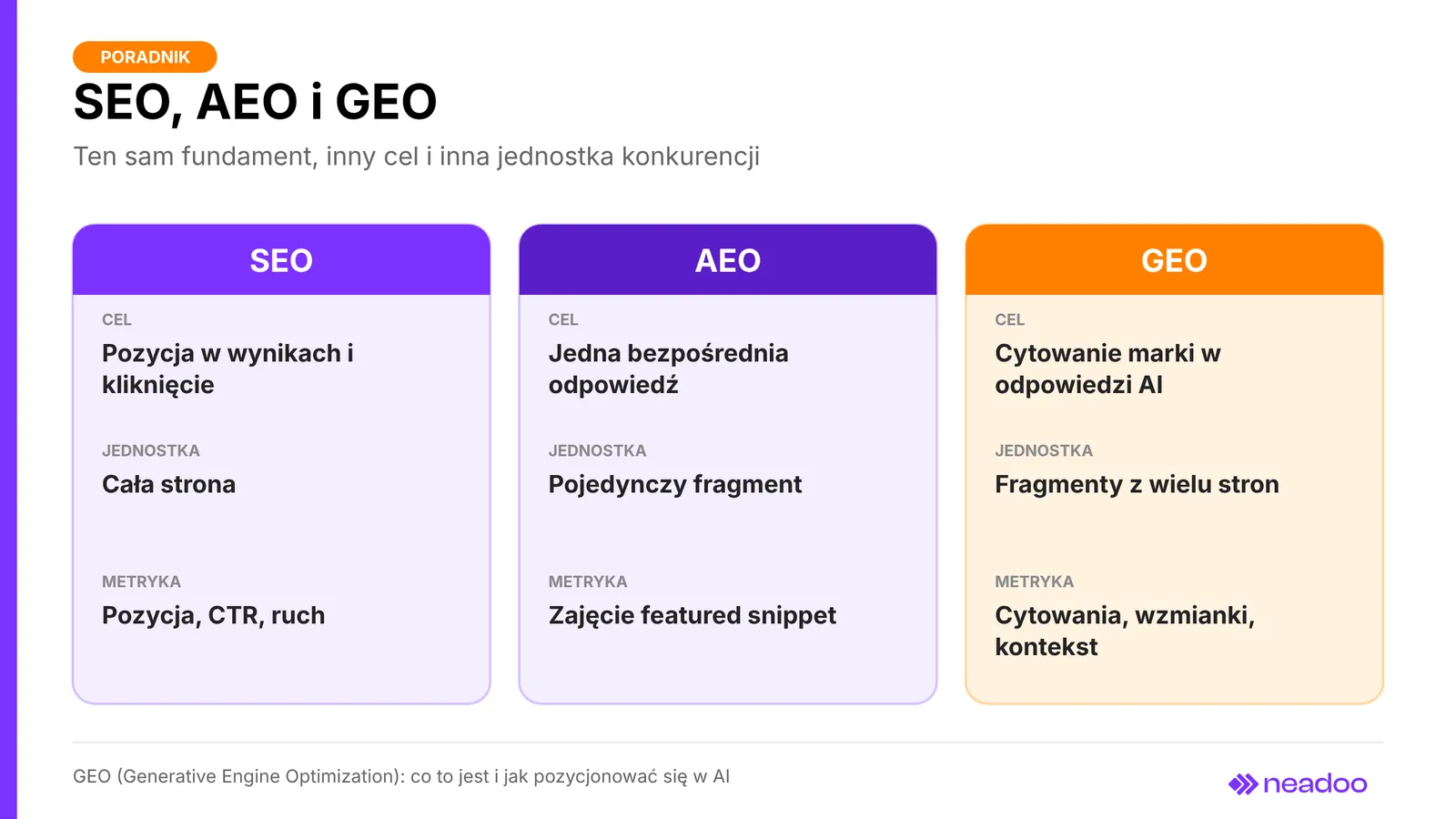
The key differences relate to the goal and the unit of competition. SEO competes for ranking positions in search results and CTR, AEO (Answer Engine Optimization) for a single, direct answer, such as in a featured snippet, and GEO for brand citation in summaries synthesized from multiple sources. In some publications, AEO and AI SEO are synonyms for GEO; here we adopt a narrower distinction.
| Criterion | SEO | AEO | GEO |
|---|---|---|---|
| Primary goal | Indexing and high rankings | Single direct answer | Brand citation in AI responses |
| Unit of competition | Entire page | Single snippet | Snippets from multiple pages |
| Primary metric | Ranking, CTR, traffic | Winning the featured snippet | Citations, mentions, context |
| Dependence on Google rankings | Direct | Partial | Depends on the system |
The dependency of GEO on rankings is neither zero nor fixed: according to Ahrefs, the most frequently cited URL in AI Overviews has a median organic ranking of position 2. A page outside the index has no chance of being cited, and a high ranking does not guarantee a mention, so treat GEO as a layer added to SEO, with separate measurement.
Let's check your website's potential
Share your website and email - we'll get back to you with a real analysis, no strings attached.
How Generative Engines Search for and Process Information
An AI response is generated from model training knowledge (static, with a cutoff date, without citing sources in its answers) and from real-time search: the system converts the question into several queries, searches for information, retrieves page snippets, and passes them to the model as context. This is Retrieval-Augmented Generation (RAG), meaning competition is not between entire pages, but fragments of text. Embeddings - vectors describing meaning rather than exact wording - are responsible for matching them to the question (a passage about implementation costs matches many price queries). Therefore, it is important that a paragraph is understandable when taken out of context from the rest of the page: without backwards-referencing pronouns, with the brand name next to the figure, and with one idea per paragraph.
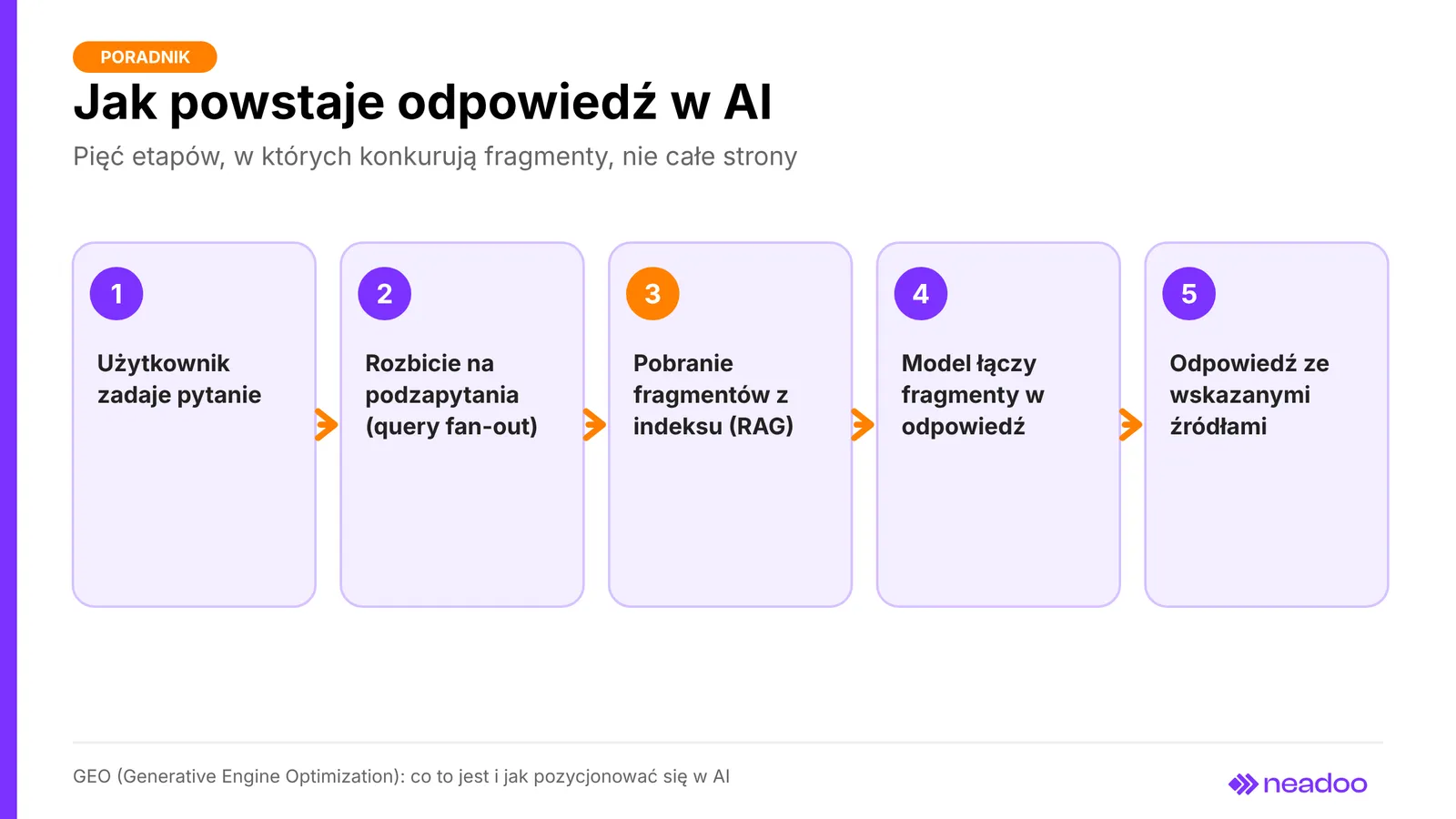
Google also describes the query fan-out mechanism: a single question is broken down into several related sub-queries executed in parallel in real time, and no provider discloses their exact number. For content planning, this means that instead of a single keyword phrase, it is worth mapping out customer questions (pricing, selection criteria, limitations, comparisons) and assigning each a separate heading with the answer at the beginning. A page that is not ranked first for the primary phrase can win on one of the sub-queries.
Principles of Writing Content Cited by AI
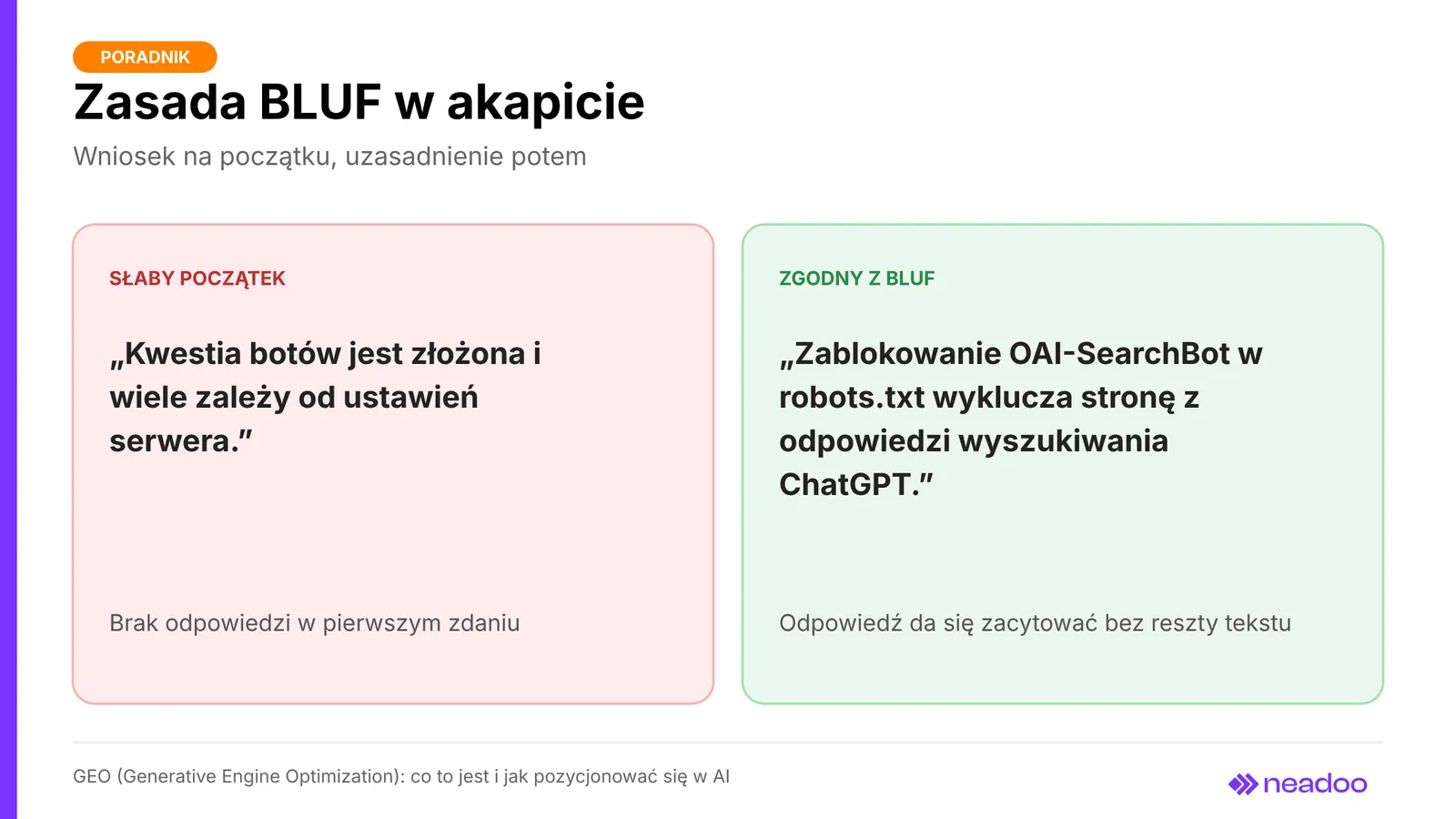
The foundation of optimizing content for AI rests on three rules: the answer comes at the beginning of the passage (the BLUF principle, Bottom Line Up Front), the paragraph is self-contained, and claims are supported by numbers and reliable sources. None of this guarantees a citation, but it increases the chances of a passage being used, and the key is tailoring content to AI models that retrieve snippets rather than entire pages. A weak opening is "The issue of bots is complex," while one aligned with BLUF is: "Blocking OAI-SearchBot in robots.txt excludes a site from ChatGPT search answers, though not necessarily from navigational links. GPTBot is a separate crawler used for model training."
Run a single-paragraph test: copy it without the heading and neighboring sentences, and check whether it is clear what it is about and on what basis. Replace pronouns like "this" or "that way" with nouns, and replace "very quickly" with a specific number, source, and year. When the primary source of a statistic cannot be found, do not cite it. Information gain comes from proprietary data with a documented methodology, precise conditions and exceptions, and comparisons based on clear criteria rather than marketing slogans.
Content Formatting That Facilitates Machine Reading
AI models more easily cite content from self-contained modules (adapting the structure to how these systems operate): tables, step-by-step lists, and subheadings framed as user questions ("What is...?", "How much does... cost?"), with the answer placed directly below the heading. You can gather questions from Google's "People Also Ask" section, from customers, and from query analysis in Search Console; in content marketing, it is worth mapping them to specific topics. A table works when a row describes a single entity and a column represents a single criterion, and when it is an HTML element rather than a screenshot. Supplement infographics with data in the body text and a descriptive alt attribute. Industry estimates suggest higher citability for such modules, but there are no independent measurements to confirm this, so treat structure as a facilitator rather than a guarantee. The rules of content optimization for AI do not replace thorough keyword and intent research.
Technical Website Requirements for AI Bots
Visibility in generative search engines starts with access: bots must receive content in server-side rendered HTML, quickly and without blocks in robots.txt, a WAF firewall, or a CDN. Some AI crawlers do not execute JavaScript, so verify crucial passages using the curl command. These requirements overlap with traditional SEO, so conduct a single technical audit for both layers and treat bot access management as an ongoing area of work.
Search Crawlers and Training Crawlers
The same companies maintain multiple user agents for different tasks, and the effect of a block depends on the specific bot.
| Bot Type | Examples | Effect of Blocking |
|---|---|---|
| Training | GPTBot, ClaudeBot, CCBot | Content is not used for training |
| Search | OAI-SearchBot, PerplexityBot, Claude-SearchBot | Site is excluded from the system's search results |
| User-requested | ChatGPT-User, Perplexity-User | Assistant will not open the page in a conversation |
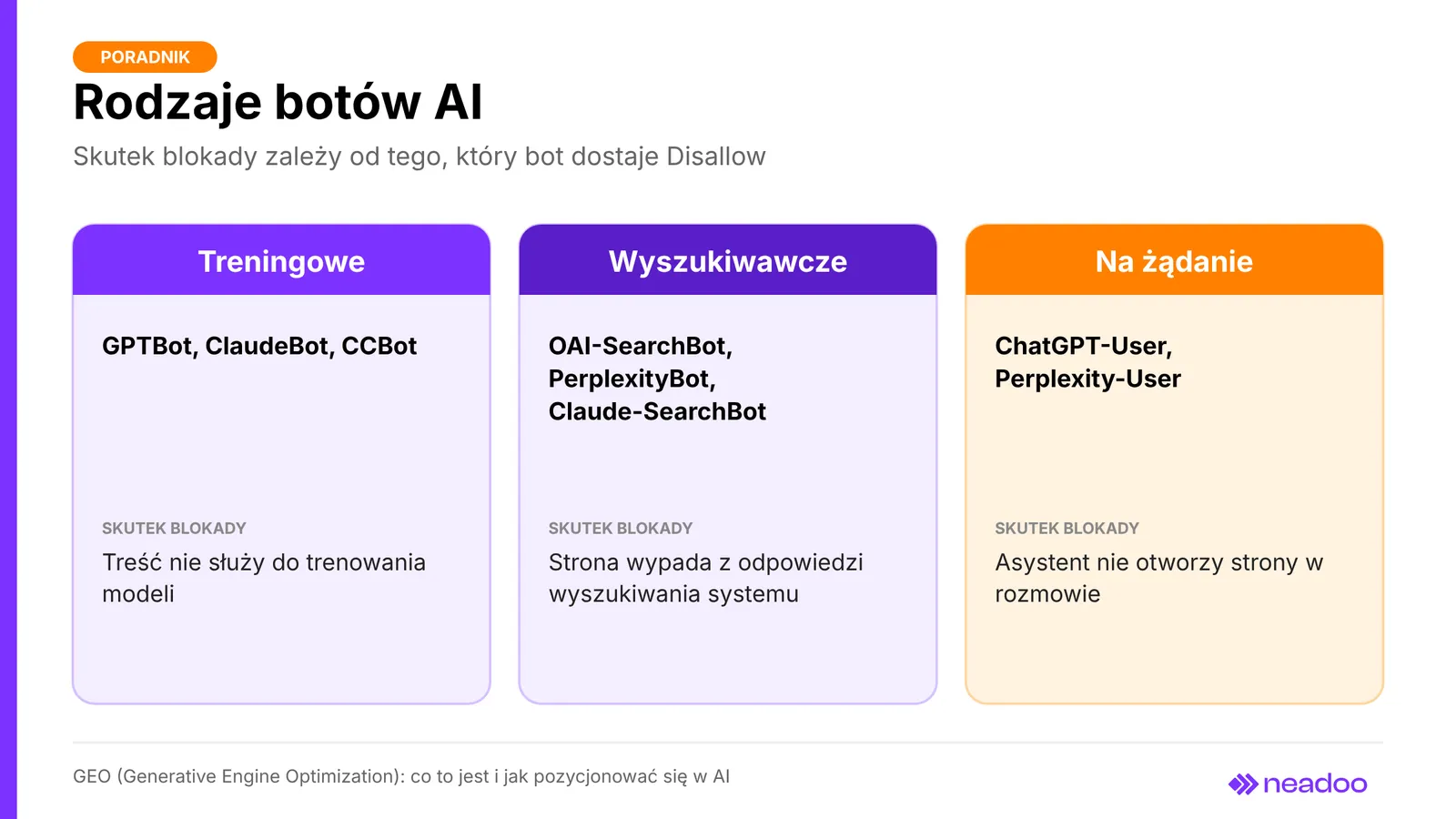
According to OpenAI documentation, blocking OAI-SearchBot excludes a site from ChatGPT search answers, while GPTBot applies exclusively to training. User-triggered bots fetch a page in real time during a conversation. Bot names change, so verify them in the providers' documentation.
Robots.txt and Google Settings
In robots.txt, you can separately configure protection against training (Disallow for GPTBot, ClaudeBot, CCBot, Google-Extended) and allow search bots. However, this is a courtesy rule: a WAF or CDN can cut off search bots with 403 or 429 status codes, even if robots.txt allows them.
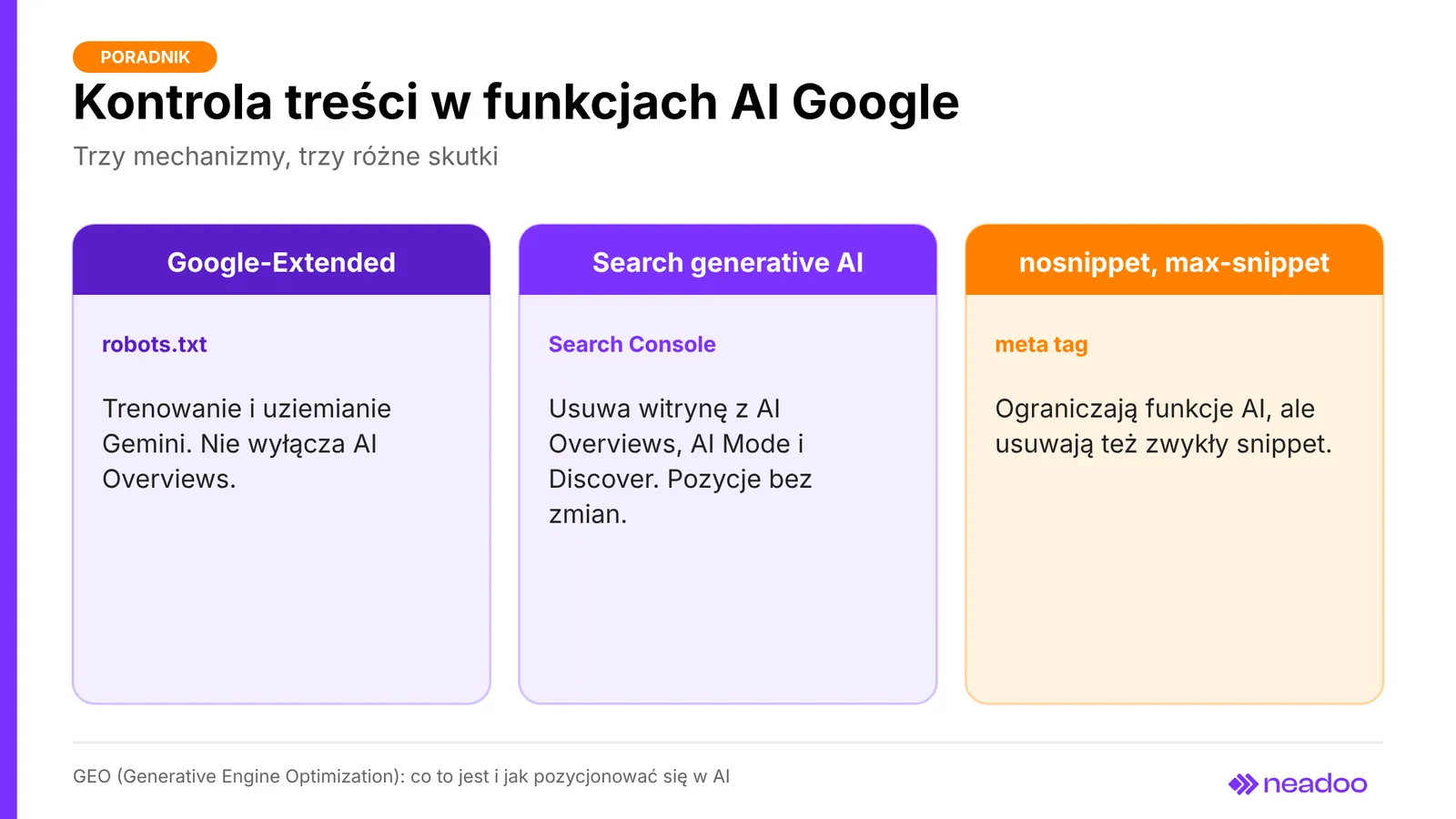
Google-Extended controls the training and grounding of Gemini models, but it does not affect presence in Google Search, AI Overviews, or AI Mode, as these features rely on Googlebot's index. Presence in these features is controlled by the "Search generative AI" setting in Google Search Console: disabling it removes the site from AI Overviews, AI Mode, and generative features in Discover without altering rankings in traditional results. The nosnippet and max-snippet directives also restrict AI features, but they remove the standard snippet at the same time.
E-E-A-T Signals and Structured Data
AI models typically prefer high-authority sources, and generative engines verify facts based on Schema.org data and E-E-A-T signals (Experience, Expertise, Authoritativeness, Trustworthiness), although E-E-A-T is a framework from Google's quality rater guidelines rather than a direct ranking factor. Article (with author and dates), Organization, Person, and Product markup, used by search engines, link content to the author and publisher entity, but they must match the visible content. Since 2023, Google has shown FAQ rich results primarily to government and health websites and deprecated HowTo rich results, so these markups now mainly serve data organization and do not guarantee citations, yet they strengthen the brand's position as a credible source.
A model must be able to attribute text to an individual whose credentials can be verified beyond a single website: this requires an author page with a fact-based bio, sameAs links (LinkedIn, speaking engagements), citations and references to sources, and visible dates of actual updates, as verifying data freshness is essential. Consistency of brand and author names across markup, footers, social media, and external publications plays a crucial role, as disparate versions fragment a single entity into multiple weaker ones.
Building Brand Reputation Beyond Your Own Website
AI models recommend brands based on their overall web presence rather than solely on the content of their own website: structured data states who the brand is, while independent sources confirm that others describe it the same way. Unlinked brand mentions in industry publications reinforce the association between the name and the topic, while links continue to influence rankings that some systems use as a starting point, making this an area that supports AI search optimization.
Start with consistent data across external databases (official registries, Google Business Profile, LinkedIn, industry-specific directories), then collect genuine reviews on industry platforms (purchased reviews violate terms of service and regulations), maintain an informative presence on forums where customers interact, and publish original research and expert commentary. Creating Wikipedia articles about yourself violates conflict of interest guidelines, and the X platform is primarily relevant for the Grok model.
How to Measure and Monitor Visibility in Generative Engines
Measurement relies on three sources: cyclical prompt auditing, referral traffic from assistants in analytics, and server logs - and none of them is sufficient on its own. GEO monitoring, meaning brand visibility tracking in AI, requires different metrics and tools than traditional SEO, and the effectiveness of your optimization and overall GEO strategy should be evaluated across trends. Starting June 3, 2026, Google provides reports for generative features in Search Console, displaying impressions in AI Overviews and AI Mode (without clicks). Conduct a prompt audit as follows: build a set of 20-30 queries using your customers' language, freeze their wording, determine the test environment (language, location, clean session without history), repeat each prompt 3-5 times, and record every month whether your brand appears in the answers, whether there is a link to your domain, what the number of citations is, and which sources were cited.
Server log analysis results will show whether GPTBot, OAI-SearchBot, PerplexityBot, and Googlebot are receiving a 200 code rather than 403 or 429, but a crawler visit is not proof of citation. In GA4, create an "AI Search" channel group for sources such as chatgpt, perplexity, gemini, copilot, and claude, positioned above the Referral channel, and treat the traffic analysis numbers as a lower bound, since some visits will be recorded as direct traffic.
The Future of Search and Integrating SEO with GEO Strategies
Conversational search requires synergy between SEO and GEO: GEO becomes a complement to traditional SEO, not its replacement, and calls for a systematic approach aligned with business goals, because the effectiveness of a GEO strategy depends on regular measurement. A single content marketing calendar is sufficient if every piece of content passes two filters: SEO (keywords, intent, structure, internal linking) and GEO (an answer in the opening sentences, facts with source and date, consistent entity naming). Consequently, the industry reports that initial results appear after about 6 months, with marked growth after 6-12 months, although this is an approximate estimate, not a guarantee. For businesses, GEO is an investment whose business benefits must be measured: through brand mentions, assistant-driven traffic, and inbound inquiries. The next phase is agentic search, where AI performs tasks on the user's behalf, so prices and terms of service should be stored as plain text, not just in graphics or PDFs, and service descriptions should be tailored to customer questions.
FAQ
Will Generative Engine Optimization replace traditional SEO?
No. GEO is a complementary layer: models rely on resources indexed by search engines, so GEO alone without foundational SEO is ineffective.
How do I check if my website appears in ChatGPT answers?
Ask ChatGPT, Perplexity, and Gemini a dozen or so questions your customers would ask, and check whether your brand or link appears. Do this using a fixed set of prompts and record the results on a monthly basis.
Do I need to rank in Google's TOP 10 for an AI model to cite my content?
Not necessarily. According to Ahrefs, the most frequently cited URL in AI Overviews has a median rank of 2 in organic search results, but the page must be indexed, accessible to bots, and the content must be specific and easily quotable.
Which Schema.org markups are most important for AI optimization?
The most useful are typically Organization, Article with author and date, and Product or Service, as well as FAQPage where actual questions and answers exist on the page. There is no guarantee that a specific markup will secure a citation.
What is the difference between an AI search bot and a model training bot?
A search bot, such as OAI-SearchBot or PerplexityBot, fetches pages to provide answers with source links, whereas a training bot, such as GPTBot, crawls content for model training purposes. They have separate directives in robots.txt.