TF-IDF in SEO: How the Algorithm Works and How to Wisely Optimize Content

TF-IDF (term frequency-inverse document frequency) is a statistical measure of how important a word is in a single text relative to an entire collection of documents. A high weight is assigned to a word that you use frequently, while others use it rarely. Words that appear everywhere, like "and" or "is", drop to zero.
In SEO tools, TF-IDF looks like a quota to fill: the bar is too low, so you add the phrase. Google does not calculate it this way, so treat the result as a list of topics that might be missing from your text. Using an example with three documents, you will see where these numbers come from and why two different tools rarely show the same result.
What TF-IDF Is and How the Mathematical Formula Works
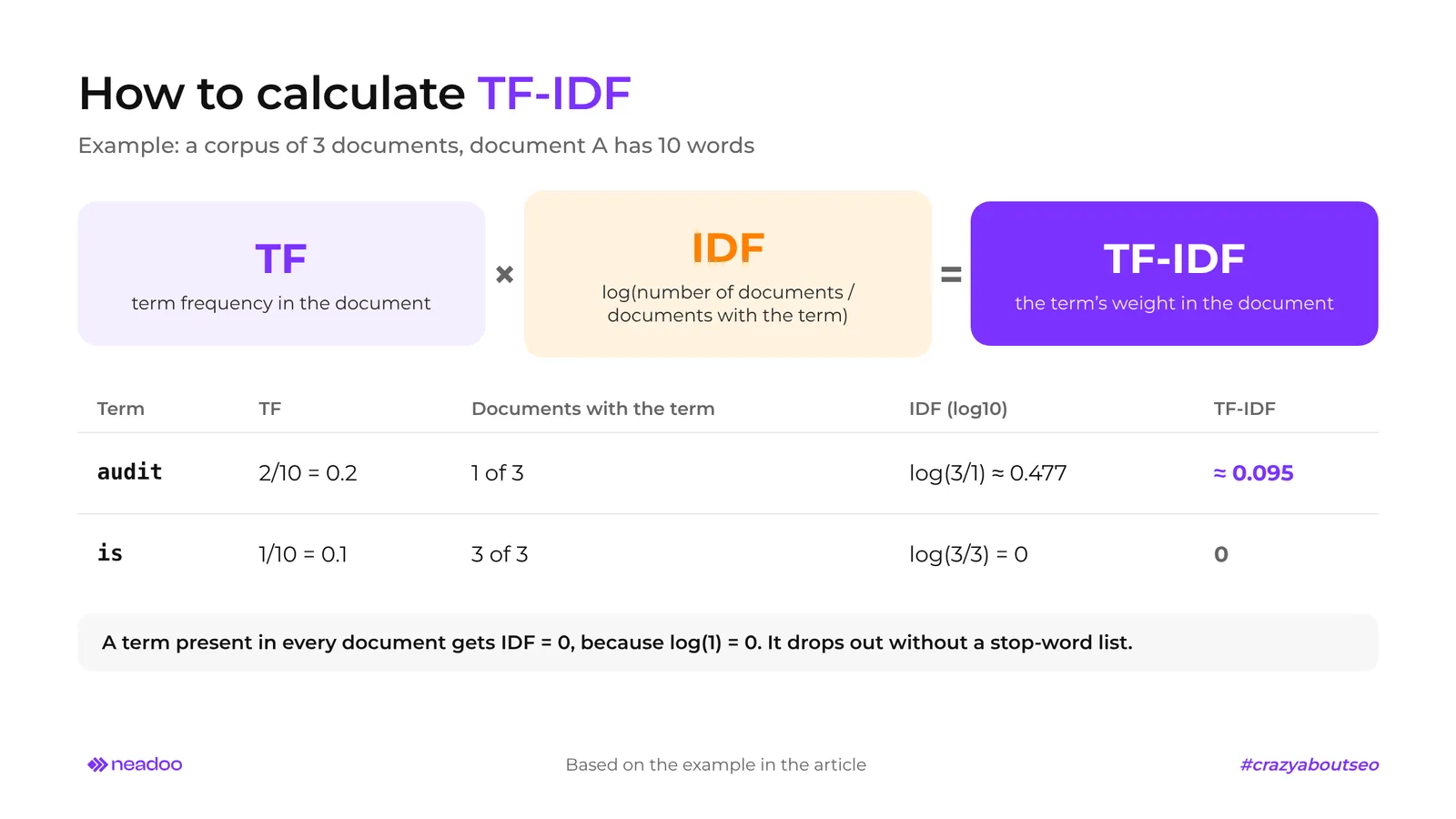
TF-IDF is a measure of a word's importance in a document relative to an entire text collection. The formula consists of two parts: you multiply TF (term frequency in a document) by IDF (inverse document frequency of documents containing that word).
How to Calculate TF-IDF with a Simple Example
Take a hypothetical corpus of 3 documents. Document A has 10 words, including "audit" 2 times and "is" 1 time. "Audit" appears only in A, while "is" appears in all three documents.
| Word | TF | Documents with the word | IDF (log10) | TF-IDF |
|---|---|---|---|---|
| audit | 2/10 = 0.2 | 1 | log(3/1) ≈ 0.477 | ≈ 0.095 |
| is | 1/10 = 0.1 | 3 | log(3/3) = 0 | 0 |
The IDF for words present in all documents of the corpus is exactly 0, because log(1) = 0. Therefore, "is" disappears without needing a stop word list.
The IDF component was introduced in 1972 by Karen Spärck Jones. In practice, you will encounter variations: TF as log(1 + count), IDF smoothed by +1 (Laplace-style smoothing to prevent division by zero), and base-10 or base-e logarithms. Scikit-learn's (1.9.1) TfidfVectorizer combines CountVectorizer and TfidfTransformer, and normalization, such as L2, is set via a parameter. The output is a sparse vector for each document.
TF-IDF is also used far beyond SEO: for document classification and clustering, keyword extraction, detecting duplicate and similar content (plagiarism detection systems), and text vectorization in machine learning.
TF-IDF Compared to Keyword Density and Semantic Models
TF-IDF is superior to keyword density because it takes into account how rare a word is in the corpus. However, as a bag-of-words model, it falls behind BM25 and semantic embeddings. That is why, when optimizing content on your website, you should not rely solely on keyword density or mechanical TF-IDF.
| Method | Considers corpus | Repetitions | Context |
|---|---|---|---|
| Word density | no | linearly | none |
| TF-IDF | yes (IDF) | linear weight increase | none |
| BM25 | yes | saturation, diminishing impact | none |
| Embeddings | yes | - | meaning without identical words |
Before TF-IDF analysis in NLP, the text undergoes tokenization, lowercasing, and lemmatization or stemming, which is mandatory with Polish inflection. Lexical search then sums the values of the query terms.
The model does not recognize synonyms, cannot handle out-of-vocabulary (OOV) words, and favors shorter texts for the same number of repetitions. So if your company writes about a topic using different words, TF-IDF will not detect these connections. Embeddings compare meaning, for example, using cosine distance.
Google describes BERT and RankBrain as systems that understand meaning and relationships between concepts, while TF-IDF is not listed among its publicly documented ranking systems. If you want to see how this shift in perspective translates to your visibility, check out AI SEO.
Do Google's Algorithms Actually Use TF-IDF?
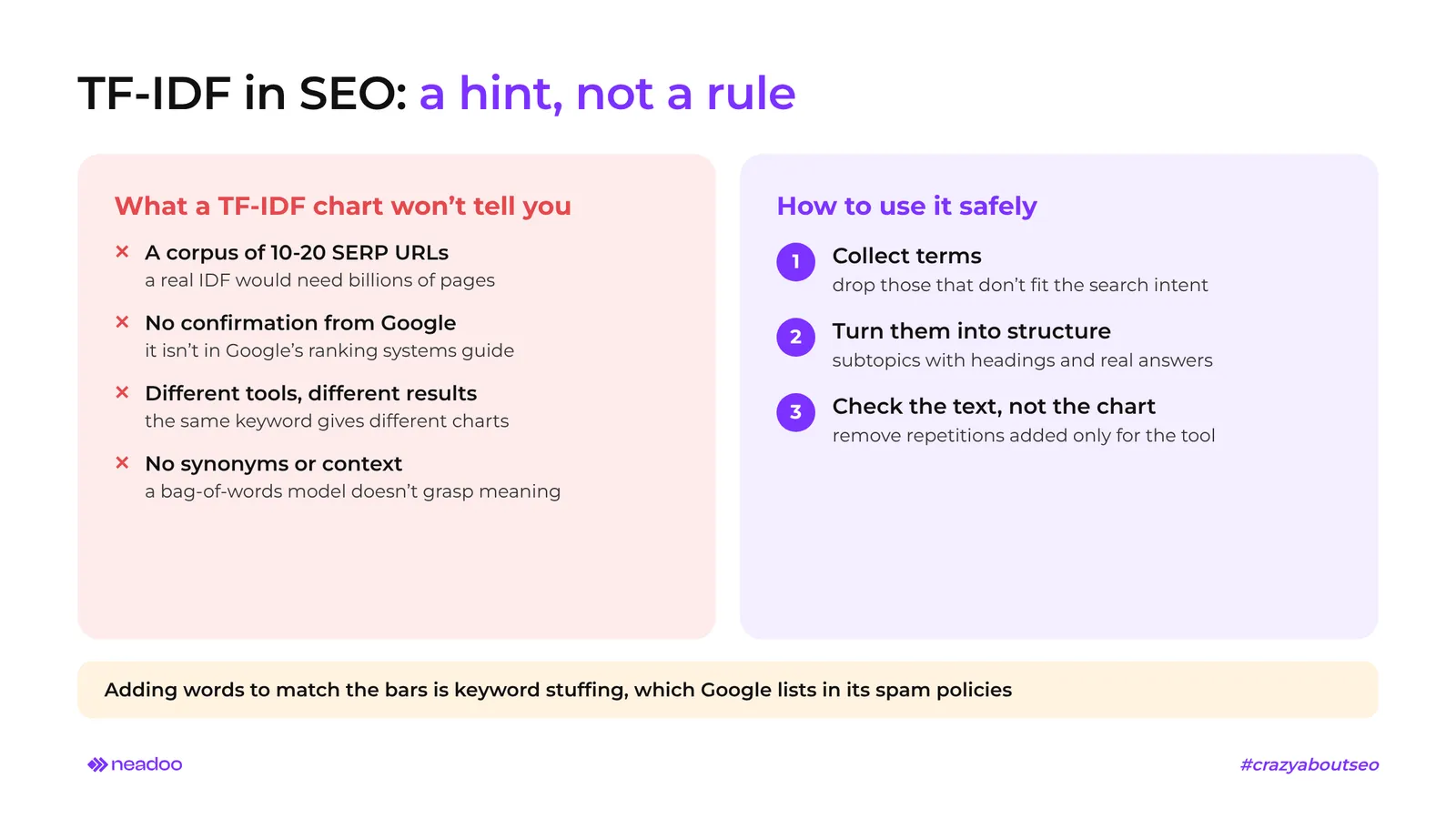
Google does not use classic TF-IDF as a ranking factor, and analyses from SEO tools rely on a sample that is far too small to infer anything about the algorithm. The metric is not mentioned in Google's Guide to Ranking Systems, nor is there any public confirmation of its use. In 2019, John Mueller called it an old metric from information retrieval theory. He advised against optimizing directly for it, as third-party tools do not have access to the full web index.
This is the core problem with TF-IDF in SEO. Surfer SEO, Seobility, or Semrush calculate TF-IDF analysis for your content against 10 or 20 URLs from the SERP. A true IDF would require a corpus of billions of pages, so such calculations do not replicate anything operating inside Google. This is a microscopic corpus flaw (sample bias). Corpus analysis of a dozen or so documents only shows what the current top results have in common, not what determined their ranking.
On top of that comes inconsistency: the same phrase produces different charts across different platforms. Treat them as hypotheses about content gaps, not as ranking guidelines.
Let's check your website's potential
Share your website and email - we'll get back to you with a real analysis, no strings attached.
How to Safely Use TF-IDF Analysis in Content Optimization
Use TF-IDF analysis results purely as inspiration to fill a content gap, not as a mandate for repetition counts. Adding words just to match the bars in a tool leads to keyword stuffing and over-optimization. Google explicitly lists keyword stuffing in its spam policies. Here is what a safe TF-IDF process in SEO looks like:
- Gather terms. Keyword extraction from the top-ranking results gives you a list of candidates. Discard any that do not match the search intent of your content.
- Turn terms into structure. Group missing concepts into subtopics and give each a subheading with an informative answer. This is how you build content completeness, not keyword stuffing.
- Verify the text, not the chart. Read the whole piece and remove repetitions added solely for the tool. Treat cosine similarity to competitors, which these tools calculate, as a clue, not a target.
The result is topical authority, not a ranking guarantee. If your content is comprehensive but traffic is still missing, consider a technical SEO audit.
FAQ
What Is the Difference Between TF-IDF and Keyword Density?
Keyword density measures the percentage of a single phrase in a single text: 2 occurrences out of 10 words is 20%. TF-IDF weights every word in a document and also evaluates how rare it is across the entire corpus. The first method tells you how many times you repeated a phrase; the second tells you which words make the text distinctive.
Does Optimizing Directly for a TF-IDF Chart Risk a Keyword Stuffing Penalty?
There is no specific penalty "for TF-IDF," but there is a risk. If you add words solely to match the chart bars, you end up with keyword stuffing, which violates Google's spam policies. This can result in a loss of visibility. Therefore, only add terms that provide real value to the content.
Why Does Polish Require Lemmatization Before TF-IDF Analysis?
Polish inflection splits a single concept into multiple forms: "audyt", "audytu", "audytem", "audycie". Without lemmatization, the model counts them as distinct words, which artificially lowers TF and distorts IDF. You reduce these forms to their base lemma, for example using spaCy with a Polish model or Morfeusz 2.
What Free Tools Allow You to Check TF-IDF?
You can calculate it yourself in Python using scikit-learn's TfidfVectorizer or in R using the tidytext package. Both are free, but for Polish text, be sure to add lemmatization first.