
On-Page SEO - What It Is and Which Elements to Optimize on Your Site
On-page SEO (also known as on-site SEO, onpage SEO, or on page SEO, short for search engine optimization) refers to all search engine optimization efforts carried out directly within a website: in the HTML code, content, structure, and technical parameters. Their goal is to improve the site's visibility in organic search results, and increasingly, to encourage AI models to cite it. Together with off-page SEO - meaning factors outside the site - it forms the two primary areas of website positioning and serves as the foundation of SEO basics.
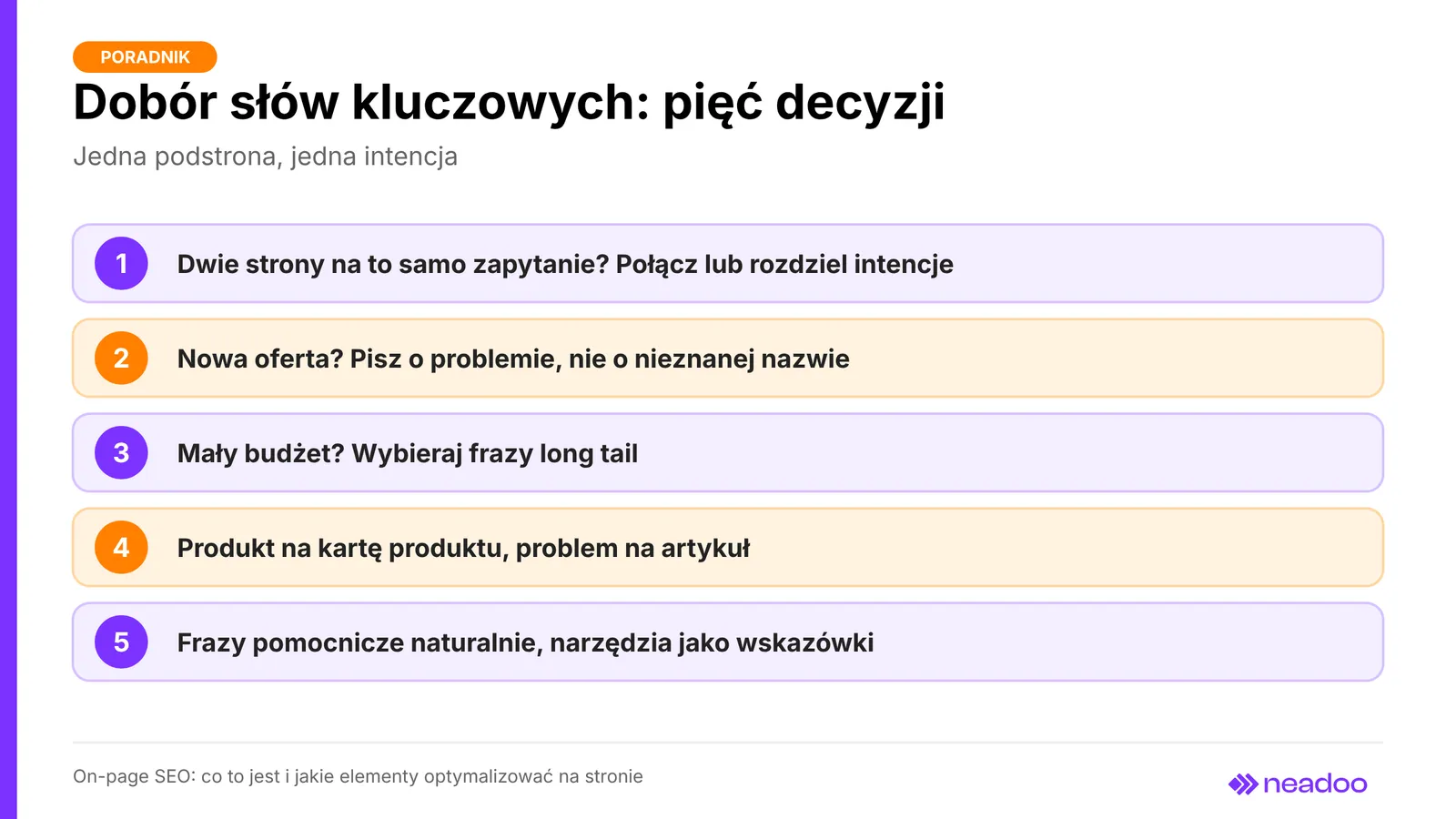
Website optimization covers several groups of factors: keyword selection, site structure and URLs, meta titles and descriptions, H1-H3 headings, content optimization, internal linking, images, and technical parameters such as page load speed and mobile usability. The changes you make on your website are not just a formal checklist: search engine crawlers and algorithms interpret the content layout, while a logical structure enhances the user experience and makes it easier for AI systems to summarize it.
What is on-page SEO and how does it differ from off-page
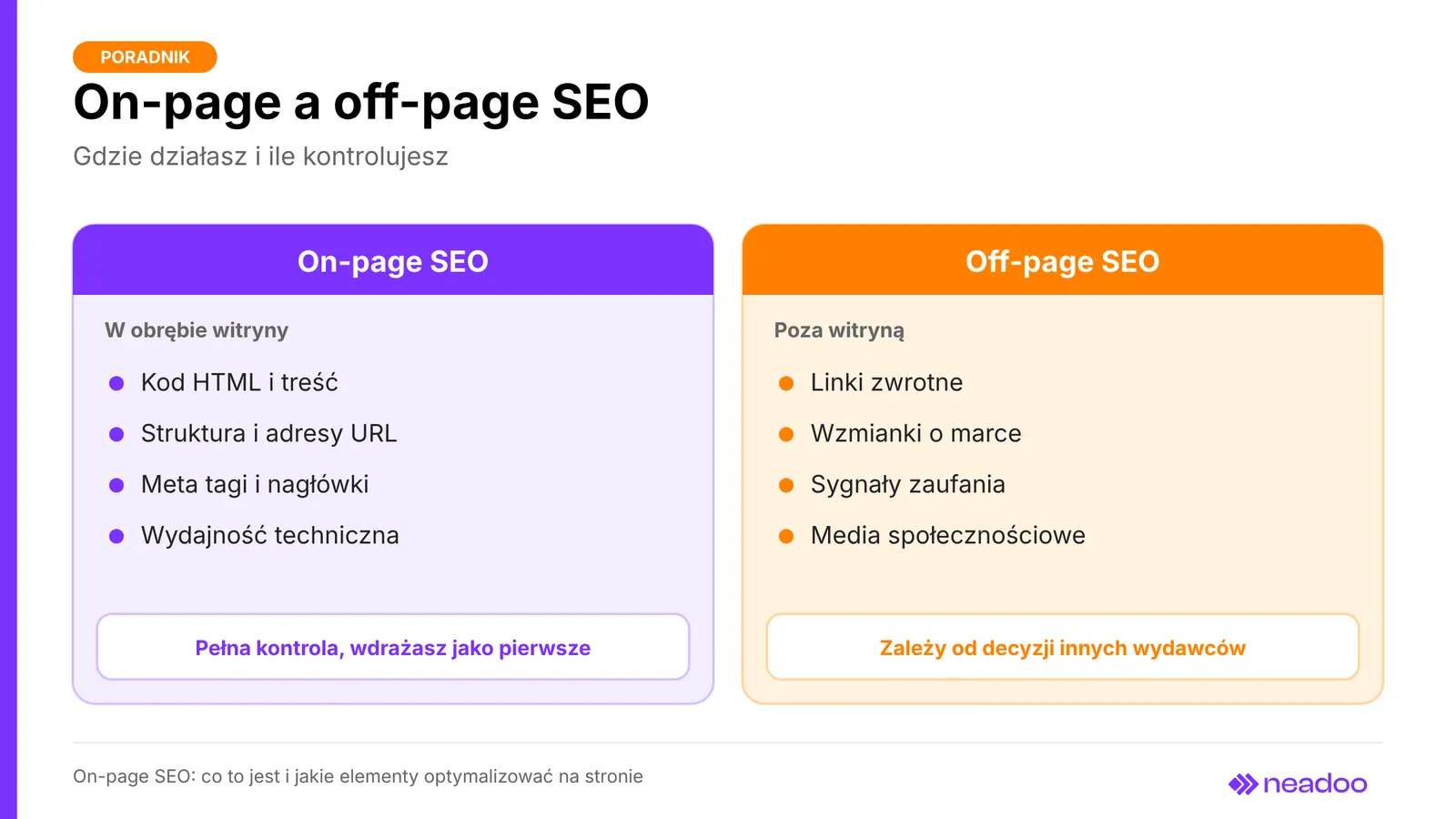
On-page SEO involves actions taken within the website's HTML code and content. Off-page SEO (also known as off-site SEO) focuses on building domain authority outside of it: acquiring backlinks, brand mentions, and trust signals from other websites. On-site SEO factors encompass content, code, and performance, while off-page activities involve external linking, link acquisition, building high-quality links, and social media mentions. Website optimization consists of both groups. You have full control over the first area, while the second depends on decisions made by other publishers. That is why on-page factors are usually implemented first, and in broader website SEO, they are complemented by external efforts. Neither area replaces the other, and properly implemented adjustments impact search rankings and website positions, but alone they do not guarantee a spot in the TOP 1.
Why organic visibility still matters
Clicks are concentrated at the top of the list, but their distribution is shifting rapidly. According to Advanced Web Ranking (July 2026, Google USA, desktop), the first organic result has an average CTR of about 20%, which drops to around 9.7% when an AI Overview appears in the results. Depending on the study, device, and sample size, these values vary significantly, so treat them as an order of magnitude rather than a strict rule.
The share of zero-click searches is also growing: according to an analysis by SparkToro and Similarweb (January-April 2026), about 68% of Google searches in the US end without a visit to a website. Therefore, optimization must provide both ranking and a compelling reason for the user to actually visit the site.
Optimizing content and metadata for search intent
Effective website content optimization begins with search intent: each subpage is assigned one intent and one primary keyword, and only then are metadata and headings aligned with them.
The page title (title tag) should be unique, concise, match the user's query, and accurately describe the subpage. A keyword helps, but it is not a requirement, and Google can also construct the title link from headings within the content. A meta description summarizes the content in a few sentences, but snippets are often generated directly from the body text, so having a description does not guarantee it will be displayed - though a well-crafted one can boost click-through rates.
The H1 heading clearly defines the topic of the page and usually contains the primary keyword, although Google does not strictly require it, while H2 and H3 headings build the text hierarchy. The content itself must be unique, grammatically correct, and helpful, and content readability (short paragraphs, subheadings) builds user trust. E-E-A-T (Experience, Expertise, Authoritativeness, Trustworthiness) is a framework from the Quality Rater Guidelines, not a direct ranking factor.
How to select keywords for subpages
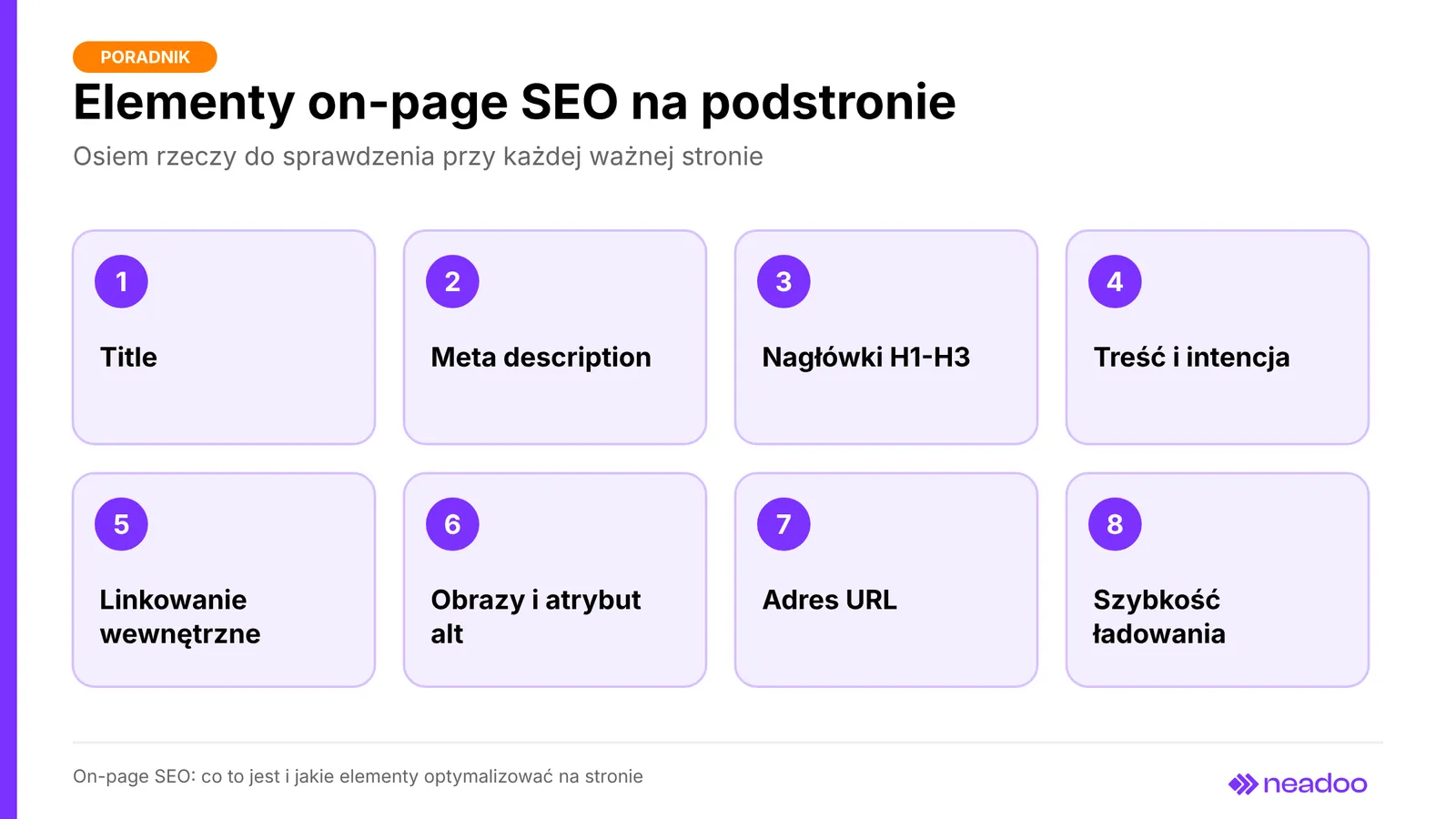
Assign keywords to subpages based on intent. Keyword selection comes down to five decisions:
- When two pages target the same query, merge them or separate their intents; otherwise, you risk keyword cannibalization.
- For a niche or new offering, optimize for the problem the product solves rather than for an unfamiliar name.
- With a limited budget, choose long-tail keywords, as they have lower competition.
- Direct product-related queries to product pages, and problem-related queries to how-to guides.
- Weave secondary keywords in naturally, as keyword stuffing is harmful, and treat metrics from SEO tools (keyword density, number of headings, text length) as guidelines, not rigid rules.
Internal linking and image optimization
Internal linking
Internal linking connects subpages within a single website: it helps search bots discover content and users navigate, organizing site structure while supporting page visibility and user experience. Link from high-value subpages to those you want to boost, use descriptive anchor text, and ensure no important subpage is orphaned - meaning left without any incoming links.
Image optimization
Image optimization involves descriptive file names, modern formats, and compression (for faster page load speeds), as well as the alt attribute describing the graphic's content. Alt text also serves people using screen readers, so write it for humans rather than search queries.
Let's check your website's potential
Share your website and email - we'll get back to you with a real analysis, no strings attached.
Technical Page Elements Key to Crawlers and Users
Technical optimization makes it easier for bots to crawl and for users to navigate the site, and some of its factors are tied to website performance. The easiest way to plan it is in three stages: indexation control, rendering and performance, and structured data. Googlebot fetches and renders pages using a Chromium-based browser, so it sees a page similar to what a user sees, although rendering does not mean understanding content like a human does. Technical errors and poor performance can hinder crawling, and on large websites, they affect how often bots revisit the site.
Indexing and Crawl Budget
In robots.txt, block unnecessary subpages, remembering that this file controls crawling rather than removing URLs from the index. Add a sitemap.xml, specify the primary version via rel=canonical, and use friendly URLs that are readable and describe the subpage content. Crawl budget matters primarily for large or frequently updated sites (according to Google, from about one million pages or 10,000 pages changing daily), so it is rarely a bottleneck on a small website.
Rendering, Performance, and Core Web Vitals
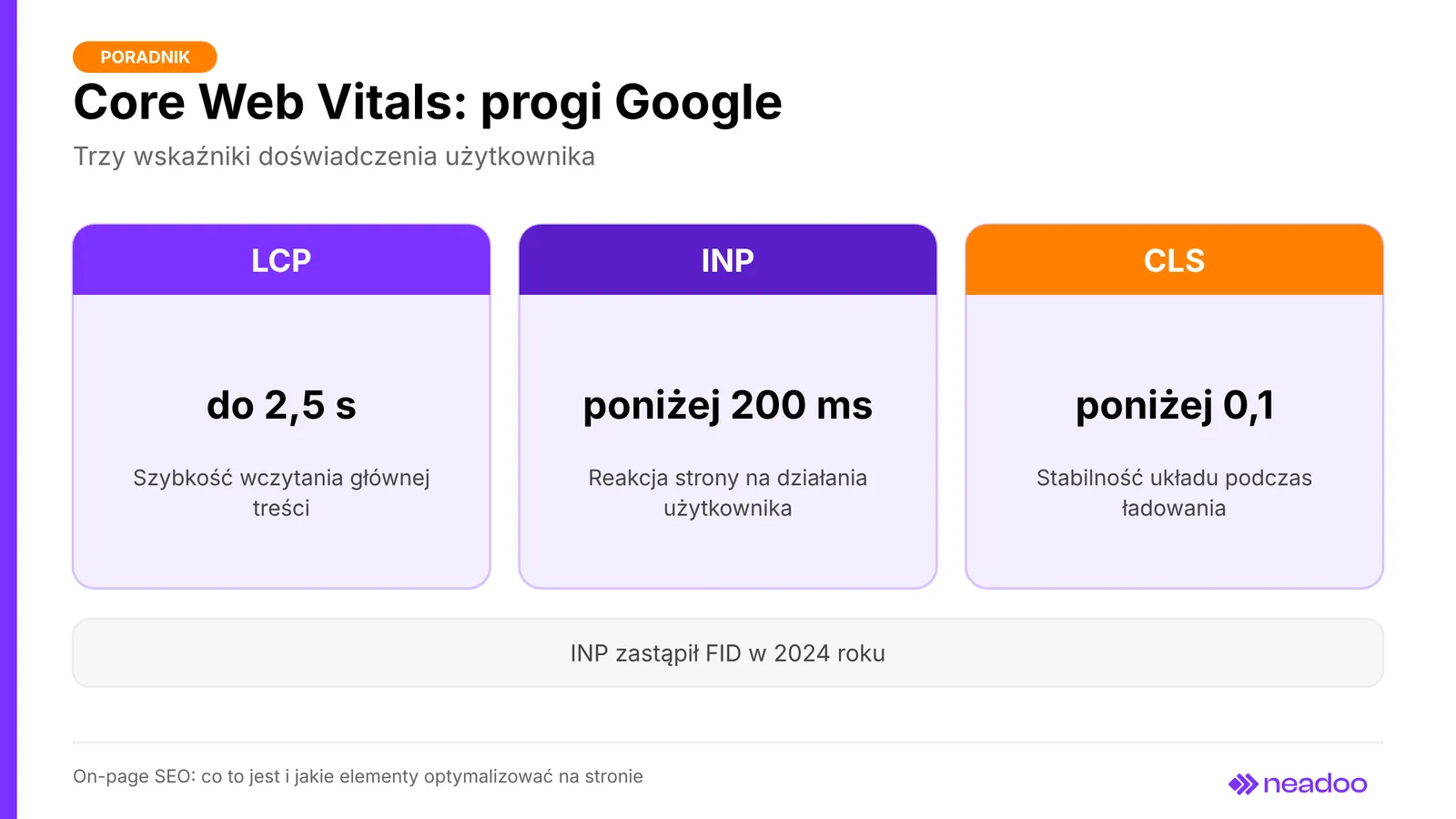
Page load speed depends on code, image compression, and the hosting server. Core Web Vitals are Google thresholds for user experience: LCP up to 2.5 s, INP under 200 ms (which replaced FID in 2024), and CLS under 0.1. Mobile-First Indexing means Google primarily evaluates the mobile version, and the simplest way to get it right is responsive web design, clear navigation menus, and consistent internal links.
Structured Data
You can implement Schema.org using JSON-LD, Microdata, or RDFa. Structured data makes content interpretation easier and can qualify a page for rich results, though it does not guarantee their appearance. Some tasks, like schema.org, canonical tags, and sitemaps, are made easier with the Yoast SEO plugin.
Traditional On-Page SEO vs. Optimization for Generative Engines
Modern on-site SEO combines classic search optimization with structuring content into concise knowledge blocks that AI Overviews and Perplexity can read and summarize. Appearing in Google Search AI features does not require separate file formats or AI tags: standard indexing rules, usability (SXO), and semantic content structure still apply.
| Area | Traditional Website Optimization | GEO and AI UX |
|---|---|---|
| Goal | High rankings and clicks | Website citation and summarization in AI responses |
| Unit of work | The page and primary keyword | A single answer block |
| Structure | H1-H3 hierarchy for web crawlers | Logical layout for easy summarization |
| Technical | Indexing, rendering, structured data | Same requirements, no special tag |
| Main risk | Thin content | Content too generic to cite |
Generative Engine Optimization (GEO) involves editing credible, expert definition snippets that language models can interpret accurately. AI UX is an approach to page layout rather than an official Google standard. Google has not confirmed any technique that guarantees citations, so the core of any strategy remains creating valuable content that answers user questions.
How to Check and Measure On-Page SEO Effectiveness
Start with an audit of your website in Google Search Console: the Performance report shows search queries, clicks, impressions, and the average position of your page in search results, while the Page Indexing report highlights technical issues. A crawler audit (e.g., with Screaming Frog) detects duplicate titles, missing H1 headings, and broken links, while PageSpeed Insights measures Core Web Vitals.
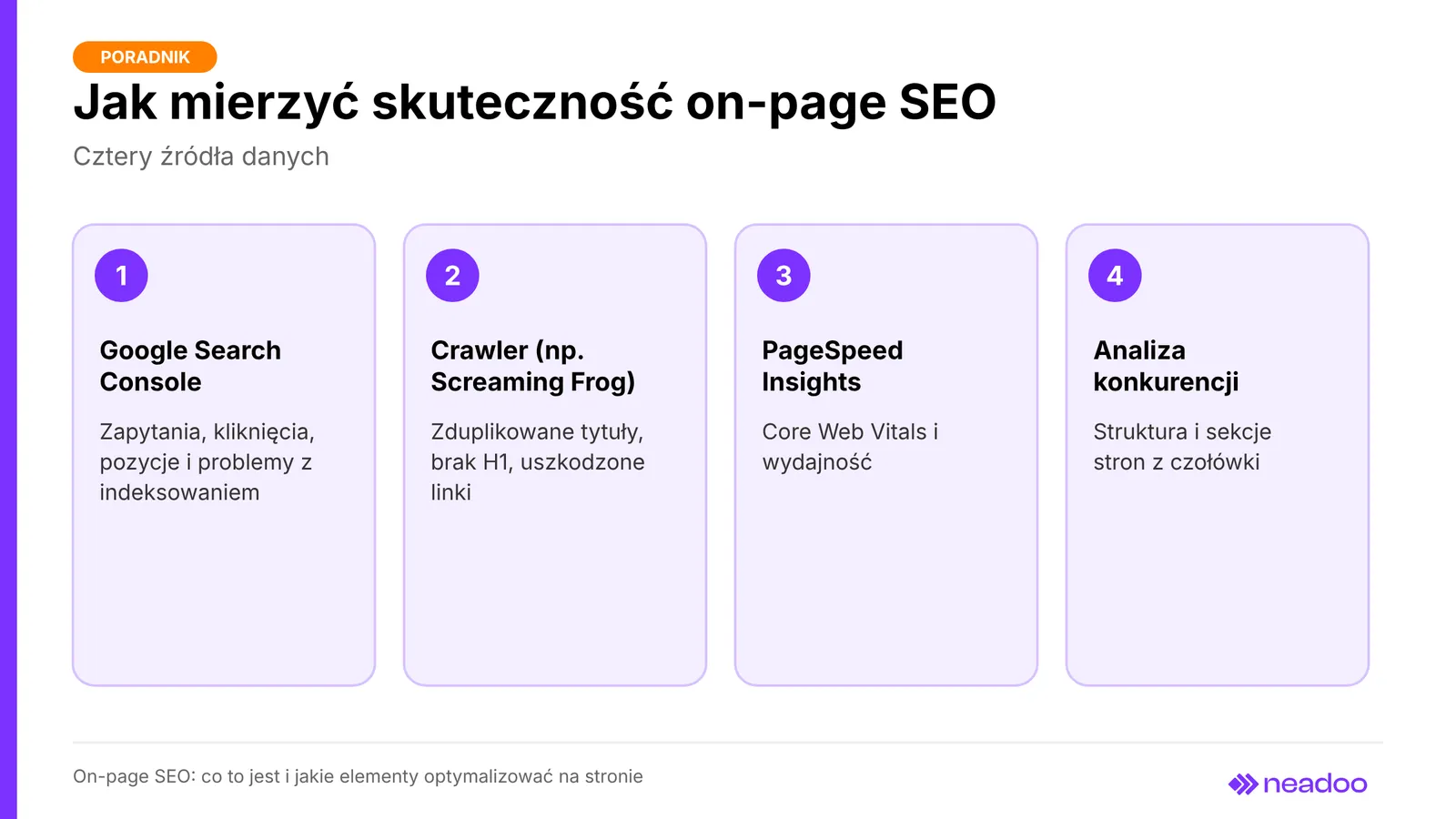
On top of that comes competitor analysis: check the structure and sections used by the top-ranking pages for your target keyword, and fill in what is missing on your site. Track changes over time, as the results of on-page improvements become visible after weeks, not days.
FAQ
What Is On-Page SEO (On-Site SEO)?
It is the optimization of elements within your own website: content, metadata, headings, internal linking, images, and technical parameters. The terms on-site SEO and onsite SEO mean the exact same thing.
What Are the Most Important On-Page SEO Elements on a Single Subpage?
The essentials include: a single primary keyword aligned with user intent, a unique page title tag and meta description, logical H1-H3 headings, valuable content, internal linking, and a clean URL. In addition, you need optimized images with alt attributes, fast page load speeds, and proper rendering on mobile devices.
How Does On-Page SEO Differ from Technical SEO?
On-page SEO encompasses everything you optimize within your website, including content, metadata, headings, and linking. Technical SEO is a subset focused on website performance and infrastructure: indexing, speed, rendering, and structured data. Some sources categorize it as a separate area, so the boundary can be fluid.
How Often Should You Update On-Page SEO Elements?
There is no single fixed schedule. It is sensible to review key subpages periodically, for instance every few months, as well as after ranking drops in search results, changes in your product or service offering, or Google algorithm updates. Content where data quickly becomes outdated (prices, statistics) should be refreshed more frequently.