
How We Managed to Increase Organic Traffic by 347% in One Year
The main protagonist of this case study is a project run by a group of experts. Its goal is to provide reliable, comprehensive, and helpful guides/reviews about home weather stations and any related accessories available on the market. Their mission is to help people choose the best weather tools for their individual needs. The target audience is not just weather enthusiasts - they want to help businesses, farmers, and various other individuals who use home weather stations. The client's business model is based on affiliate marketing. This means a partnership between a seller (advertiser) and a partner - affiliate (in this case, our client), who acts as an intermediary in selling a given product. By creating a new distribution channel for the seller of these products through the partner, the affiliate accepts compensation for the sale of the given product.
How did our cooperation come about?
The client asked us for help at the beginning of August 2018. After initial analyses, we noticed that the client's specialization was quite niche, while the content on the website was quite rich and exhaustive. However, this was not enough for the website's visibility to be satisfactory. Therefore, we started by planning a strategy for the coming months. We presented it to our client, who, without a shadow of a doubt, decided to entrust us with the SEO campaign. The main goal we set together was a significant increase in organic traffic to the client's website.
Game on: technical details.
1. Redirects
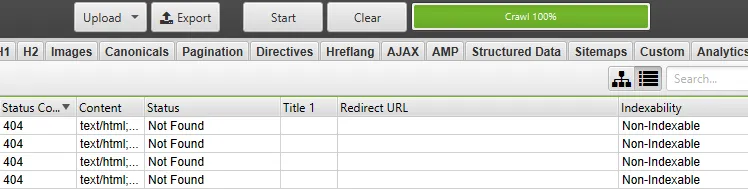
Navigation using internal redirects is detrimental both to the user experience and to optimizing how search engine bots crawl the website structure. This has a negative impact on indexing time and the evaluation of a given subpage. We removed unnecessary redirects from the client's website, which not only improved the site's usability, but also had a positive impact on the crawl budget and its utilization.

Tip
For this type of analysis, you should use a dedicated tool whose behavior mimics a user: it should check every page of the website, following every link it finds. This allows you to identify all technical issues on the site related to error pages. Examples of such tools include ScreamingFrog, SiteBulb, and DeepCrawl. For a basic analysis of a small website (up to 500 URLs), the free version of ScreamingFrog will be a solid solution.
2. URL Structure
The existing URL design was modified to create a new, more optimal structure for subpages and categories. At the beginning of the optimization process, transitional category pages contained a noindex tag, resulting in an incomplete, and therefore unnatural, site tree structure in the Google index. So we decided to create a subfolder structure and allow search engines to freely index these URLs. We prepared content describing these categories appropriately. This subpage optimization significantly increased their value for both users and search engine bots. Meanwhile, we suggested that the client create additional topical articles. For this type of website, it is important that the topics covered in the articles are truly helpful to potential readers/future buyers. A niche market creates powerful opportunities, but it also introduces limitations that must be taken into account. In this case, there is always a risk of describing a topic too broadly (e.g., "weather stations"), which is not far from keyword cannibalization. Taking into account all the factors mentioned above, we were well on our way to creating a search engine-friendly website structure that would allow the site to reach its maximum potential.
3. External Linking / Backlinks
One of the elements that negatively affected our client's website visibility in search results was toxic links pointing to their site. According to all research and analysis, backlinks are one of the most important ranking factors in Google's algorithm. That is why we paid special attention to this area. Spam comments and low-quality sites could have led to an algorithmic penalty. We began the recovery process by "disavowing" low-quality links by submitting their list via the Disavow Tool, which in a relatively short time led to a noticeable increase in organic traffic. In addition, our outreach team continuously acquired valuable links from sites related to the client's niche.
4. Internal Linking
We noticed that the client's website had many articles, reviews, and guides closely related to each other, so we decided to leverage this in the campaign. Therefore, we suggested that related subpages should link to each other. Not only does this strengthen and improve internal linking, but it is also a convenience for site visitors. A user reading an article on a given topic can now go directly from within the text to a product review related to the topic they just read about.
5. Internal Duplicate Content
Properly evaluating websites with duplicate content presents a significant hurdle for Google. Duplicates themselves always have a negative impact on how search engine bots assess a site.
Unfortunately, we detected duplicate content across different pages of the client's website. Similar subpages on a single site were competing with each other for the same word
key. Due to the "Panda" algorithm, we were forced to address this issue to avoid a drop in reach within organic search results. We merged some of the smaller articles, using their content to create a more comprehensive piece. In doing so, we created a rich source of knowledge and information gathered in one place for potential customers. At the same time, removing internal duplicates stopped the dilution of content value across multiple subpages. Reducing the number of duplicates also helps Google crawlers understand the meaning of each subpage, curbing keyword cannibalization.6. Improving Content for UX
Some articles on the site were presented in a way that made reading difficult. The content itself was valuable, unique, and interesting, but it was a wall of text, making it difficult for the reader to navigate and find what they were looking for. We fixed this by dividing the text into sections that were internally linked with sticky navigation via a header or sidebar that follows the user.

TipIn the case of WordPress - make sure you have the right Hx heading structure and use one of the plugins to generate a table of contents. This will allow you to easily organize the structure of your post. This kind of navigation can also be implemented manually using anchors and assigning appropriate IDs to paragraphs:https://example.com/product-review<a href=”https://example.com/product-review#name”>Product name review``<h3 id=”name”>Product name``
7. Rich Snippets and Microdata
On the client's website, we used a structured data markup schema (schema.org), which allows the search engine to better understand the meaning of its content. The structured data markup schema also provided greater visibility in search results through rich snippets. In addition to elements like the page title or description, rich snippets can include tags such as user ratings, images, author information, etc. Displaying them is significantly supported by microdata, and using it makes the service stand out perfectly in organic search results, which considerably improves the click-through rate (CTR), and - combined with overall site optimization - reduces the bounce rate. That is exactly what happened with our client.
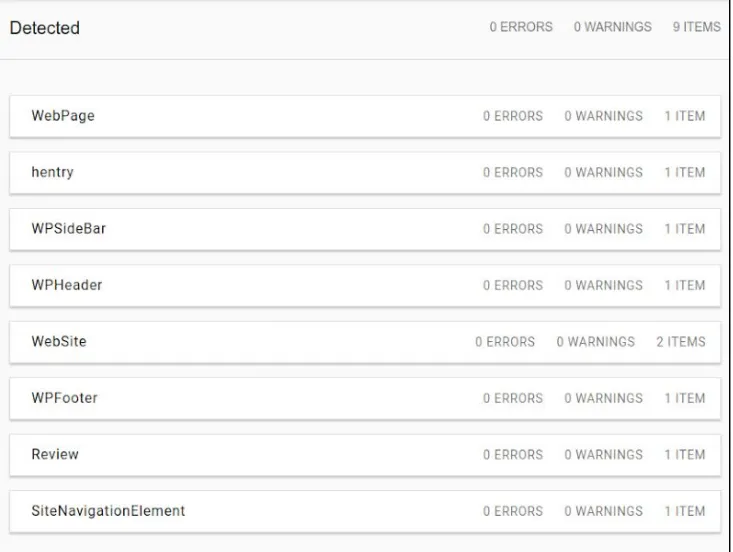
Structured data is basically a summary of what the user can expect from the content on a given page. Remember, however, never to introduce inaccurate information this way, nor data that is not covered by the content of your site. Such a violation could even result in a manual penalty imposed by Google.
TipYou can check the validity of microdata using a dedicated Google tool. Take advantage of this opportunity to eliminate any warnings, but above all, make sure you eliminate every errorhttps://search.google.com/structured-data/testing-tool/u/0/
Results - Over 300% of the Baseline in 6 Months
The actions taken, after thorough reindexing and recalculation by the search engine, brought very good results.
a) 380% More Keywords in TOP10
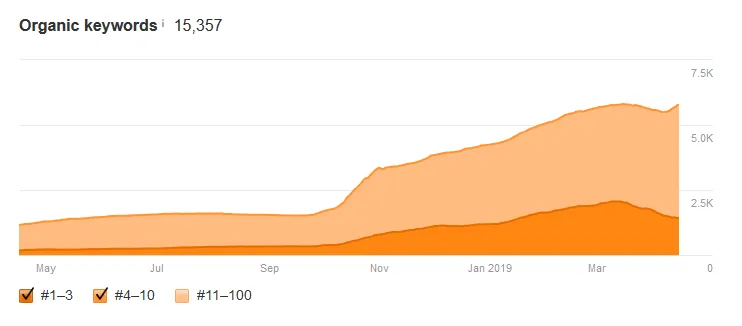
During our work, the number of organic keywords in the top 10, according to Ahrefs, increased from 1,230 to 4,663. This represents an overall increase of 380%.
That is more than three times the initial organic traffic!Our team's optimization efforts meant that after six months, monthly website traffic increased more than threefold:
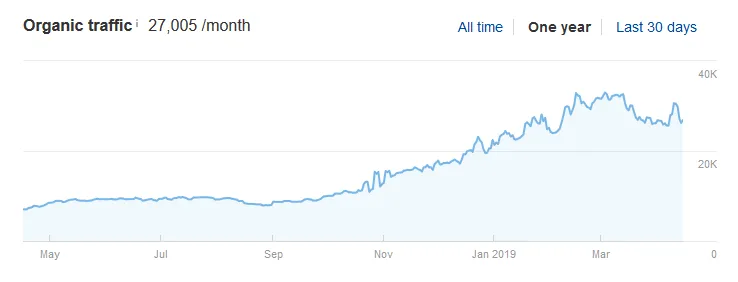
Of course, that is according to Ahrefs - and we all know that its forecasts tend to be very optimistic. What do Google Search Console and Google Analytics have to say about this?
b) 388% More Impressions According to GSC
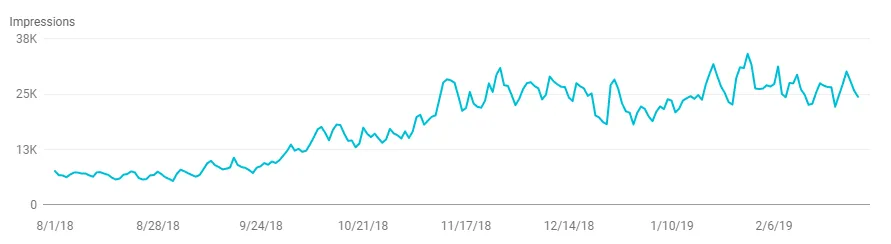
Google Search Console clearly shows: there was a noticeable increase in impressions. In February 2018, we had about 190k impressions - now that number exceeds 738k. That is an increase of 388%!
c) 325% more clicks according to Google Search Console
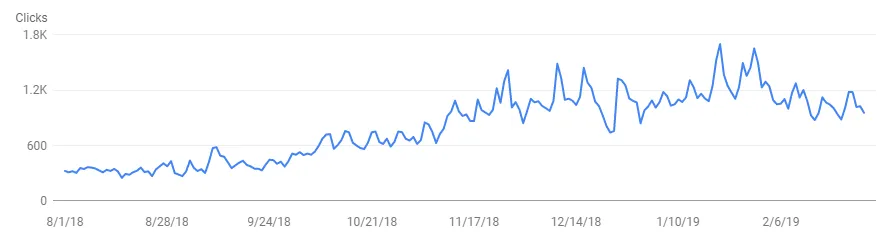
And how does the situation look with clicks? Actually, it looks great! Comparing February (9.26k clicks) to September (over 30k clicks), one thing is clear: there was a noticeable increase in clicks - by about 325%!
d) 3.5 times more organic traffic in 6 months
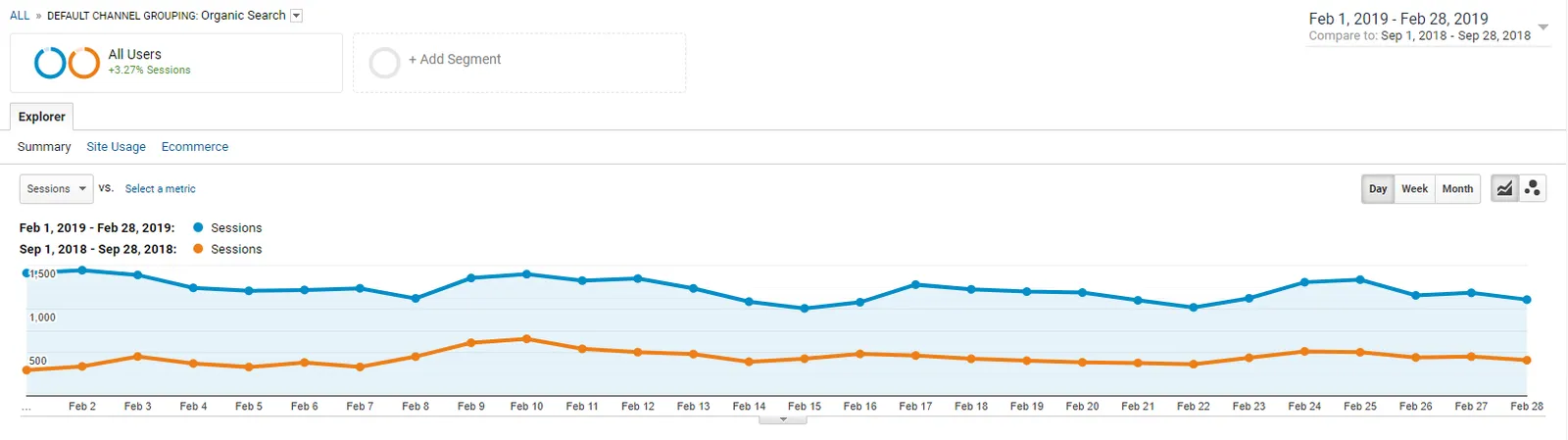
Now it is time to visit Google Analytics and see how things look when it comes to organic traffic. We compared two periods: August (9,896 visits) and February (32,326 visits). The numbers speak for themselves. However, to save you the mental math, we are proud to state: We increased organic traffic by about 350% in 6 months!
Let's check your website's potential
Share your website and email - we'll get back to you with a real analysis, no strings attached.
A conclusion with a happy ending
To sum up: it can be done! Working closely with the client, we managed to achieve incredible results that exceeded all expectations. After all, we are talking about increasing all relevant variables by 300-350% in 6 months!!! Either way, this is just one example of how Neadoo's work with a client delivers such results, so you can expect similar (and even more impressive!) examples from us in the future.
Will there be more case studies?
Of course! After all, practice is the best instructor of all. For this reason, we will continue creating this type of content for you.
Are we happy with ourselves?
Yes, but we try not to rest on our laurels. We continue our work, believing that in the near future we will be able to deliver even better results. If you want us to give you an update on this case - let us know in the comments!
Are we bragging?
Yes, probably... But admit it - we did great! And that is not all - we can achieve similar results for you! Contact us, and we will take a look at your website, analyze it, and tell you what results you can realistically expect! Thank you for reading our case study. If you have any questions - do not hesitate to ask them in a comment or write to us at: [email protected]. Do not forget to check out our profiles:
TL;DR:
- plan ahead and thoroughly think through your website structure - avoid keyword cannibalization and internal duplicates,
- block all low-quality subpages - make sure Google indexes only the most valuable and helpful pages - be strict, it is better to have 20 truly valuable subpages than 80 mediocre ones,
- make sure your articles are properly formatted - leverage the potential of microdata (AggregateRating) and, for longer articles, make sure you have a table of contents and internal links to sections.