
Meta Description - How to Write a Snippet That Increases CTR
A meta description is a short description of a page placed in the HTML code that a search engine may display below the title in search results. It does not affect a page's ranking, but it does influence whether someone clicks on the result. There is a catch, however: Google displays it less often than it seems. In 2020 studies, it replaced the meta description with its own snippet in 62.78% of results (Ahrefs) and in 68-71% (Portent).
That is why in this article we do not stop at a list of rules. We show when Google keeps your description, what meta description A/B tests have revealed, and how to check in Search Console whether a new description actually improved CTR. State of knowledge: October 2026.
What is a meta description?
A meta description is a tag in the <head> section of a page. In HTML code, it looks like this:
<meta name="description" content="Shoes with foam cushioning, weight 240 g, drop 8 mm. Check available sizes and 24 h delivery.">
The text from the content attribute is a suggested description to appear in Google search results under the title. A suggestion, because according to Google's documentation, a search result snippet is primarily generated from page content, and the meta description is used when it describes what the page is about better than a content snippet. The same subpage can receive a different description for different user queries.
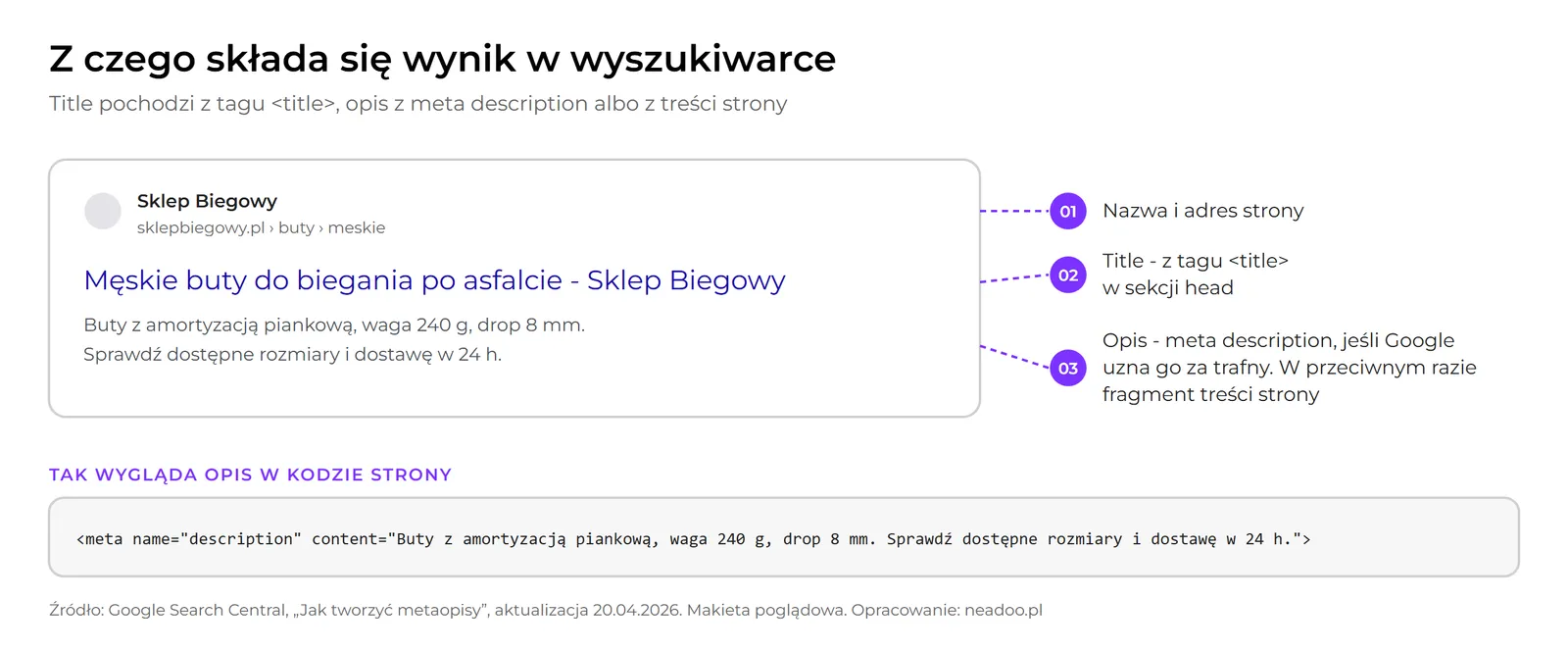
Fig. 1. What a search engine result consists of. Illustrative mockup based on Google documentation. Source: neadoo.pl
Meta title vs. meta description
Both tags are meta tags, but they work differently. The title (<title>) is the result's heading and the tab name in the browser. The meta description is the text underneath designed to encourage a click. A good description expands on the title rather than repeating it: since the title explains what the page is about, the description details what the user will find there.
Does the meta description affect search rankings?
Not in Google. The position has been consistent for years. In 2009, Google wrote on its blog that it does not use the meta description in ranking (Google Search Central Blog, Sep 21, 2009), and in 2020, John Mueller confirmed that descriptions serve for snippets but are not used to determine rankings. Therefore, the meta description is not a ranking factor, and keyword stuffing in it will not improve anything.
Bing takes a different view. Its webmaster guidelines state that missing, duplicate, or overly short titles and meta descriptions can harm indexing reliability, rankings, and the likelihood of being cited in AI-generated answers. If you care about traffic from Bing and Copilot, a missing description is not inconsequential.
In Google, a meta description works solely through CTR (click-through rate), which is the percentage of impressions that result in a click. At the same ranking position, a description that better matches a query can generate more traffic. However, it will not make up for low rankings.
Why does Google rewrite descriptions and how to limit it?
The two description rewrite studies we came across date back to 2020. We have not found newer ones, so treat the numbers as approximations.
| Study | Sample size | Share of descriptions rewritten by Google |
|---|---|---|
| Ahrefs, 10/9/2020 | 20,000 keywords, desktop | 62.78% |
| Portent, 9/10/2020 | about 30,000 keywords | 68% desktop, 71% mobile |
Both are measurements by SEO industry companies (Ahrefs is a tool provider, Portent is an agency), based on English-language data.
Fig. 2. How often Google replaces the meta description. Sources: Ahrefs, Portent, 2020. Prepared by: neadoo.pl
Three practical takeaways emerge from these data points:
- Length has little bearing on rewrites. In the Ahrefs study, descriptions that were too long were replaced in 61.46% of cases, while the rest were replaced in 63.69%. Shortening a description will not make Google display it.
- Write the description for the primary query. In Ahrefs' data, high-volume keywords had their description rewritten in 59.65% of results, while long-tail keywords saw rewrites in 65.62%. Portent also noted that the higher the query volume, the less frequently Google swaps the description. For long-tail queries, Google will pull an excerpt from the content anyway.
- The reasons for rewrites can be limited. According to reports of John Mueller's statements (Search Engine Journal, 2020), Google replaces a description when it is a clump of keywords, when the identical description appears across multiple pages, or when it does not match the query while another section of the page does. Mueller also noted that there is no way to force your own description 100% of the time.
Let's check your website's potential
Share your website and email - we'll get back to you with a real analysis, no strings attached.
Does a good meta description increase CTR? Test results
Top Polish guides answer this question with a simple "yes," without providing a single number. We found four tests with published methodologies. Each covers a single website and measures something slightly different.
| Test | What was changed | Result |
|---|---|---|
| Semrush SplitSignal, March 24, 2023 | about 15,000 product pages of a music store: CTA-focused descriptions replaced with product-focused descriptions | +2.2% clicks, statistically significant result (95%) |
| SearchPilot, December 7, 2023 | online store: removed overly long descriptions on category listing pages | +4.2% sessions, not significant at 95%, positive at 90% |
| Seer Interactive, September 27, 2023 | 237 blog pages: human-written descriptions, ChatGPT-4 descriptions, empty descriptions | CTR: human-written +16.26%, no description (benchmark group) +10.55%, ChatGPT-4 -21.48% |
| SearchPilot, November 19, 2020 | location pages: data-nosnippet forced Google to show the meta description instead of page content snippets |
-3% organic traffic, statistically significant result |
All results come from testing tool providers and agencies. The authors of the Seer test point out themselves that many variables were at play in their experiment.
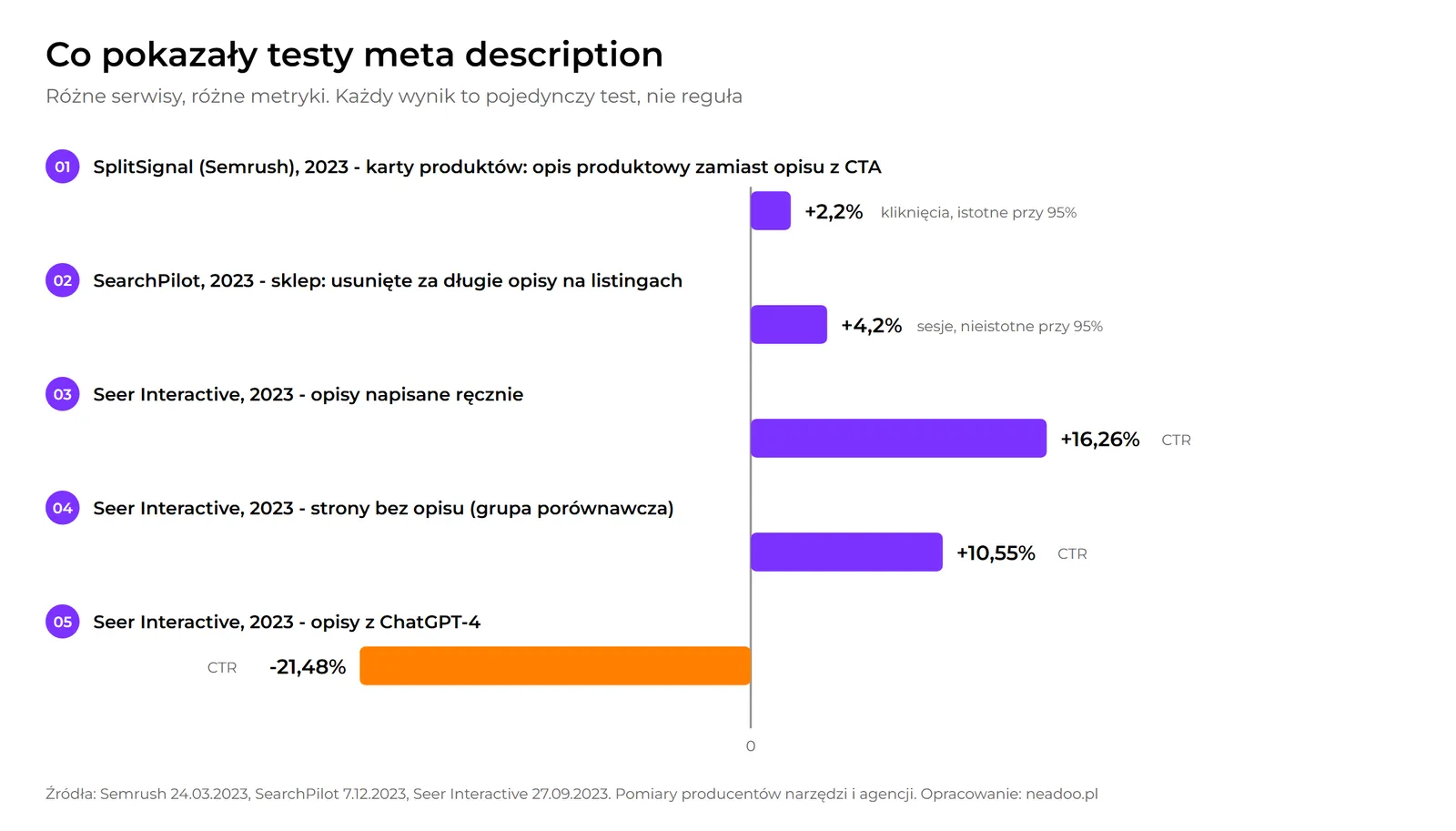
Fig. 3. What meta description tests showed. Sources: Semrush, SearchPilot, Seer Interactive, 2023. Prepared by: neadoo.pl
In our view, an honest conclusion is this: a well-tailored description delivers an effect of a few percent, while a poorly matched one can cause harm. Three findings are surprising. In SplitSignal, a product-focused description outperformed one with a call to action, and Google displayed it more often. In SearchPilot's 2023 test, removing overly long descriptions - meaning handing snippet selection over to Google - did not hurt traffic. In SearchPilot's 2020 test, forcing custom descriptions decreased traffic by 3%, even though the SEO team considered them good. And at Seer, pages with descriptions from ChatGPT-4 performed worse than pages that had no description at all. A worse description can therefore be worse than none. That is why we measure every major description update (process below).
Meta description length - how many characters?
Google provides no character limit. Its documentation states that a meta description can be of any length, and the snippet is truncated to fit the device's screen width. All figures circulating in guides are tool thresholds or measurements from a specific timeframe.
| Source | Threshold | What it is |
|---|---|---|
| Screaming Frog SEO Spider | too long: over 155 characters or 985 px; too short: under 70 characters or 400 px | default tool filters, can be changed |
| Moz, 03/24/2025 | 120-160 characters | recommendation |
| Portent, 09/10/2020 | desktop: fully around 150-160 characters; mobile: peak at 118 characters, sharp drop after 121 | measurement of displayed descriptions |
Truncation depends on pixel width, not the character count. A description with many wide letters (W, M, uppercase characters) will be cut off sooner than one with narrow letters. This is why plugins like Rank Math measure description length in pixels.
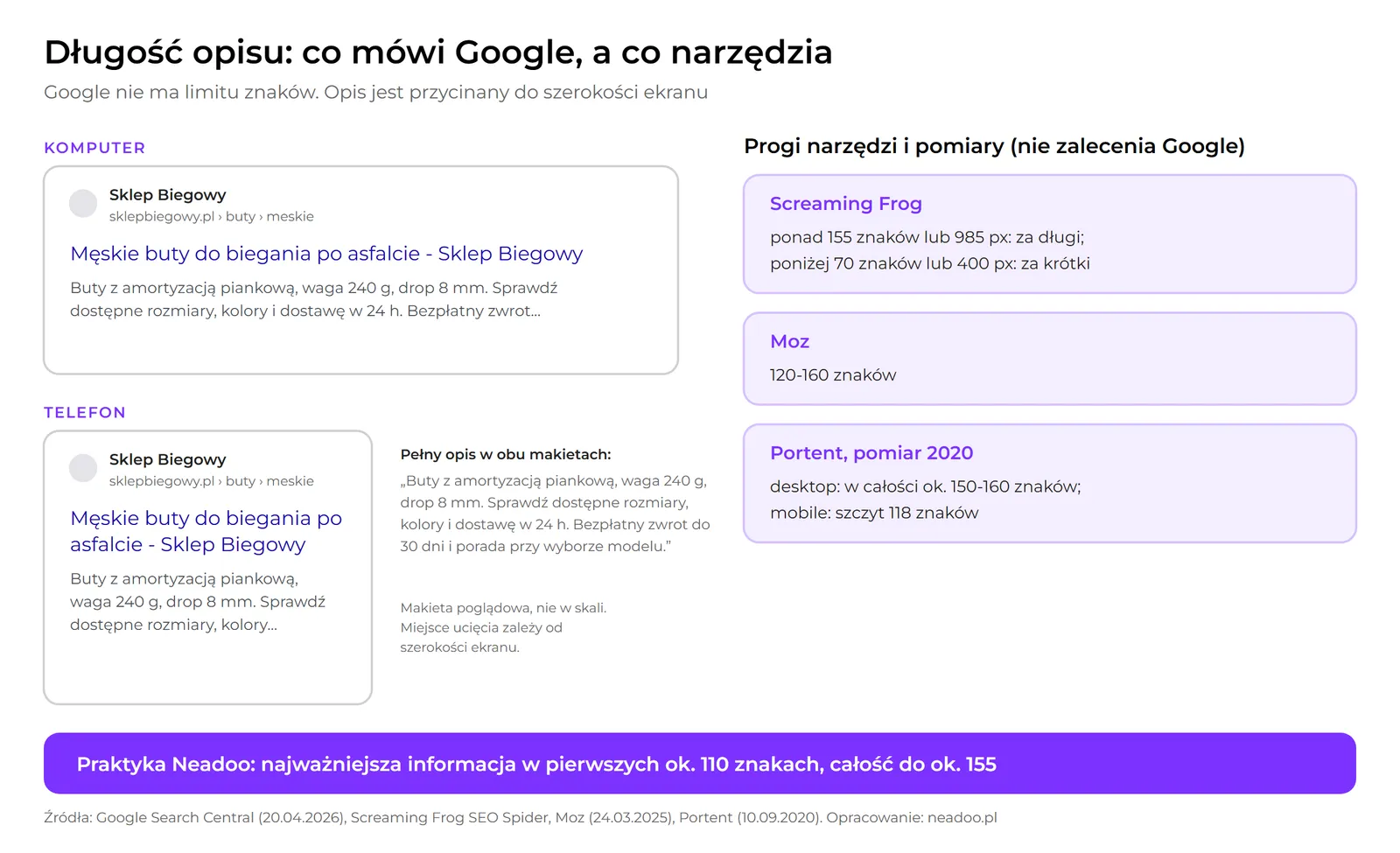
Fig. 4. Description length: Google's stance and tool thresholds. Illustrative mockup. Prepared by: neadoo.pl
In our practice, we follow a simple rule: the most important information in the first ~110 characters, since that is what fit on mobile devices according to Portent's measurements, and the entire text up to ~155 characters. An overly short description is a bigger problem than one that is slightly too long: a few words rarely communicate what the page is about. In the English version of Google's documentation, just "Mechanical pencil" is cited as an example of an overly short description.
How to Write a Meta Description That Increases CTR?
Start with Search Intent
Before writing a description, check what a person typing a given query is looking for. An informational query needs a preview of the answer; a transactional one needs prices, availability, and delivery terms. The SplitSignal test shows this well: on product pages, where the user already knows what they want, a description with product specs won over a generic call to action.
Specific Details That Users Will Find on the Page
In its documentation, Google encourages including specific information about the page in the description: for an article, the author and publication date; for a product, the price, manufacturer, and key specs. Numbers and facts give a reason to click; adjectives ("best," "professional") do not. One caveat: the promise in the description must be backed up by the page content. A description that promises things that are not there attracts clicks that end in a quick bounce back to the search results.
Natural Keyword Placement, Without Keyword Stuffing
Include the keyword once, in a natural sentence. The description is then aligned with the query it is meant to serve, which is one of the conditions for Google to display it. A list of keywords does the opposite: Google explicitly states that such a description is less likely to make it into the snippet, and Mueller lists it among the main reasons for rewriting.
A Unique Description for Every Subpage
Every subpage intended to be visible in search engines needs its own description. Duplicate meta descriptions signal that the description says nothing about the specific page, so Google is more likely to replace it with a text snippet from the content. Also, do not copy the title tag into the description: that is the same information twice and a waste of space.
If you do not have time for all pages, Google advises starting with the homepage and the most popular subpages. Therefore, prioritize describing the homepage, service or category pages, and articles that already get a lot of impressions.
When Does a CTA Make Sense, and When Does It Get in the Way?
A call to action ("Check sizes," "Book a consultation") helps when it tells the user specifically what they will do on the page. It hurts when it takes up space meant for the information they are looking for. "Click and read!" says nothing about the page. "View the size chart and available colors" does. In the SplitSignal test on product pages, the spec-driven description won over the CTA-focused one, so where the decision depends on specifications, provide specifications.
Special Characters and Quotation Marks
A straight quotation mark (") inside the content attribute closes the attribute and truncates the rest of the description at the HTML code level. Inside the description, use typographical quotes (“ ”) or the " entity. Emojis and symbols in the description are allowed, but we have not found a test demonstrating their impact on CTR. If you use them, measure the effect just like any other change.
What Not to Do?
In its documentation, Google provides examples of bad descriptions:
- A description that is too short and does not explain what the page is about,
- A list of keywords instead of complete sentences,
- The exact same description across every page of the website,
- A description that does not summarize the page content, but merely advertises it.
Meta Description - Examples for Different Types of Pages
We prepared the examples below for this article using fictional companies. The numbers in them are part of the example, not actual data.
| Page type | Weak description | Better description | Why |
|---|---|---|---|
| Store homepage | Running Store - homepage. Welcome to our online store. | Running shoes, apparel, and watches from 12 brands. In-store treadmill shoe fitting in Poznan, 24-hour shipping, and 30-day returns. | explains what the store sells and what makes it stand out |
| Store category | Women's running shoes. Buy women's running shoes at the running shoe store. | Women's running shoes for road, trail, and treadmill. Filter by drop, weight, and cushioning; sizes 35-43; 24-hour delivery. | covers product range and selection tools instead of repeating the phrase |
| Product page | Buy running shoes. Best men's sports shoes at a low price. Check out our online shoe store. | Men's road running shoes with foam cushioning. Weight 240 g, 8 mm drop. Check available sizes and order with 24-hour delivery. | specifications match purchase intent |
| Blog post | Blog SEO, SEO blog, how to do blog SEO, WordPress optimization, organic traffic. | How to choose topics, internal linking, and post structure so your business blog drives Google traffic. 9 steps with WordPress examples. | previews specific content without a keyword list |
| Service page | Affordable and reliable accounting Warsaw. Warsaw accounting firm, accounting services, HR and payroll. | Running a business in Warsaw? Accounting, HR, and payroll with a dedicated specialist, monthly reports by the 10th, and 24-hour response time. | a question targets the audience, followed by specific terms |
All the better descriptions stay within 155 characters and place the most important information right at the beginning.
Automatically Generated and AI-Generated Descriptions
For an online store with thousands of products, writing descriptions manually is unrealistic. Google anticipates this: the documentation allows automated description generation for large, database-driven sites, provided the descriptions are readable and diverse. In practice, this means a template with variables, e.g., "{product name} by {brand}. {two key specs}. Price: {price}, delivery in {delivery time}." You can set up templates in plugins (more on that below), and on other e-commerce platforms, usually in the SEO settings for categories and products.
We are cautious with descriptions written by AI models. The only test we found - the previously mentioned Seer test - turned out poorly for them: descriptions from ChatGPT-4 had a 21.48% lower CTR, while manual ones had a 16.26% higher CTR. That is just one test on one blog, but it is enough reason not to roll out AI descriptions en masse without testing. In our process, AI writes the draft, and a human refines the descriptions for the most important pages.
How to Add and Check a Meta Description?
In HTML Code
You place the <meta name="description" content="..."> tag in the head section, one per page. To check the meta description of any page, open it in a browser, right-click, select "View page source" (Ctrl+U), and then search for name="description". Remember that this is the description saved in the page code. You can only verify how the meta description looks in search results within the search engine itself, as Google may display a different description.
In WordPress: Yoast SEO and Rank Math
- Yoast SEO plugin: you will find the description field in the "Google preview" section below the post editor. Description templates for content types are configured in Yoast SEO > Settings > Content types, under the "Search appearance" section, using variables inserted via the "Insert variable" button.
- Rank Math: in the snippet preview, click "Edit Snippet"; the "Description" field is located under the "General" tab. Default values come from the templates in the plugin settings, and the bar below the field shows the length in pixels.
Field names change with plugin updates. We checked these in the Yoast and Rank Math documentation in October 2026.
Across the Entire Website
You can check individual pages manually, but a crawler will find site-wide errors. In its Meta Description tab, Screaming Frog SEO Spider has ready-made filters: missing, duplicate, over 155 characters, below 70 characters, and exceeding 985 px.
Directives: nosnippet, max-snippet, and data-nosnippet
A description can also be restricted or disabled. The rules described in the robots meta tag specification are used for this purpose:
| Rule | How to implement | What it does |
|---|---|---|
nosnippet |
<meta name="robots" content="nosnippet"> in head |
Google does not show a text snippet or video preview. The page is still indexed |
max-snippet:[number] |
<meta name="robots" content="max-snippet:120"> |
Limits snippet length to the specified number of characters; 0 works like nosnippet |
data-nosnippet |
Attribute on span, div, and section elements |
Excludes a given part of the page from the snippet, e.g., a cookie banner or variable price |
Use them sparingly. According to Google documentation, these same rules also restrict the use of content in AI Overviews and AI Mode, so nosnippet strips the page of more than just the description snippet itself. A 2020 test by SearchPilot also showed that using data-nosnippet to force Google to show the page's own description decreased traffic by 3%.
How to measure if a new description increased CTR?
CTR in Google Search Console is the number of clicks divided by the number of impressions (GSC Help, Performance report). A CTR increase alone after changing a description does not prove anything yet, because CTR also fluctuates due to seasonality, rank changes, and new elements in search results. That is why we use a procedure based on the same principle as SplitSignal and SearchPilot tests: we compare changed pages with a control group.
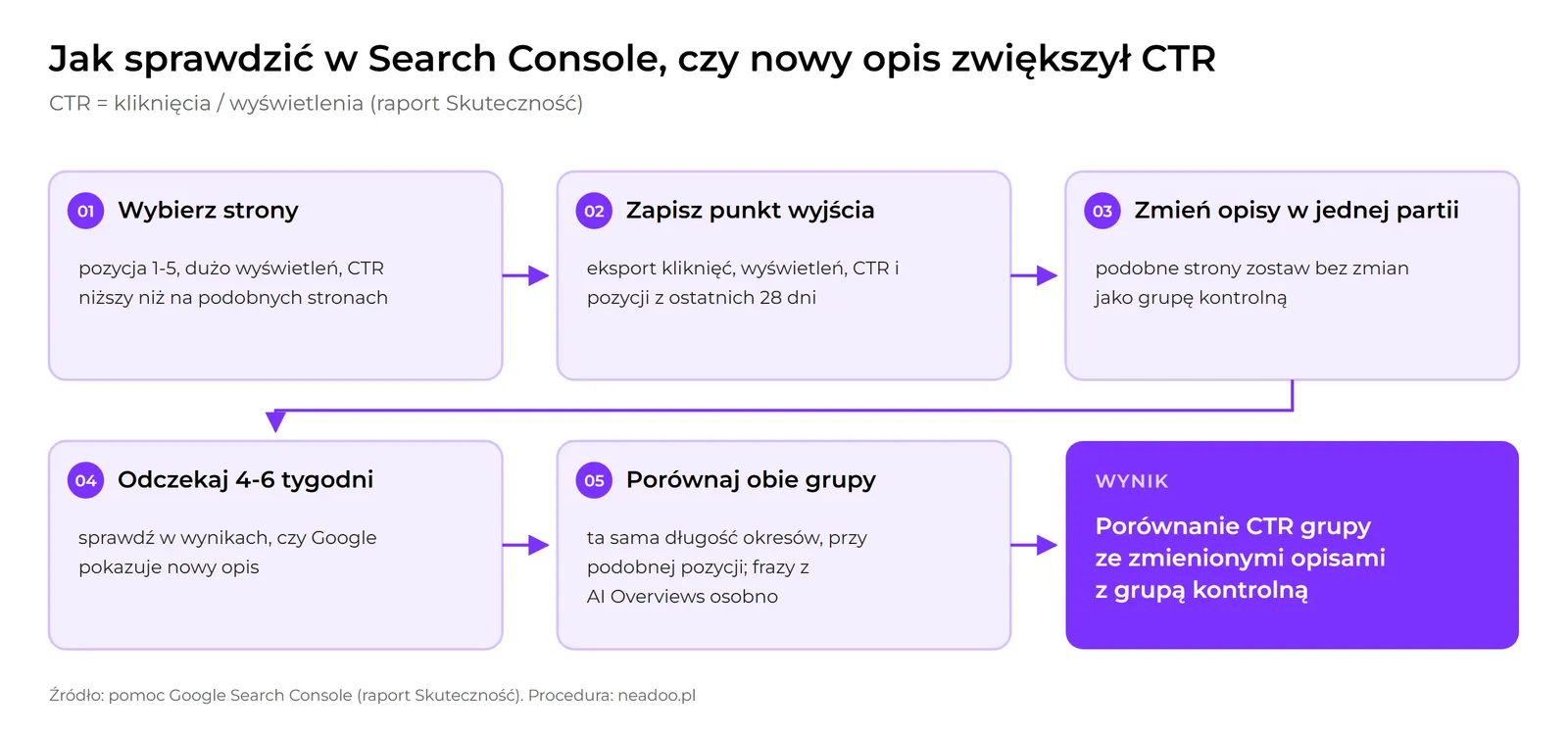
Fig. 5. How to check in Search Console whether a new description increased CTR. Procedure: neadoo.pl
- Select the pages. In the Performance report, with the "Pages" dimension, look for pages in positions 1-5, with a high number of impressions and a CTR lower than on similar pages across the site. This is where improving the description has the greatest chance of making a difference.
- Record the baseline. Export clicks, impressions, CTR, and position from the last 28 days, separately for each page.
- Change the descriptions in a single batch. Similar pages that you leave untouched serve as the control group.
- Wait 4-6 weeks. During this time, check the search results to see whether Google is showing the new description at all. If not, the change could not have affected CTR.
- Compare both groups. Use periods of the same length and pages with similar positions before and after. If the CTR of the changed group increased more than that of the control group, and positions remained unchanged, the description worked.
One note: Google counts impressions from AI Overviews and AI Mode under the "Web" search type, and AI Overviews significantly reduce CTR. On a sample of 300,000 queries, Ahrefs measured that the presence of an AI Overview is associated with a 58% lower position 1 CTR (Ahrefs, Feb 4, 2026, vendor study, correlation). An independent study by Pew Research Center from 2025 showed a click on a result in 8% of visits to pages with an AI summary, compared to 15% without one. Seer Interactive, in turn, reported in April 2026 a CTR rebound for AI Overviews from 1.3% in December 2025 to 2.4% in February 2026. If Google enables an AI Overview for your queries during the test, CTR will drop regardless of the description. Therefore, analyze queries with and without AI Overviews separately.
Meta descriptions vs. AI Overviews and Copilot
Google states in its documentation on AI features that a page does not need any additional technical efforts to appear in AI Overviews or AI Mode. It is enough for it to be indexed and eligible to be shown with a snippet. The documentation does not mention meta descriptions at all, so we do not claim that the description affects AI Overviews.
It is different in Bing, which explicitly connects title and meta description with the chances of being cited in AI-generated answers in its guidelines. If you want to take care of how your company appears in Copilot and other assistants, the description is one of the elements, but not the only one. We handle this as part of our AI search visibility service.
If you prefer someone to review descriptions across your entire site and measure the effect of the changes, we do this as part of our SEO services.
Frequently asked questions about meta descriptions
1. How many characters should a meta description be?
Google does not specify a limit; it truncates the description to fit the screen width. Tools typically recommend around 155 characters (Screaming Frog) or 120-160 characters (Moz). Fit the most important information within the first roughly 110 characters so that it remains visible on mobile as well.
2. Does the meta description affect SEO?
Not in Google, which the company has confirmed since 2009. It affects CTR, meaning the number of clicks at a given position. Bing states in its guidelines that a missing or duplicate description can lower rankings.
3. Why is Google not displaying my meta description?
Because it decided that another snippet from the page better answers the query. The most common reasons are a description that is just a list of keywords, the same description used across multiple pages, or a description that does not match the search query. In 2020 studies, Google replaced the description in 62.78-71% of results.
4. Is a missing meta description an error?
It is a lack of control, not a technical error. A page without a description will still be indexed, and Google will select a snippet from the content. In a 2023 SearchPilot test, removing overly long descriptions did not harm traffic, and at Seer, pages with descriptions generated by ChatGPT-4 performed worse than pages without any description. However, a well-thought-out, unique description gives you a chance to display your own messaging for the primary query.
5. Can you write meta descriptions with AI?
You can, but monitor the results. In the only test known to us (Seer Interactive, 2023), descriptions generated by ChatGPT-4 had a 21.48% lower CTR, while human-written ones had a 16.26% higher CTR. For large e-commerce stores, templates with variables, which Google explicitly allows, work better.
6. How do you check any page's meta description?
View the page source (Ctrl+U) and search for name="description". For an entire website, use a crawler like Screaming Frog, which will highlight missing, duplicate, and overly long descriptions.
7. What is a good CTR?
There is no single benchmark. CTR depends primarily on position, query type, and whether an AI Overview appears above the results. In Backlinko's (Semrush) analysis of roughly 4 million results, the average CTR for the first position was 27.6%, while Ahrefs measured a position 1 CTR of 1.6% for queries with an AI Overview in December 2025. Instead of comparing yourself to a general average, compare a page's CTR with similar pages on your own site and with your own metrics prior to the change.