
DeepSeek: What It Is, How the Chinese AI Model Works, and Why It Shook the Tech Market
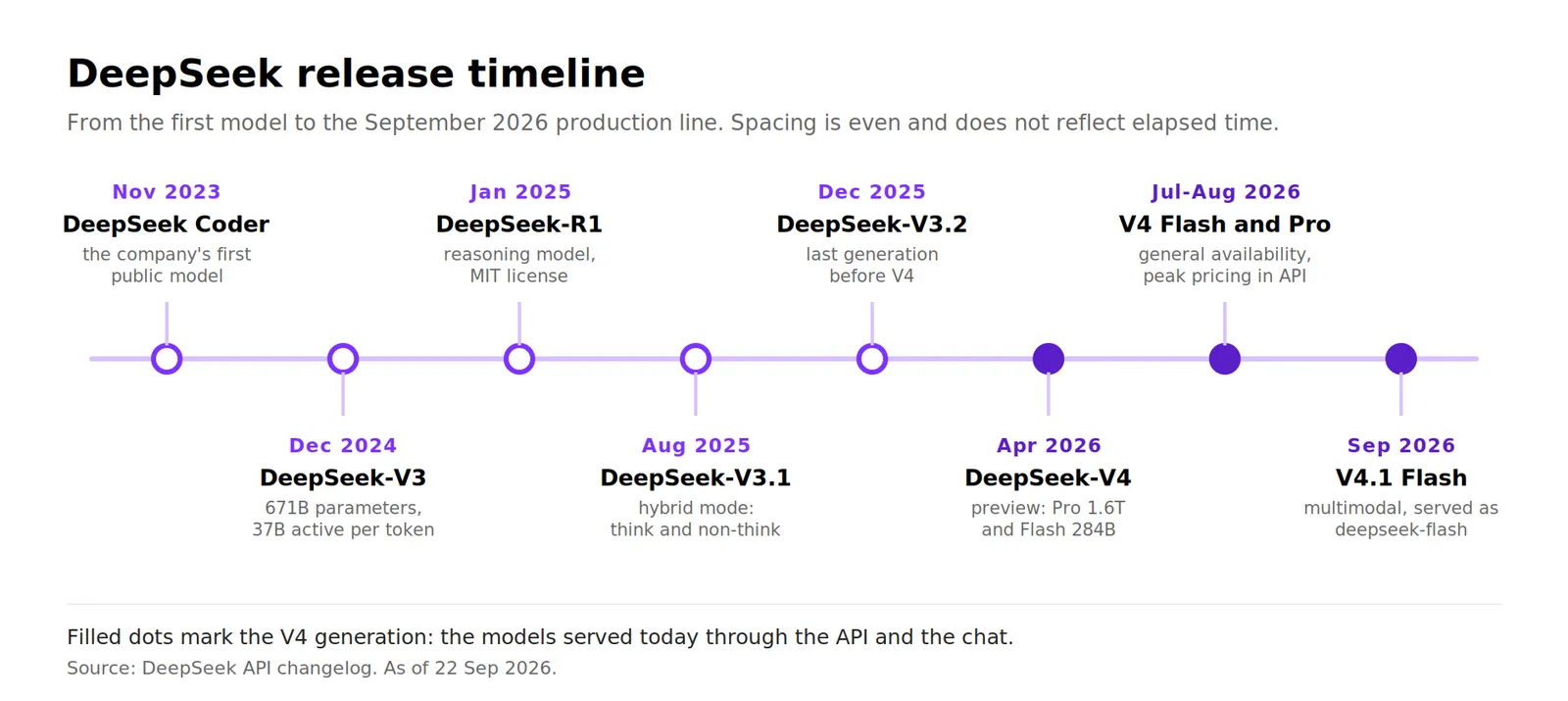
DeepSeek is a Chinese AI model utilizing a Mixture-of-Experts architecture, which activates a fraction of its parameters for each token. It is developed by a research company based in Hangzhou, founded in 2023 and funded by the High-Flyer hedge fund. The models are released under the MIT license, with weights available for download, and can be accessed via a web chat, a mobile app, and an API. It was precisely the economics of its training that built the brand's renown: DeepSeek priced the reinforcement learning phase for the R1 model (January 2025) at $294,000, and the base V3 model at approximately $5.6 million, while achieving results on par with OpenAI's o1 model in mathematics and programming.
The product line is currently led by the V4 generation, released on April 24, 2026: V4-Pro (1.6 trillion parameters, 49 billion active per token) and the smaller V4-Flash, replaced on September 10, 2026, by the multimodal V4.1-Flash. Both variants support a context window of one million tokens. The chat works in Polish and is free of charge, and the weights can be run locally, offline, without sending data to the cloud. Two things spoil this picture: the official interface censors topics politically sensitive to Beijing, and the Italian Garante has prohibited the processing of Italians' personal data by the platform since January 2025.
What DeepSeek Is and Why It Gained Global Renown
DeepSeek is a large language model (LLM) and an entire family of models developed by a Chinese AI research company. The model operates on an open-weights basis: the weights are publicly available for download, modification, and local deployment. Its global renown stems from three factors: radically lower training costs than those of Western giants, performance competitive with GPT or Gemini, and the decision to open the weights under the MIT license. This last point distinguishes the Chinese AI chatbot from the closed ecosystems of OpenAI and Google.
Project Origins: Liang Wenfeng and the High-Flyer Fund
DeepSeek AI was spun off in July 2023 in Hangzhou (Zhejiang province) from the Chinese quantitative hedge fund High-Flyer. The fund specializes in algorithmic trading and had been purchasing GPU infrastructure for trading purposes for years. This hardware foundation became the backend for training AI models. Both entities are led by Liang Wenfeng, an engineer and entrepreneur who founded High-Flyer before the era of large language models and later redirected part of the fund's computing power toward AI research. The company released its first public model, DeepSeek Coder, in November 2023.
The capital came from hedging operations, not from venture capital or government subsidies. This is a rarity in the industry. It partly explains why the team was able to experiment without pressure from external investors and without quarterly accountability for performance.
Wall Street Shock: Impact on the Valuation of Nvidia and Tech Companies
On Monday, January 27, 2025, Nvidia's stock plummeted by 16.97 percent, closing at $118.42. A staggering $589 billion evaporated from the company's valuation, which remains the largest single-day market capitalization loss in US stock market history. The Nasdaq Composite fell by 3.1 percent that day, the S&P 500 by about 1.5 percent, and Broadcom by nearly 19 percent.
The sell-off had a specific trigger. A week earlier, on January 20, DeepSeek published the R1 model, and over the weekend its app surpassed ChatGPT on the top free apps chart in the US App Store. Investors juxtaposed this with the reported training cost of under $6 million on downgraded H800 chips and concluded that American corporations were overpaying for AI infrastructure.
That conclusion proved premature. The very next day, Nvidia shares rebounded by nearly 9 percent, and analysts at JPMorgan and Citi pointed out that the declared figure covered only the training run itself, excluding prior experiments, data, and infrastructure. By mid-2026, Nvidia's share price was approximately 48 percent higher than on the day of the R1 launch, and the company closed fiscal year 2026 with a record revenue of $215.9 billion. In our view, the January sell-off was a correction of expectations regarding model training costs rather than the demand for GPUs, and that is how it should be interpreted in market analyses today.
Engineering breakthrough: why DeepSeek was so cheap to train
The figures in this section refer to the V3 and R1 generations from the turn of 2024 and 2025 - the models that caused all the commotion. Training DeepSeek-V3 consumed about 2.788 million H800 GPU hours, which translates to just under two months of continuous operation on a cluster of 2,048 chips. At a rate of around $2 per hour, this amounts to roughly $5.576 million. After adding the reinforcement learning phase for the R1 model, the total cost reaches about $5.9 million.
Mixture-of-Experts (MoE) architecture and GPU power savings
The foundation of these savings is the Mixture of Experts architecture. The model does not activate all parameters for every query; instead, it dynamically selects a subset of specialized "experts" appropriate for a given token.
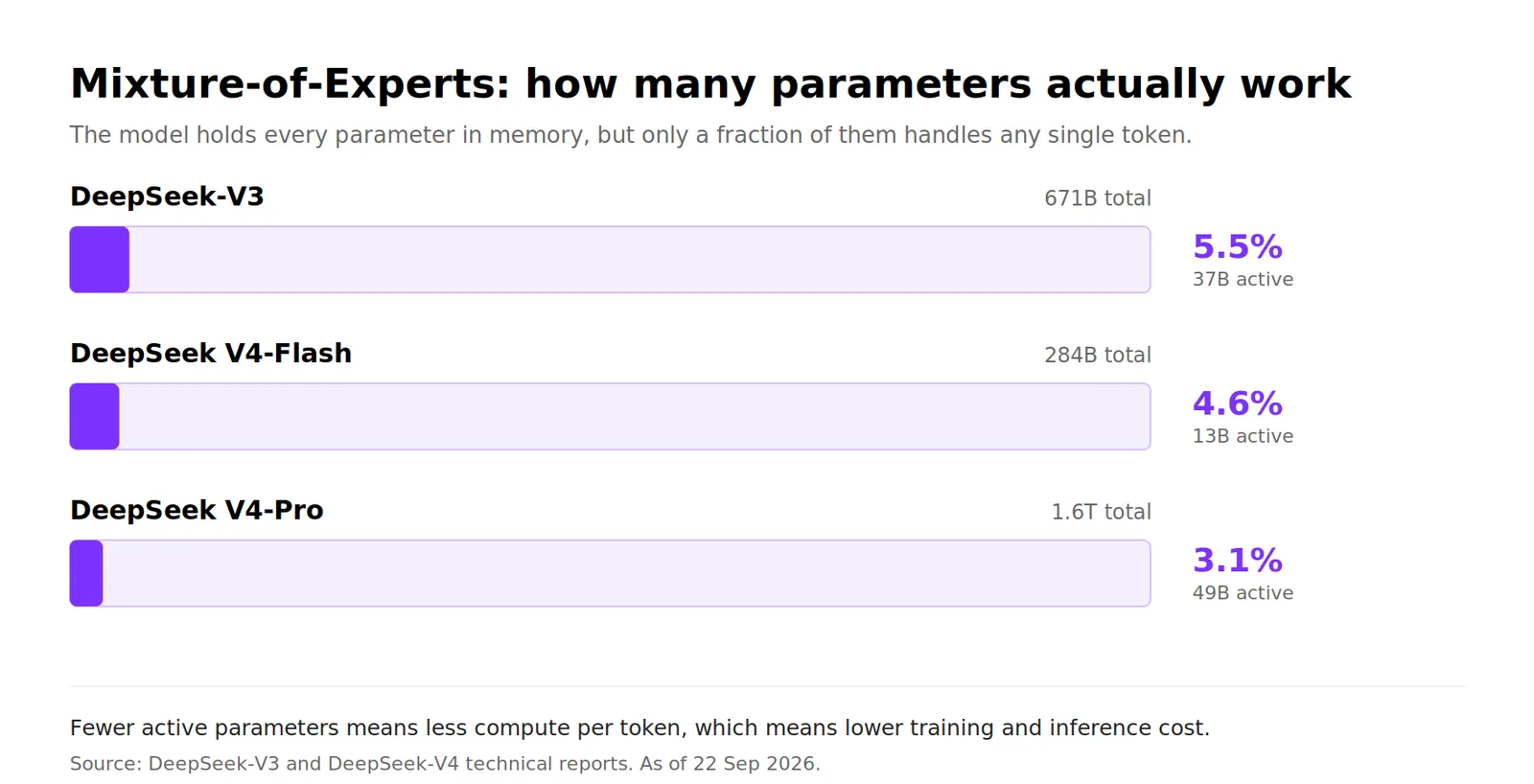
- Parameter scale. The V3 base model has a total of about 671 billion parameters, but during inference, it activates about 37 billion per token - less than 6 percent of the total. In the V4 generation, the ratio is even more pronounced: 49 billion out of 1.6 trillion in the Pro variant and 13 billion out of 284 billion in Flash.
- The limited number of active parameters translates into lower energy consumption and shorter training times. This is the main factor reducing the cost of models in this class.
- Thanks to this, training fit onto a cluster of 2,048 NVIDIA H800 chips, rather than tens of thousands of the latest GPUs, as is the case with models trained by American tech giants.
Multi-head Latent Attention (MLA) mechanism and cache memory
The second innovation in V3 was Multi-Head Latent Attention: a proprietary attention mechanism that compresses key-value representations (key-value cache) into a lower-dimensional latent form, rather than storing them in full size.
The MLA mechanism in DeepSeek compresses the cache, supporting longer contexts and more concurrent requests with the same amount of GPU memory. This directly cuts server infrastructure costs. MLA works alongside Mixture of Experts, so the savings from both solutions accumulate across both training and inference.
The V4 generation took things further, replacing MLA with a hybrid attention architecture composed of Compressed Sparse Attention and Heavily Compressed Attention, supported by the Muon optimizer and an mHC mechanism in residual connections. The effect is measurable: according to the technical report, V4-Pro requires about 27 percent of the computational overhead and about 10 percent of the KV cache memory compared to DeepSeek-V3.2 when generating a single token. It was this change - rather than MoE alone - that made a one-million-token context economically viable in the API pricing.
Pure reinforcement learning: the DeepSeek-R1-Zero innovation
The third breakthrough is the experimental DeepSeek-R1-Zero model, trained exclusively using reinforcement learning through trial and error, without an initial supervised fine-tuning stage on demonstration data.
- Departure from the standard pipeline. Traditional reasoning models first learn from examples of human solutions and are only refined through RL afterward. R1-Zero skipped this first step entirely, and its score on AIME 2024 increased during training from 15.6 to 77.9 percent.
- Training relied on the Group Relative Policy Optimization technique, which compares groups of generated responses against each other. This eliminates the need to maintain a separate critic model.
- The final, commercial R1 combines RL with additional fine-tuning to improve the readability and coherence of responses compared to the Zero version.
The methodology underwent scientific peer review. On September 17, 2025, a description of R1 appeared in "Nature", making it the first prominent large language model verified through the peer-review process of a prestigious journal. Along the way, the bill was revealed: $294,000 for training reasoning capabilities on 512 H800 chips (64 nodes with 8 GPUs each), roughly 198 hours for R1-Zero and about 80 hours for R1.
Model Ecosystem Overview: From the Flagship R1 to the V4 Generation
DeepSeek R1 is a logical reasoning model released on January 20, 2025, and built on the foundation of DeepSeek-V3. It generates long reasoning chains before providing a final answer in mathematical and programming tasks. Today, that chapter is closed. The production engine role has been taken over by the V4 generation, and R1 remains available exclusively as open weights for self-hosting.
| Model | Characteristics | Key facts |
|---|---|---|
| DeepSeek-V2 | Earlier generation of the general-purpose model, predecessor to V3, where MoE and MLA attention compression debuted | Conceptual foundation for optimizations developed in V3; merged with the Coder line in the V2.5 release in September 2024 |
| DeepSeek-V3 | General-purpose Mixture-of-Experts base model, December 2024 | 671 billion total parameters, approx. 37 billion active per token, 128k token context; approx. 2 months training, cost approx. 5.58 million USD |
| DeepSeek-R1 | Logical reasoning model specialized in mathematics and coding | Built on top of V3 via an additional RL phase; described in "Nature" on September 17, 2025; RL phase cost 294k USD |
| DeepSeek-Coder | Family of models dedicated to code generation and analysis, released in 2023 and 2024 | Absorbed by the general-purpose line in the V2.5 release from September 2024; today archival weights only, no separate name in the API |
| DeepSeekMath | Specialized model for mathematical tasks | The GRPO algorithm originated here, later used in R1 training |
| DeepSeek-V4 (Flash, Pro) | Current general-purpose generation, released on April 24, 2026, as a preview | V4-Pro: 1.6 trillion parameters, 49 billion active, final release August 13, 2026. V4-Flash: 284 billion and 13 billion active, final release July 31, 2026. 1M token context, output up to 384k. |
| DeepSeek-V4.1-Flash | Smallest model of the new architectural family with native vision understanding, released September 10, 2026 | Replaced V4-Flash in the API under the name deepseek-flash; legacy deepseek-v4-flash names are temporarily redirected to this model |
The license here is specific, not generic. The code and weights of R1, V3.1, V3.2, and the entire V4 generation are published under the MIT license, which allows commercial use, modifications, and distillation for training other models. Two caveats need to be checked before deployment: the initial V3 release from December 2024 separated the code license (MIT) from a distinct model license, and distilled R1 variants inherit the terms of their base models, namely Apache 2.0 for the Qwen2.5 family and Meta's license for Llama 3.x. The web and mobile applications remain proprietary.
Knowledge distillation itself relies on smaller models learning to reproduce the reasoning quality of the teacher model with lower computational requirements. The lighter versions created this way retain a significant portion of the original's analytical capabilities and are suitable for deployments with limited hardware resources.
Let's check your website's potential
Share your website and email - we'll get back to you with a real analysis, no strings attached.
DeepSeek R1 vs ChatGPT o1: Direct Comparison of Reasoning Models
This comparison dates back to early 2025, when both models were flagship releases from their creators. Today it holds historical value, as R1 and o1 have been replaced by newer generations, but it illustrates a pattern DeepSeek continues to repeat: comparable results at an incomparably lower cost and with open weights.
According to the table in DeepSeek's technical report, R1 scored 79.8 percent on the AIME 2024 benchmark compared to 79.2 percent for the o1-1217 model, and 97.3 percent on MATH-500 compared to 96.4 percent. The results come from the vendor, not from an independent measurement, and should be treated as such.
The first real difference lies in the transparency of the thought process. R1 displayed the full reasoning chain; the user could see each step of the model's deduction. o1 hid the internal chain and presented only a summary. In the V4 generation, DeepSeek maintained this practice: in the API, the reasoning trace is returned in the reasoning_content field, and in the web interface as a collapsible block above the response. For teams auditing model decisions, this remains a key factor.
The second difference is the development cost disclosed in "Nature": 294k USD for the RL phase, compared to OpenAI's publicly undisclosed expenditures for training comparable reasoning models.
| Criterion | DeepSeek R1 | OpenAI ChatGPT o1 |
|---|---|---|
| AIME 2024 score | 79.8 percent | 79.2 percent (o1-1217, DeepSeek measurement) |
| MATH-500 score | 97.3 percent | 96.4 percent (o1-1217, DeepSeek measurement) |
| Reasoning visibility | Full, visible reasoning chain | Hidden chain, summary only presented |
| RL phase cost | approx. 294k USD (512 H800 chips, approx. 80 hours) | training cost not publicly disclosed |
| Licensing model | Open weights under MIT license, on-premise deployment permitted | Proprietary model, available exclusively via OpenAI API and interface |
| Status as of September 2026 | Deprecated from API, available as downloadable weights | Replaced by newer OpenAI models |
Companies looking for lower operating costs with comparable reasoning quality will find DeepSeek's models to be a genuine alternative, provided they accept the differences in response stability and technical support availability, which is extensively developed commercially at OpenAI.
How to use DeepSeek: official chat, mobile app, and free model
DeepSeek is free for individual users. The basic chatbot requires no fees or payment card and works via a browser as well as iOS and Android apps, with Polish language support. The manufacturer does not publish a daily message limit or a paid subscription for the consumer version. Only access to the commercial API is paid.
Browser access and Polish language setup
The web chat interface works at DeepSeek's official address and requires no installation. All you need to do is create an account using your email or sign in with Google.
- Registration and sign-in take under a minute. The model automatically detects the language of the prompt and responds in that same language, so the Polish version requires no regional configuration.
- The launch of V4 replaced the former DeepThink toggle with two named modes. Instant Mode runs V4-Flash and responds quickly, while Expert Mode runs V4-Pro and reasons longer before answering. Both have a separate toggle to display the reasoning process.
- The one-million-token context is active by default, along with file uploads and web search. In practice, you can paste an entire documentation set and ask for details without splitting it into pieces.
- Prompt engineering. In Expert mode, it is worth framing questions in multiple stages, breaking a complex problem down into steps. This lets you observe the inference process, not just the final result.
- The web account syncs chat history across devices.
Mobile and desktop computer app
The DeepSeek app is a native client for iOS and Android, functionally matching the web version.
- Installation. The app is free on the App Store and Google Play, and sign-in uses the same account as the browser, so your chat history syncs automatically. In Italy, the app has been unavailable in official stores since January 2025.
- The mobile version supports voice input and image scanning, such as taking a photo of an equation or a piece of code for analysis.
- Desktop version. The official app for Windows and macOS provides the same features as the web interface in a standalone window, without needing to keep a browser tab open.
- Image understanding is a feature of the V4.1-Flash model. V4-Pro remains a text-only model, so screenshot analysis is routed to the faster, not the more powerful, variant.
During peak server load periods, the interface may refuse service with a busy message. This especially applies to peak hours of the Chinese infrastructure, meaning 01:00-04:00 and 06:00-10:00 UTC on business days.
Political censorship in the interface vs. neutrality of the commercial API and weights
Chinese content restrictions apply only to the web and mobile DeepSeek chat interface. There, censorship covers political and historical queries that are sensitive to the authorities in Beijing. Commercial access via API and locally deployed models using open weights are free from these filters.
The official chat refuses to answer or evades questions about the Tiananmen Square protests and other topics inconvenient for Beijing. The filter operates at the application level, not within the model's parameters, making it a product decision by the provider. Queries cut off in the chat interface can be processed freely either locally or through raw API calls.
This distinction has practical consequences. Developers using the API Platform and organizations downloading the open weights do not encounter the topical blocks enforced in the web chat, but an API hosted in China still routes queries and data through the provider's infrastructure. Thus, the absence of censorship does not mean the absence of regulatory risk, and these two issues are conflated in most Polish analyses. We describe the legal risk in the GDPR section.
DeepSeek API Economics: Token Costs and Digital Marketing Automation
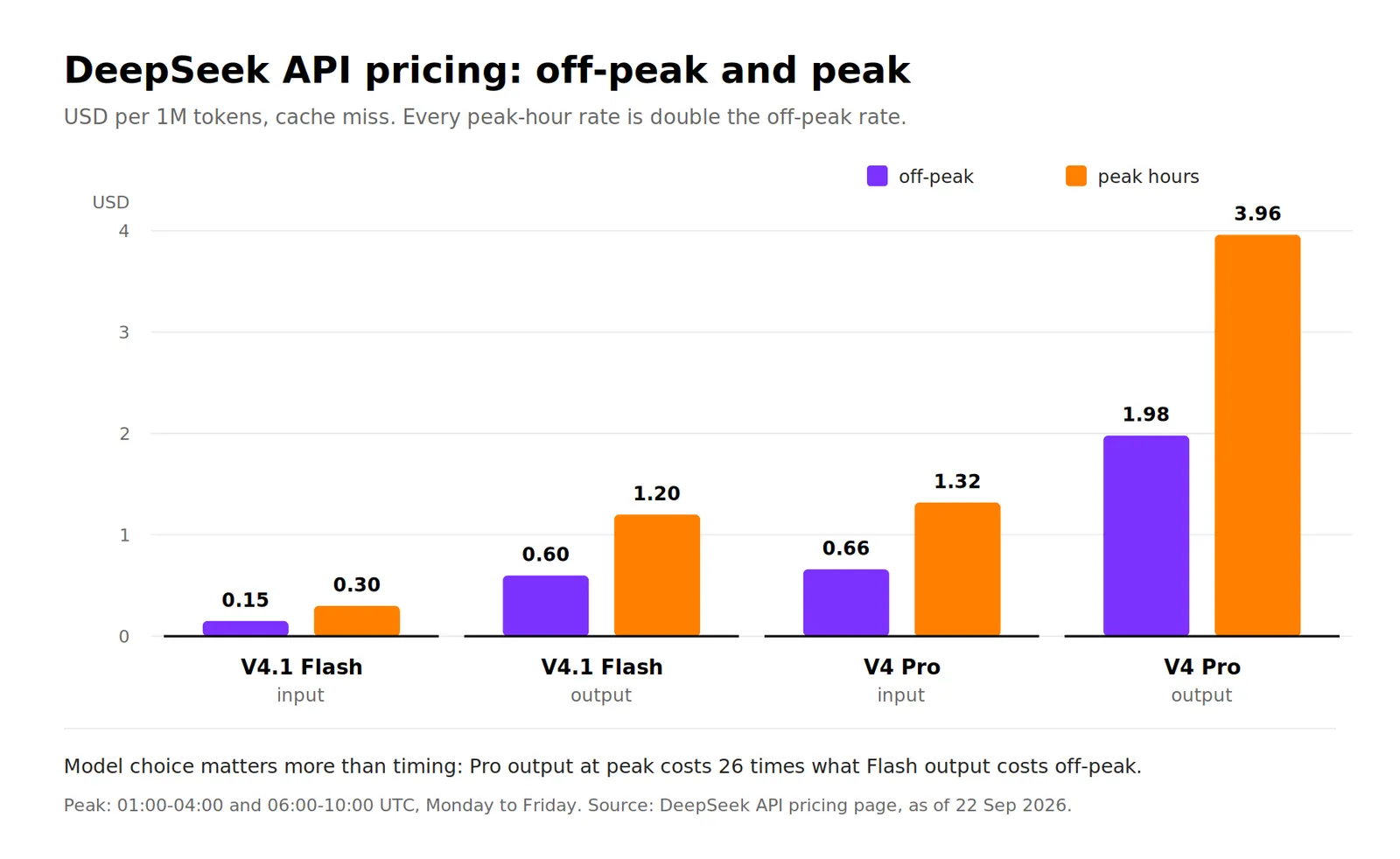
DeepSeek lowers the break-even point for bulk text processing tasks thanks to low token prices: $0.15 per million input tokens and $0.60 per million output tokens for the Flash variant during off-peak hours. As a result, bulk content generation, data analysis, and SEO automation become accessible to companies that previously could not scale these processes using generative AI.
API Pricing: Comparing Rates per Million Tokens with the Competition
DeepSeek's API Platform is a commercial interface for integrating with external applications. It imposes no ideological filters and bills strictly based on tokens consumed. Starting August 16, 2026, a daily tariff applies: off-peak rates are half the peak rates, with peak hours falling between 01:00-04:00 and 06:00-10:00 UTC Monday through Friday, excluding Chinese public holidays.
| Model / Variant | Input Tokens per 1M (Cache Miss) | Output Tokens per 1M | Notes |
|---|---|---|---|
| DeepSeek V4.1 Flash (deepseek-flash) | $0.15 off-peak, $0.30 peak | $0.60 off-peak, $1.20 peak | Cheapest variant; cache hit costs $0.003; supports vision; 2,500 concurrent request limit |
| DeepSeek V4 Pro (deepseek-v4-pro) | $0.66 off-peak, $1.32 peak | $1.98 off-peak, $3.96 peak | Variant for tasks requiring higher precision; text only; 500 concurrent request limit |
| DeepSeek R1 Reasoner | Retired | Retired | The name deepseek-reasoner disappeared from the API on July 24, 2026; reasoning is now handled by thinking mode in V4 |
| OpenAI Models (for comparison) | Rates an order of magnitude higher | Rates an order of magnitude higher | Multiplier depends on the model compared; check current OpenAI pricing before calculating |
Doubling fees during peak hours is a mechanism specific to DeepSeek. The cost of the same request depends on the time it is sent, which forces planning bulk tasks outside the peak window. The difference can make or break a budget: a batch of 500 million input tokens costs $75 off-peak and $150 at peak.
However, we do not recommend basing a business plan on the round figure of "20 times cheaper than OpenAI." The price ratio changes with every pricing update on either side, depends on the model variant, context length, and prompt caching efficiency, and, as of August 2026, also on the time of dispatch. Calculate the cost based on your own volume.
Applications in SEO, Content Generation, and RAG Systems
The low token cost shifts the profitability threshold where Western providers' rates previously made a project unviable.
- Bulk SEO content generation. At $0.15 per million input tokens, creating large volumes of product descriptions, category articles, and metadata without limiting the number of variations becomes cost-effective.
- RAG (retrieval-augmented generation) systems. The low cost of output tokens makes it easier to build pipelines where the model queries the company knowledge base multiple times within a single session, for example, for answers based on technical documentation. A million tokens of context allows feeding entire documents into the prompt instead of just snippets.
- Code generation works in the API just like in chat, but in an automated mode useful for integration scripts and unit tests.
- Text data analysis, from customer reviews to query logs, no longer requires sampling due to cost constraints.
- Digital marketing automation. Integrating the API with CMS and campaign tools allows generating headline and ad copy variants tailored to audience segments, without manual copywriting work for every iteration. Companies building visibility in generative search engines treat this as an element of AI SEO, not as a replacement for strategy.
The Flash variant excels at repetitive, high-volume tasks. Pro costs more than four times as much for input tokens, so it makes sense where reasoning precision counts: in financial data analysis or generating code with high logical complexity.
Privacy, GDPR, and Local On-Premise Deployments
Companies subject to GDPR can bypass the risks of Chinese cloud jurisdiction by deploying DeepSeek open weights on their own infrastructure. The weights can be downloaded for free and run locally without sending data to an external cloud. This is the answer to the question "is DeepSeek safe": safety depends on the deployment location, not the model itself.
The scale of regulatory oversight is well documented. On January 30, 2025, the Italian Garante ordered Hangzhou DeepSeek Artificial Intelligence and Beijing DeepSeek Artificial Intelligence to restrict the processing of personal data of individuals located in Italy, after deeming the company's responses insufficient and after the company challenged the Italian authority's jurisdiction. The decision has not been overturned and remains in force today; the app disappeared from Italian app stores, although the web version remained accessible. According to an IAPP analysis from February 2026, proceedings were underway in thirteen European jurisdictions, and the European Data Protection Board set up a dedicated task force to enforce regulations against AI. A separate matter was concluded by the Italian antitrust authority AGCM on April 30, 2026, accepting commitments from DeepSeek, Mistral, and NOVA AI to warn users more clearly about the risks of hallucinations.
Running Models Offline via Ollama and LM Studio
DeepSeek provides open weights that users can run locally without writing code from scratch. Users deploy DeepSeek models using two popular tools:
- Ollama is a command-line tool for managing models locally. It downloads a quantized version of the model with a single command and exposes it via a local API compatible with the OpenAI format, allowing you to connect existing applications without changing client code. Support for new DeepSeek architectures appears here with a delay relative to llama.cpp, so check the availability of a specific version before planning a deployment.
- LM Studio is a desktop application with a graphical interface that lets you browse, download, and test models from the Hugging Face repository without command-line knowledge. It is useful for teams evaluating response quality before making a production decision.
The source of the weights is Hugging Face: that is where official releases and community quantizations come from, including GGUF files for both tools and safetensors for server deployments. In all three paths, inference runs entirely on the user's hardware, with no internet connection required after downloading the model. For companies subject to GDPR, this means that input data never leaves the local network.
Hardware Requirements, VRAM, and Quantization Techniques
Quantization reduces the numerical precision of weights, for example from 8 bits to 3, shrinking file size and memory requirements several times over at the cost of a slight drop in response quality. Without it, DeepSeek models require server-grade hardware.
- V4-Flash (284 billion parameters). In original precision, approx. 175 GB of memory; in 8-bit quantization, approx. 162 GB; in 3-bit, approx. 103 GB. The latter version boots on a machine with 110 GB of total memory, for example on a Mac with unified memory, but that is still hardware far beyond the average workstation.
- V4-Pro (1.6 trillion parameters). Requires a multi-GPU Blackwell server or an H200 cluster. Deployment is only realistic on dedicated infrastructure.
- R1 Distilled Variants (7B, 8B, 14B, 32B, 70B) remain the only path for a single consumer GPU with 8-24 GB VRAM. They are less capable than the V4 generation, but they account for the majority of real-world on-premise deployments in smaller companies.
A fair concluding note: self-hosting rarely wins on the cost balance sheet. At a rate of $0.15 per million input tokens, renting GPUs only pays off at very large, consistent volumes. The argument for local deployment is data control and lack of dependence on Chinese infrastructure, not cost savings, and that is how we recommend justifying this expense to the board. Companies planning to use AI in content processes, including as part of an AI search optimization strategy, usually start with quantized variants as a compromise between hardware cost and content quality.
FAQ
In short: DeepSeek is a Chinese research company, its models are open under the MIT license and free in the chat, paid via the API, and legal risk depends on whether you use the provider's cloud or your own server.
What exactly is DeepSeek?
DeepSeek is a Chinese AI research enterprise spun off in July 2023 in Hangzhou from the High-Flyer hedge fund, led by Liang Wenfeng. It develops a family of open language models based on the Mixture-of-Experts architecture, available via web chat, mobile app, and API. The current lineup includes V4-Pro and V4.1-Flash; earlier generations are V3 and R1.
Is DeepSeek free to use?
The web chat and mobile app are free, with no subscription and no publicly declared message limit. Model weights can be downloaded and run locally for free. The commercial API is paid: starting at $0.15 per million input tokens and $0.60 per million output tokens for the Flash variant off-peak, with rates doubling during peak hours.
Under what license are DeepSeek models released?
The code and model weights for R1, V3.1, V3.2, and the V4 generation are covered by the MIT license, which permits commercial use, modifications, and distillation. Exceptions apply to the initial V3 release with a separate model license and the R1 distilled variants, which inherit the terms of the base Qwen2.5 and Llama models. The consumer applications remain proprietary.
Does DeepSeek support Polish properly?
Yes, the models detect the language of the query and respond in the same language without additional configuration. The maker does not publish separate benchmarks for Polish, so quality in specialized tasks should be tested on your own prompts before deployment.
Is DeepSeek safe in terms of GDPR and data privacy?
The cloud version is subject to Chinese jurisdiction and censors political topics, and Italy has an active ban on personal data processing issued by the Garante in January 2025. For companies subject to GDPR, the safer option is local deployment of the open weights on their own infrastructure, where data never leaves the organization's network.