
Cursor AI - What Is It and How Does It Work?
AI coding assistants have settled into daily work faster than any programming tool in the past decade. Cursor stands out in this group due to its architecture: it is not a plugin bolted onto an existing editor, but an independent IDE built around language models from the very first line of code. For developers tired of juggling between an editor and an external AI chat, this is a difference that shows in the pace of product changes every day.
What is Cursor AI?
Cursor AI is an autonomous integrated development environment (IDE) created by Anysphere, built as a fork of Visual Studio Code with natively integrated artificial intelligence models.
Anysphere was founded in 2022; the first public release of Cursor reached developers a year later. The application supports Windows, macOS, and Linux. Because it is based on Visual Studio Code, the entire VS Code ecosystem - extensions, themes, keyboard shortcuts, and Jupyter notebooks - transfers seamlessly, and importing configurations takes just one step. SpaceX is one of the editor's leading corporate users. For experienced VS Code developers, migration requires zero environment adaptation.
The code editor supports Python, JavaScript, TypeScript, PHP, Java, C++, Go, Rust, SQL, and other programming languages. What does Cursor AI mean in practice? It is the choice of a development environment, not just picking an assistant plugin - the language model has native access to the repository structure and relationships between components, something a host-installed plugin cannot provide.
Cursor does not simply overlay an artificial intelligence layer on top of an existing host - it builds an environment where AI models have direct access to the editor's internal mechanisms and the project's AST. This architectural difference translates into the depth of context available with every query and the overall quality of code generation.
Key Features and Editor Mechanism
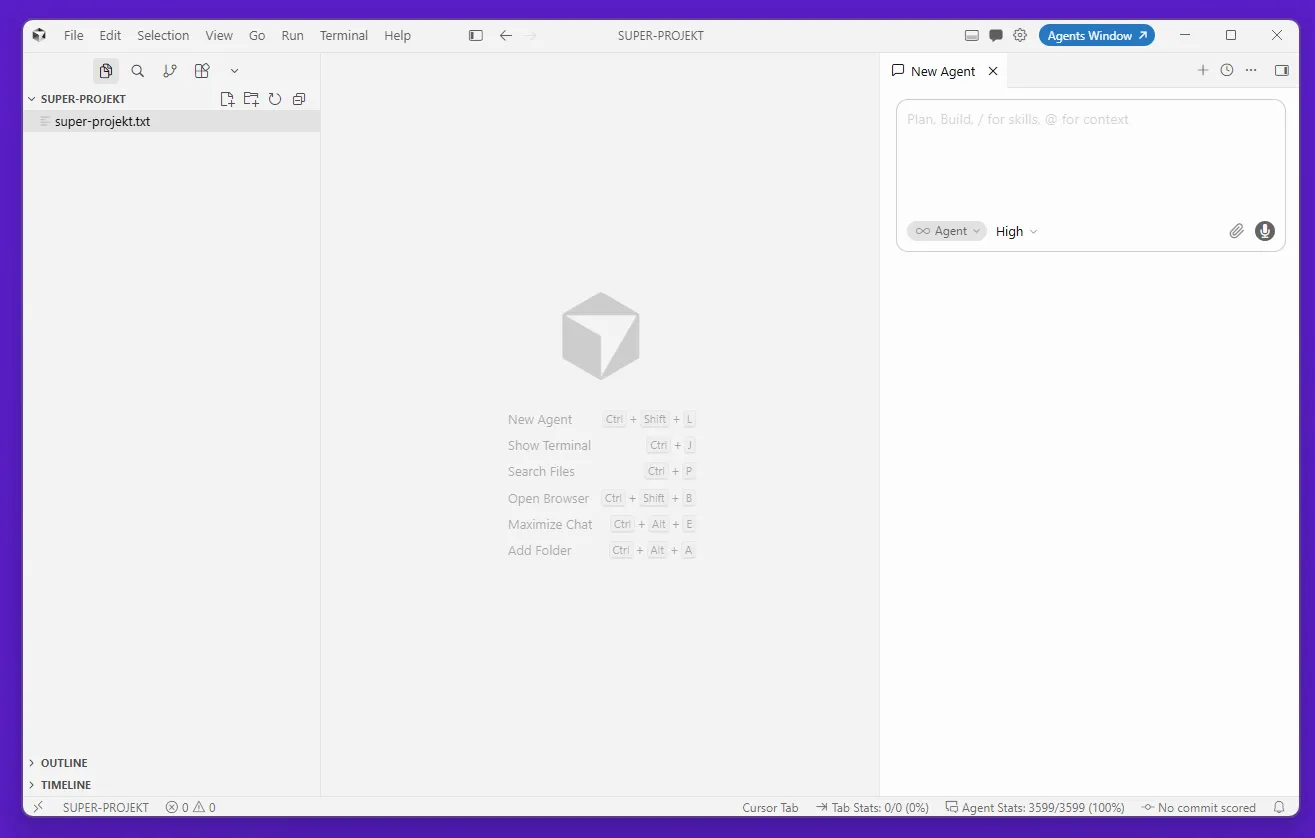
The operation of Cursor AI is based on integrating advanced large language models (LLMs) with deep, real-time repository context analysis.
Cursor supports both external and local AI models. On the Anthropic side, Claude 3.5 Sonnet and Claude 3.7 Sonnet are available; the latter, with its particularly long context window, is chosen by experienced developers working with extensive codebases. On the OpenAI side, the editor uses GPT-4 and GPT-4o, as well as Google Gemini models. Developers who prefer to keep data locally or want to reduce costs run local AI models via Ollama. The length of an artificial intelligence model's context window directly affects the quality of suggestions in complex projects.
The AI interface is divided into two modes. The Cmd+K shortcut (Ctrl+K on Windows and Linux) opens an inline panel to edit a selected code snippet or an entire function - the AI suggests changes directly at the cursor location, without opening a separate window. Cmd+L (Ctrl+L) launches the project chat in Ask mode, where you can ask natural language questions about architecture, generate new modules, and analyze logic. Both modes use the same indexed code context.
Cursor differs from plugins in that the AI does not operate on the currently visible file, but on a full index of the repository. Every query carries information about the entire project.
Multi-File Editing in the Composer Module and Intelligent Autocomplete
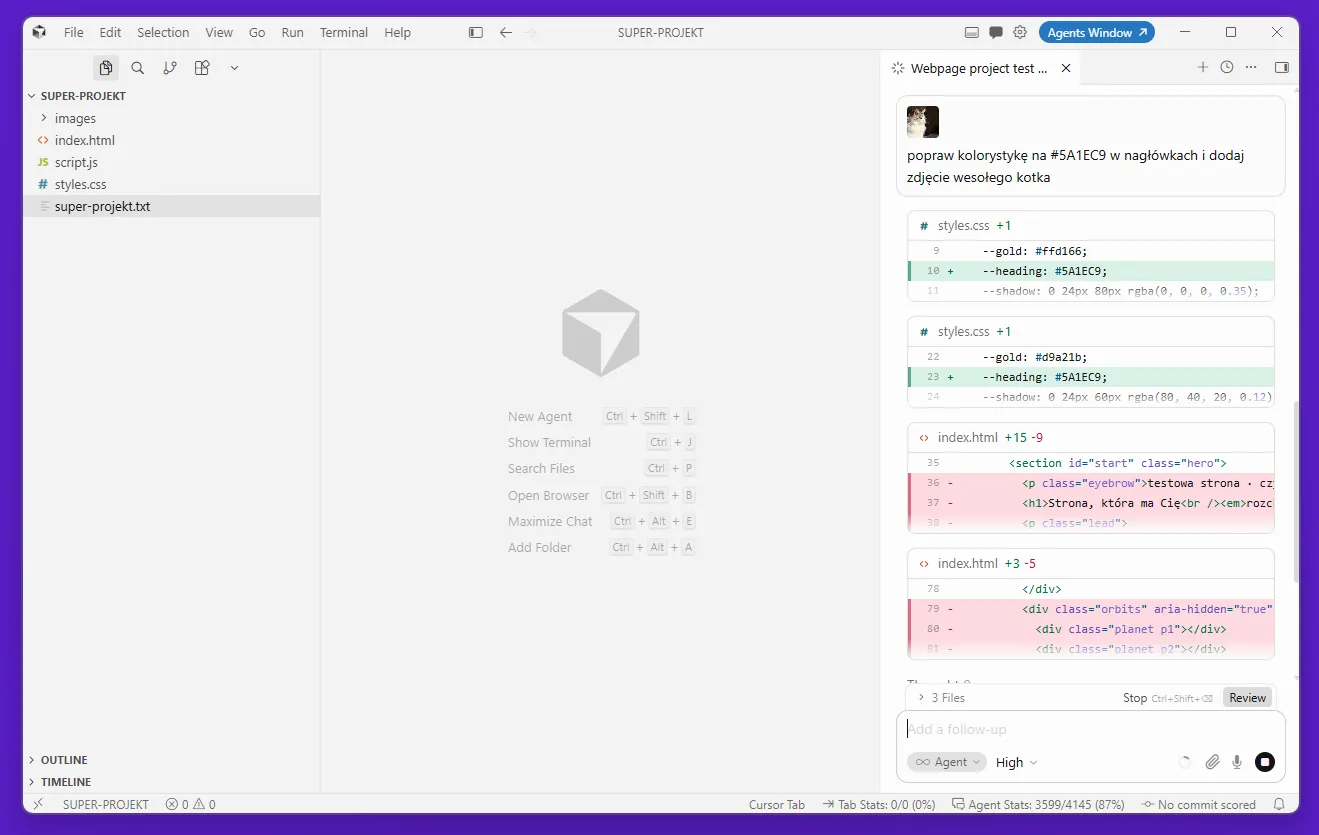
The Composer module allows for the parallel generation and modification of code across multiple files simultaneously, eliminating the need to manually copy changes.
The prompt "add input validation to all endpoints in /routes" is executed by Composer as a cohesive set of changes across files at once, presented in a Diff view prior to acceptance. The developer reviews the code snippets proposed by the AI, approves or rejects individual blocks, and arrives at a finished result - instead of tracking each file individually and manually copying the pattern.
When generating code in repetitive patterns - CRUD handling for subsequent models, generating functions based on a signature, tests for existing methods - the time difference is clear. The vendor reports a productivity increase of around 30%, resulting from the automation of routine programming tasks and focusing work on business logic instead of writing boilerplate code.
The Cursor Tab feature is an autocompletion mechanism that goes beyond the next token. It predicts entire code snippets and multi-line modifications accepted with a single press of Tab. Intelligent autocomplete reduces the time spent writing code in repetitive patterns - completing TypeScript interfaces, replicating error handling across controllers, filling in documentation comments. The savings compound when working with multiple files simultaneously throughout the day.
Agentic Work and Context Management with the @ Operator
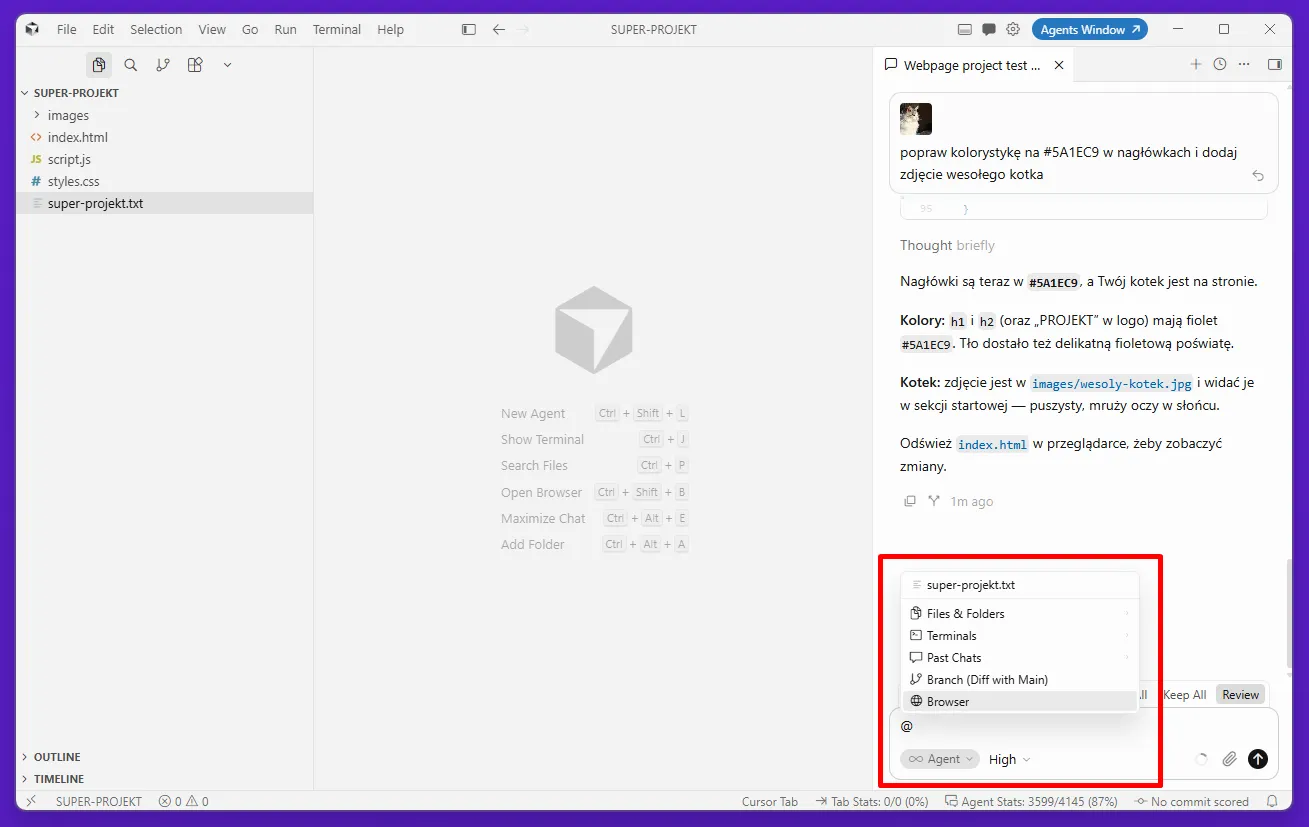
Precision in code generation within Cursor stems from the Codebase Indexing mechanism and granular resource referencing using the @ operator.
Codebase Indexing vectorizes the entire codebase after opening a workspace folder. This builds a full repository context: AI models see the relationships between classes, imports, and the architecture of the entire project. The @ operator allows you to attach specific files, folders, symbols, external documentation, and search results to the prompt. The query "how do we handle user sessions in our project?" generates an answer based on actual code - not on the model's generic knowledge of the framework's API.
Agent mode expands the editor's capabilities beyond text editing. Cloud Agents execute terminal commands, run tests, and complete multi-step programming tasks without manual oversight of every step. Bugbot verifies changes in pull requests for potential bugs and logical inconsistencies. The automated fixes that Cursor suggests during compilation errors are based on the context of the entire project - not on patterns from training data.
The editor scans code for errors in real time, suggests fixes, and the automated optimization of code snippets reduces the need for manual refactoring. Debugging complex applications with full repository context is another advantage over tools that only operate on the visible file.
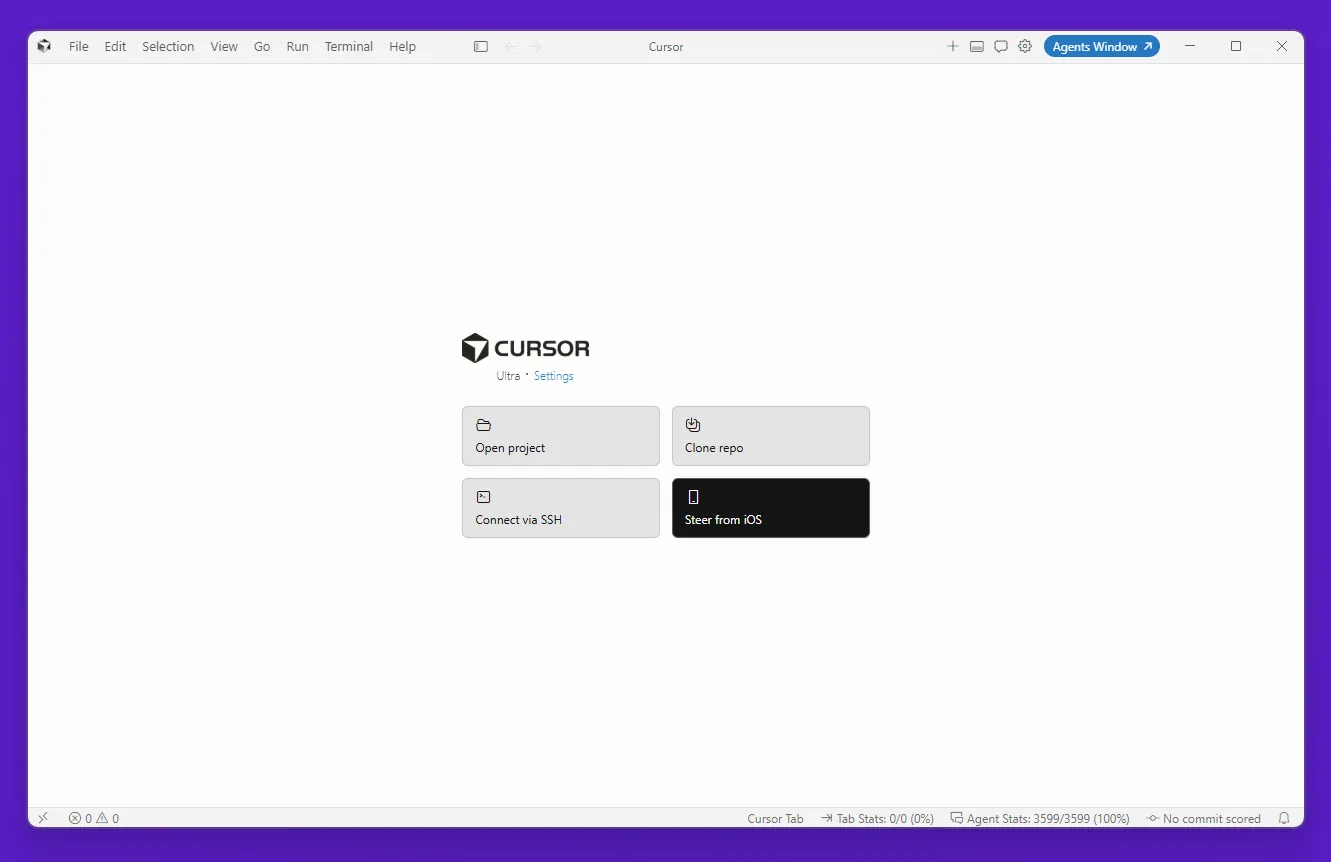
| FUN FACT: Cursor also features a "Steer from iOS" function - the agent runs on the desktop, while the developer controls it from an iPhone via a dedicated mobile panel. During multi-hour agentic tasks - refactoring a large codebase, generating a test suite - you can step away from your computer and adjust the workflow direction from your phone. The welcome screen also offers "Clone repo" and "Connect via SSH", completing the workflow: clone the repository, run agentic tasks, push changes - without needing to sit at your desk for the entire duration of the task. |
|---|
Code Security, Privacy Mode, and Regulatory Compliance
Deploying artificial intelligence tools in a commercial environment requires absolute control over intellectual property retention and processing.
Cursor offers Privacy Mode, which disables sending user code to train public AI models. In this mode, API providers do not store query data - requests are processed and deleted with zero retention on the artificial intelligence tool side. Companies with compliance requirements can use the BYOK (Bring Your Own Key) option, which lets them use their own API keys via the settings interface. This shifts control over data flow to the client side and resolves most objections related to source code confidentiality.
In the context of GDPR and the AI Act, two aspects require verification: data processing location and the responsible entity. Privacy Mode reduces the risk of unauthorized code usage, but it does not exempt organizations that process sensitive data from conducting a DPIA, nor does it eliminate the need to enter into a DPA with Anysphere.
An AI model can propose function calls or API imports that do not exist in the project, especially when prompts are too vague. These are architectural hallucinations - a phenomenon mitigated by precisely pointing to context with the @ operator and breaking down tasks into smaller components. Every team should account for potential issues of this kind in their process for reviewing changes before accepting them.
Cursor Pricing Plans (as of September 2026):
| Plan | Price | Scope |
|---|---|---|
| Hobby | Free | Basic editor features, limited access to Composer and Agent |
| Cursor Pro | $20/mo | Unlimited Cursor Tab autocompletion, extended Agent limits |
| Pro+ | $60/mo | Higher limits, access to premium models |
| Ultra | $200/mo | Highest limits, priority processing |
| Teams Standard | $40/user/mo | Team management, shared settings |
| Teams Premium | $120/user/mo | Advanced features for enterprise environments |
How much does Cursor cost in the free tier? The Hobby plan does not require a credit card and includes basic editor features sufficient to evaluate the tool over a few weeks of work. The Hobby plan should not be confused with the mode based on using your own API key - these are two separate access options.
Let's check your website's potential
Share your website and email - we'll get back to you with a real analysis, no strings attached.
How to Get Started with Cursor AI Step by Step:
Getting started with the editor does not require changing established coding habits, thanks to an automated migration process.
Download Cursor from the vendor's website for your operating system. After the initial launch, the installer detects your existing VS Code setup and prompts for a one-step import. This automatic adjustment migrates extensions, themes, and keybindings from VS Code - developers land in a visually identical environment with native AI under the hood. Setting up repository indexing takes just a few clicks.
Good prompting is more important here than knowing shortcuts. A developer's daily work with Cursor is made easier by the rule of one task per prompt. Instead of "fix this code," use "in auth.service.ts, in the validateToken method, add expired JWT handling and return a 401 code with the message 'Token expired'". The more precise the prompt, the fewer unwanted edits in unexpected parts of the project. Practical tips: specify the exact file and method, describe the expected result, break refactorings down into verifiable steps.
Installation, Importing VS Code Configuration, and First Queries
The one-step import transfers your complete configuration from Visual Studio Code, including extensions, keybindings, and themes.
After installation: trigger Codebase Indexing (Cursor > Settings > Codebase Indexing), wait for the repository vectorization to complete - which takes a few minutes for a medium-sized project - and run a first test query via Cmd+K on a selected snippet. The Diff view before accepting acts as a checkpoint that protects against unintended modifications across multiple files simultaneously.
For a new project - whether a web application, a microservice, or a library module - we recommend starting by having the AI explain an existing function in plain language before asking it for modifications. This verifies whether the model has correctly read the project context before you entrust it with changes to production code. During onboarding, Cursor accelerates understanding code structure by allowing you to ask questions about relationships between components.
Cursor AI vs. GitHub Copilot - Key Differences
While GitHub Copilot functions primarily as an assistant in the form of a plugin, Cursor AI is a complete, standalone environment designed from the ground up around large language models.
The architectural difference is fundamental. GitHub Copilot is an extension installed in an existing code editor, operating within the boundaries of that host's API. The modern Cursor editor is an independent fork of VS Code with direct access to the developer environment's internal mechanics.
| Criterion | GitHub Copilot | Cursor AI |
|---|---|---|
| Architecture | Editor plugin | Standalone IDE fork |
| Context Scope | Active file | Entire project via Codebase Indexing |
| Scope of Changes | Single file | Multiple files simultaneously (Composer) |
| Context Management | Limited | @ operator (files, symbols, documentation) |
| Cloud Agents | None | Cloud Agents, Bugbot, automated PRs |
| AI Models | GPT-4, GPT-4o | Claude 3.5/3.7 Sonnet, GPT-4/4o, Gemini, local |
In projects based on multi-layered web applications - API, frontend, database - the advantage of a multi-file environment is apparent during any major refactoring. GitHub Copilot suggests changes in the open file; Composer propagates them as a single, coherent operation across the entire stack. Claude 3.7 Sonnet, as one of the models available in Cursor, performs exceptionally well when working with extensive codebases, where the length of the context window is critical to suggestion quality.
Cursor and Claude Code, Anthropic's autonomous terminal coding agent, serve different needs. Claude Code excels at autonomous tasks within CI/CD pipelines; Cursor provides visual control over code snippet changes inside the IDE.
New features are added to Cursor on a regular basis - the vendor releases updates every few weeks. AI support at the IDE level, rather than through a plugin, gives developers a real competitive edge in building complex software - especially for teams working on projects where website SEO is part of the product strategy.
Cursor AI in Production Environments - Evaluation for Teams
Cursor AI shifts the focus from single-line autocompletion to the autonomous execution of programming tasks. For teams considering implementation: productivity increases measurably, but it requires changing prompting habits and the output review process.
Questions to consider before deciding: code compliance with Privacy Mode or BYOK, potential DPIA requirements, and calculating the plan cost against hours saved on routine tasks. The Hobby plan lets you explore this without upfront costs. Cursor automates routine programming tasks - code generation, refactoring, unit testing, SQL query optimization - but supervising the outputs and the final approval of changes always rests with the developers.
Contact Neadoo if you want to assess whether your technical processes are ready for implementing AI tools - we analyze the stack, regulatory risk, and realistic savings potential. We support software houses, businesses, and agencies with nationwide website SEO and local SEO. We also specialize in search engine optimization for AI environments (AI SEO).
Frequently Asked Questions About Cursor
How much does Cursor AI cost?
Cursor costs from $0 to $200 per user per month. The Hobby plan is free, no credit card required - with limited access to AI. Cursor Pro is $20/month with unlimited Cursor Tab. The Pro+, Ultra, and Teams plans are designed for enterprise environments - see the table above for details.
Is Cursor AI free?
Yes - the Hobby plan is free and includes the editor's core features with limited AI access. It is not the same as the BYOK (Bring Your Own Key) mode, which is a separate option. For evaluating the tool, the free plan is sufficient for several weeks of intensive coding.
What is the AI in Cursor all about?
Cursor integrates large language models (Claude, GPT-4, Gemini, and others) directly into the development environment and indexes the entire repository, not just the visible file. The AI operates on the real context of the user's project: generating application code, multi-file refactoring, real-time error detection. You ask questions in natural language; Composer presents the results as sets of file changes ready for approval.
What does Cursor Pro offer?
Cursor Pro, priced at $20 per month, removes Cursor Tab autocompletion limits (which are limited in the Hobby plan), expands agent request limits, and grants full access to Composer. For developers using the editor in daily professional work, the Hobby plan limit is typically exhausted within a few business days. Cursor Pro is effectively the minimum plan for production work; for developers who treat productivity as a measurable metric, higher plans pay off with large codebases and teams.