
Copy.ai in Practice: Capabilities, GTM Process Automation, and Tool Review
Copy.ai started out as a content generator, but today it is a GTM AI (Go-To-Market AI) platform: it combines text generation with sales and marketing process automation and integrates with systems like Salesforce or HubSpot. Since October 2025, it has been owned by Fullcast, which is developing it within its suite as Fullcast Propel (powered by Copy.ai).
In practice, the tool goes beyond content for SEO and e-commerce needs (blog posts, product descriptions, email sequences) and handles CRM enrichment, personalized outreach, and lead qualification. The platform uses models from OpenAI, Anthropic, and Google Gemini, while components like Workflows, Copy Agents, and Infobase let you build an automated process from the first touch with a lead to ready-made sales collateral. Further below, you will find out how much Copy.ai costs, whether there is a free version, and how well the tool handles Polish.
What is Copy.ai and How Did It Evolve into a GTM AI Platform?
Copy.ai is a GTM AI platform that automates a company's revenue cycle: marketing, sales, and operations. The vendor claims 17 million users on its pricing page, but does not specify how many of them are active, paying customers.
This shift in focus addresses a problem Copy.ai calls GTM bloat: an overabundance of narrow point solutions, each handling a single stage of the funnel. One generates content, another manages email sequences, and a third enriches CRM records. This fragmentation drives up licensing costs and hinders data flow between departments. Copy.ai consolidates these capabilities into a single interface built around a unified customer dataset.
The acquisition by Fullcast on October 15, 2025, solidified this direction. Fullcast combines territory and quota planning, sales forecasting, analytics, and commissions into a single suite, with Copy.ai serving as its execution layer: content generation and agentic workflows. Fullcast describes the entire suite as a "Plan-to-Pay" model.
In practice, Copy.ai enables marketing and sales teams to design entire revenue processes - from first lead contact, through message personalization, to writing data back into the CRM - without switching between multiple apps. A similar consolidation is taking place in search marketing, where AI SEO merges brand data, content, and distribution into a single process.
LLM-Agnostic Architecture: Why Model Independence Gives You an Edge
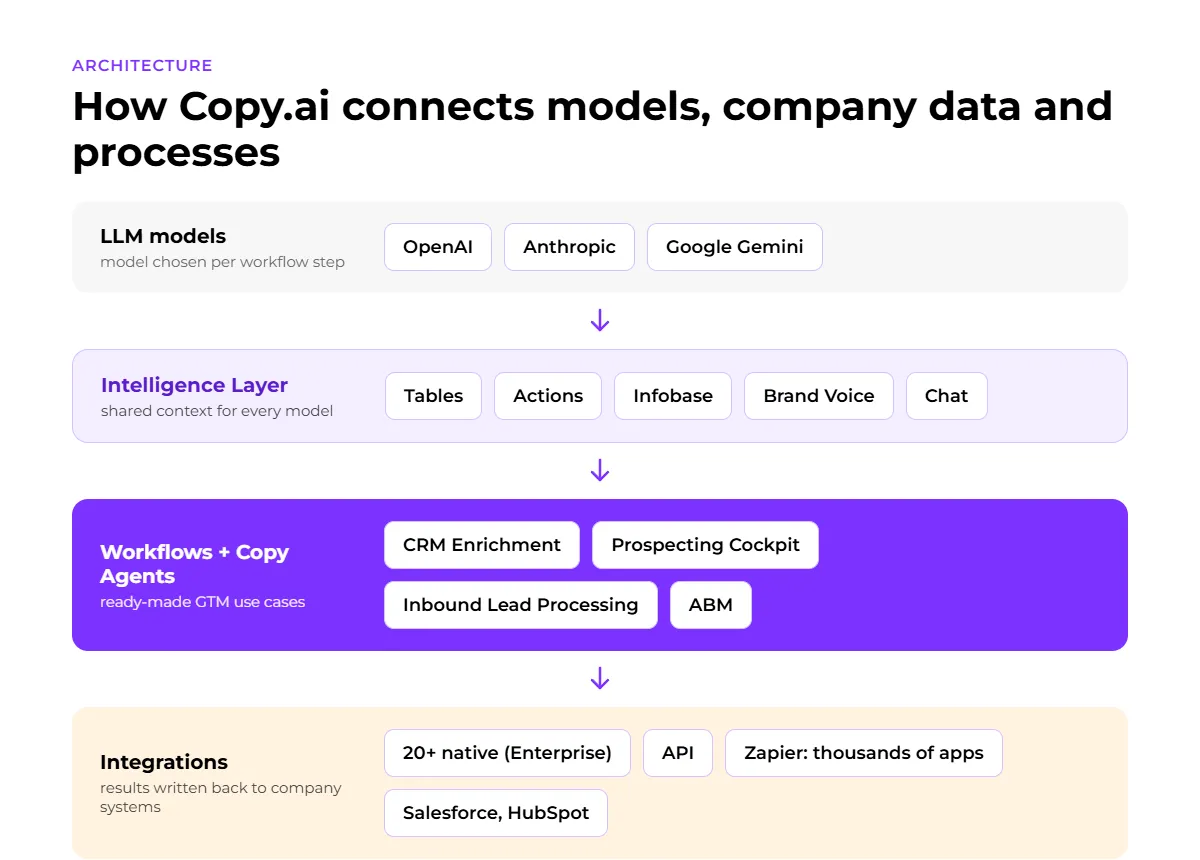
Copy.ai does not lock you into a single AI provider: every paid plan provides access to models from OpenAI, Anthropic, and Google Gemini. In Workflows, models are selected on a per-step basis, so lead data analysis can go to a more capable reasoning model, while extracting the final output can be routed to a cheaper, faster one. On its blog, the vendor outlines this choice across three criteria: model speed, cost, and reasoning capability.
Independence from a single provider matters in larger-scale deployments. When a provider deprecates a model, raises API prices, or updates terms of service, a workflow step can be switched to another engine without rebuilding the entire process. Tools built around a single API lack this flexibility.
Copy.ai calls the layer between the models and company data the Intelligence Layer. It is made up of Tables, Actions, Infobase, Brand Voice, and Chat - components that feed context to the model: customer data, product knowledge, and brand voice. This context is shared across all models, so switching engines does not require re-entering your company knowledge.
In our view, this is the strongest argument in favor of Copy.ai in 2026. Model life cycles are now measured in months, and workflows tied to a single vendor have to be rewritten with every major change.
Key content marketing features: from knowledge base to SEO and e-commerce copy
The Infobase and Brand Voice modules ensure that generated content stays aligned with your company identity. Infobase is responsible for facts and company knowledge, while Brand Voice handles style and tone. Together, they let you produce SEO articles, ad creatives, and e-commerce descriptions at scale, without having to add context to every prompt.
Infobase and Brand Voice: eliminating hallucinations and ensuring a consistent brand tone
Infobase is a central repository for company information. Data about products, offerings, procedures, and industry terminology is saved once and then referenced across Chat and Workflows. The vendor does not publish Infobase limits for individual plans on its pricing page, so it is best to confirm them before purchasing.
Brand Voice analyzes existing brand assets (articles, product descriptions, ads) and replicates their tone; you can also define the voice manually. Organizations with multiple target audiences create separate profiles, e.g., one for B2B content and another for social media.
Combining both modules reduces the risk of hallucinations, because the generator draws on verified company data rather than relying solely on the model's general knowledge. It does not eliminate the risk entirely. The model can still invent a product parameter or feature that does not exist in Infobase.
SEO blog posts, ad copy, and Polish language nuances
Copy.ai generates SEO blog articles, e-commerce product and category descriptions, posts for Facebook, Instagram, and LinkedIn, ad headlines, newsletters, and email sequences. These are supplemented by features such as:
- SEO suggestions: keyword selection and headline recommendations tailored to search intent.
- Paraphrasing and shortening existing text without losing the core marketing message.
- Content updating, useful for refreshing older articles with new data or an updated product offering.
- Translation and localization, which the vendor highlights as a dedicated use case (Translation & Localization).
The platform supports the Polish language through multilingual LLMs; Polish was also listed among over 30 languages on an archived version of the Copy.ai translations page. The quality of Polish copy depends heavily on the data in Infobase and the precision of Brand Voice. Without them, Polish copy tends to be more generic than its English counterpart: syntactic calques, English sentence structure, and overused transitions often appear. Every piece of content therefore requires stylistic editing by a native Polish speaker.
How to write ad copy in Copy.ai step by step
You will get the best results with a brief that includes strict format limits, an attached Brand Voice, and a request for multiple variations instead of just one. Here is the workflow for search and social media ads:
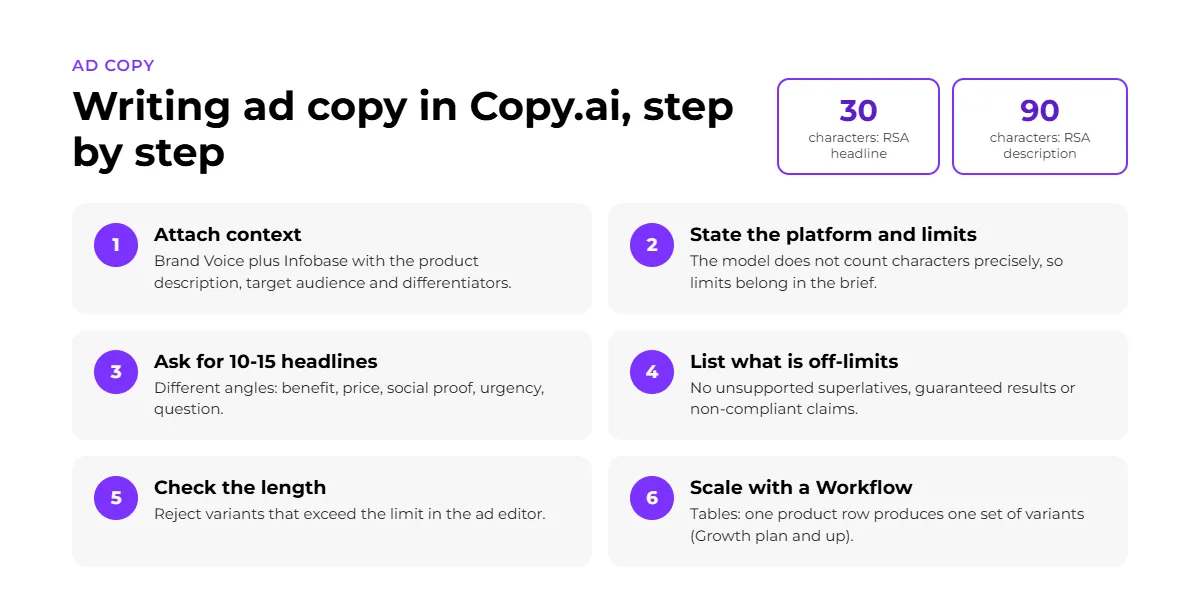
- Open Chat and link your Brand Voice profile along with Infobase entries containing the product description, target audience, and unique selling points.
- Specify the platform and character limits in the brief. In Google Responsive Search Ads (RSA), a headline allows up to 30 characters and the ad description up to 90. You must state this clearly to the model, as it cannot count characters precisely on its own.
- Ask for 10-15 headlines from different angles: benefit, price, social proof, urgency, and question. Having diverse variations gives the ad platform more meaningful combinations to test.
- Specify what the copy must not promise: unsupported superlatives, guaranteed results, or claims that violate ad platform policies or industry regulations.
- Check the length of each variant in the ad editor and discard any that exceed the limit.
- For dozens of products, move the same brief into a Workflow using Tables: each table row (product, USP, target audience) produces a separate set of variations. The public pricing page only includes workflow credits starting with the Growth plan and above.
Let's check your website's potential
Share your website and email - we'll get back to you with a real analysis, no strings attached.
Process automation using Workflows and AI agents
Copy.ai automates marketing and sales through no-code Workflows that combine AI agents (Copy Agents), web research, and integrations with business applications. The Enterprise plan includes over 20 native technology integrations and API access, while Zapier allows you to connect the platform to thousands of additional apps, including Salesforce and HubSpot. The vendor does not publish a full list of native integrations, so support for specific systems (e.g., Gong, Outreach, or Salesloft) should be confirmed before implementation.
Copy.ai bases its architecture on five interconnected components. Workflows define the sequence of steps, from data collection to the finished text. Actions are modular, no-code blocks that trigger specific functions or external systems. Tables store input and output data for subsequent steps. Infobase and Brand Voice provide knowledge and brand tone. Chat handles ad hoc requests.
The vendor builds out-of-the-box scenarios on top of this architecture. CRM Enrichment fills in customer records with company and contact data. Prospecting Cockpit researches accounts and contact persons before drafting a personalized message. Lead + Account Intelligence builds decision-maker profiles and industry context, while Inbound Lead Processing qualifies and prioritizes inbound leads. On top of that come Account Based Marketing campaigns and Deal Coaching & Forecasting, which relies on sources like sales call transcripts. Together, these handle repetitive research and initial outreach, tasks typically assigned to SDRs.
Tasks are carried out by Copy Agents: agents that handle narrow assignments and make minor decisions within preset rules, embedded inside multi-step processes. A single workflow can combine text generation, web scraping, and a research agent, all without writing code.
Tool Comparison: Copy.ai vs ChatGPT vs Jasper AI
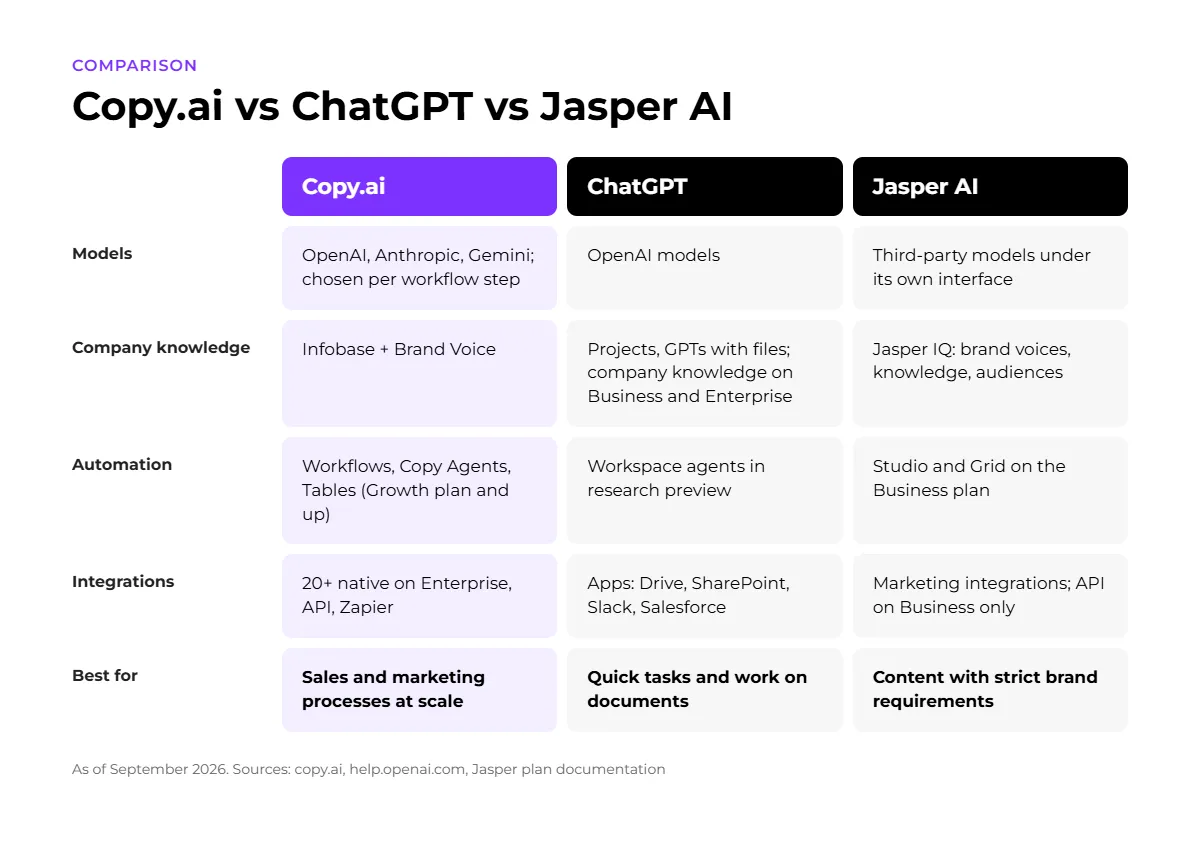
Copy.ai wins in multi-step GTM process orchestration and the freedom of model selection. ChatGPT has closed the gap in its business tiers with access to company knowledge and agents, while Jasper has evolved into an on-brand marketing content platform. The difference comes down to the center of gravity: Copy.ai starts from the sales and marketing process, ChatGPT from a universal assistant powered by OpenAI models, and Jasper from brand control.
Only Copy.ai lets you assign different models (OpenAI, Anthropic, Google Gemini) to consecutive steps within a single process. ChatGPT operates strictly within the OpenAI ecosystem. Jasper uses third-party models under its own interface.
| Criterion | Copy.ai | ChatGPT | Jasper AI |
|---|---|---|---|
| Base model | OpenAI, Anthropic, Google Gemini, selectable per workflow step | OpenAI models | Third-party models integrated under a proprietary interface |
| Core feature | AI copywriting + GTM process automation (Workflows, Copy Agents) | Universal assistant; Business and Enterprise plans also offer agents and company knowledge | On-brand marketing content (Canvas, Agents, Grid) |
| Company knowledge base | Infobase + Brand Voice | Projects and custom GPTs with files; company knowledge (Business, Enterprise, Edu) from apps like Drive, SharePoint, Slack | Jasper IQ: Brand Voices, Knowledge, Audiences; Pro plan is limited to 2 voices, 5 knowledge assets, and 3 audience segments |
| Multi-step automation | Workflows combining Actions, Copy Agents, Tables, and integrations (Growth plan and up) | Workspace agents in research preview (Business, Enterprise, Edu) | Studio (no-code agent builder) and Grid on the Business plan |
| Business integrations | Over 20 native integrations in Enterprise, API, Zapier | Apps (formerly connectors), including Drive, SharePoint, Slack, Salesforce | Marketing integrations; API only on the Business plan |
| Best used for | Scalable content and sales-marketing processes | Quick writing tasks, research, working with company documents | Campaigns with strict brand consistency requirements |
The choice depends on what needs to be automated. ChatGPT is enough for one-off editorial tasks and rapid content prototyping without setting up a workflow. Jasper works well for a marketing team that produces a lot of content and needs to safeguard brand voice and style, but does not need integration with the sales process. Copy.ai has the upper hand when content is just one stage in a broader process, from lead research to outreach and CRM logging. The same applies to AI search optimization efforts, where consistent company data and brand tone across multiple stages at once are critical.
Enterprise Data Security and Regulatory Compliance
Copy.ai secures enterprise data with a SOC 2 Type II (AICPA) certification and Single Sign-On (SSO) integration, and states on its security page that it does not train models on customer data. Each of these elements addresses a different risk: the SOC 2 audit confirms the vendor's internal process controls, SSO centralizes authentication within the company's infrastructure, and the no-training policy protects intellectual property. GDPR compliance requires separate verification.
For IT and compliance departments, this means the following setup:
- SOC 2 Type II: an independent audit of security controls over an extended period. The report is available via the vendor's Trust Center (trust.copy.ai).
- GDPR: the Copy.ai security page does not mention it explicitly. When working with EU contact lists, request a Data Processing Agreement (DPA) and a list of sub-processors.
- Single Sign-On (SSO) connects logins to the company's authentication system, eliminates standalone passwords, and reduces the risk of unauthorized access.
- Data isolation: the vendor declares that prompts and input data do not train its models and are never shared with other customers.
One detail gets overlooked in most reviews. Copy.ai uses models from three external providers, meaning prompt data also passes through their infrastructure. Data processing terms for OpenAI, Anthropic, and Google must be reviewed on the sub-processor list, not just in Copy.ai's own statements.
The pricing table reserves the full suite of enterprise-grade security features for the Enterprise plan. For organizations processing sensitive customer data or running automated outreach at scale, this is practically the only tier that will clear an internal security review.
Copy.ai Pricing: Subscription Plans, Free Version, and Implementation Costs
Copy.ai offers five plans: Chat for $29 per month ($24 with annual billing), three automation plans - Growth, Expansion, and Scale - and Enterprise with custom pricing. The public pricing page does not include a free version. According to archived website snapshots, the Free, Starter, and Advanced plans were removed from the offering in the second half of 2025.
| Plan | Target Audience | Key Scope |
|---|---|---|
| Chat | Freelancers, small marketing teams | 5 seats, unlimited words and projects in Chat, OpenAI, Anthropic, and Gemini models; $29/mo or $24/mo with annual billing |
| Growth | Companies implementing their first automations | 75 seats, 20,000 workflow credits per month; $1,000/mo, billed annually ($12,000) |
| Expansion | Larger GTM teams | 150 seats, 45,000 workflow credits per month; $2,000/mo, billed annually |
| Scale | Organizations with large-scale automation | 200 seats, 75,000 workflow credits per month; $3,000/mo, billed annually |
| Enterprise | Sales and marketing departments in large organizations | Over 20 tech integrations, API and bulk workflow runs, unlimited workflows, dedicated account manager, enterprise-grade security; custom pricing |
There is a huge gap between the Chat and Growth plans: $24 and $1,000 per month. The Chat plan includes only the chat interface, while automation begins with Growth. A workflow credit is a unit of computing power for process steps, such as text generation, web search, or page scraping. Consumption depends on the complexity of the workflow and is visible with each run; additional credits can be purchased. According to independent pricing analyses, unused credits do not roll over to the next month.
We do not recommend Copy.ai to companies that only need marketing copy. The Chat plan is sufficient for writing, but the platform's core value - automation - costs at least $12,000 per year, and there are cheaper tools available for copywriting alone.
The cost of the Enterprise plan goes beyond licensing. It includes configuring integrations, connecting the API to the company's systems, and building workflows tailored to the organization's GTM process. The vendor conducts this as part of a Guided Jumpstart Implementation and outlines an estimated timeline: kickoff on day one, testing in the first week, and production around day 15. The final cost depends more on the scope of integrations and the number of seats than on the license price.
Advantages, Limitations, and Effective Implementation into Company Strategy
Copy.ai generates content and executes GTM processes, but every output requires verification in a human-in-the-loop model. The platform pays off where a team has a lot of repetitive work, along with a person who reviews the output before publication or sending.
Overview of Benefits and Barriers in Daily Use
The platform's greatest strengths are consistency and scale. Infobase and Brand Voice maintain the brand voice regardless of the volume of materials, while Workflows with Actions and Copy Agents automate the chain from lead research to the finished content. Organizations running multiple campaigns and prospecting processes in parallel stand to gain the most.
Limitations stem from the nature of generative models, regardless of whether a step is performed by an OpenAI, Anthropic, or Gemini model:
- Risk of hallucinations. The model can generate a statistic, quote, or parameter that sounds plausible but has no basis in reality.
- In niche industries (legal, medical, narrow B2B), the model replicates technical and regulatory context superficially.
- Every automatically generated asset requires human fact-checking before publication or sending to a client.
- Infobase quality affects every output: an outdated or incomplete repository duplicates errors across every generated piece of content.
Human-in-the-Loop Model and Implementation Steps for Marketing Teams
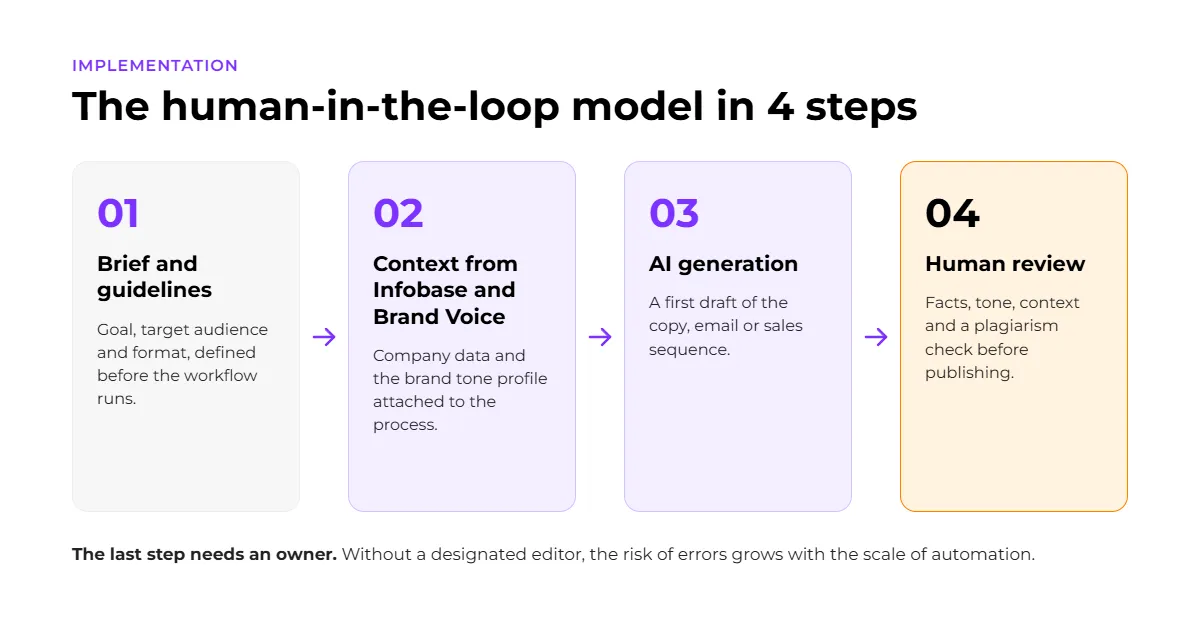
Effective implementation requires a human-in-the-loop model, in which the automation of content generation and prospecting is safeguarded by editorial review and substantive verification. The model is based on four repeatable steps:
- Brief and guidelines. The team defines the material's goal, target audience, and format before running the workflow.
- Context from Infobase and Brand Voice. The workflow references company data and the brand voice profile.
- Automatic content generation. The platform creates the first draft of the copy, email, or sales sequence.
- Final human review. An editor checks facts, tone, and contextual fit, and runs a plagiarism check before publication.
The final stage must have an owner. Without a designated editor, the risk of publishing incorrect information grows alongside the scale of automation. The same division applies to outreach sequences: automation prepares message variants, while a sales rep or SDR checks the context before sending to a specific lead.
FAQ
Is Copy.ai completely free?
No. Copy.ai's public pricing does not include a free plan; the most affordable option is the Chat plan at $29 per month ($24 with annual billing). Workflow automation begins with the Growth plan at $1,000 per month, billed annually.
Does Copy.ai handle generating content in Polish well?
The platform supports Polish via multilingual LLMs (OpenAI, Anthropic, Gemini), but it requires checking for stylistic accuracy. Quality improves significantly after populating Infobase and Brand Voice with the company's Polish-language assets.
How does Copy.ai differ from the free version of ChatGPT?
Copy.ai is a GTM AI platform featuring Workflows, Tables, Copy Agents, Infobase, and Brand Voice modules, over 20 native integrations in the Enterprise plan, and access to models from three providers. Free ChatGPT is a general-purpose assistant powered by OpenAI models; company knowledge and shared team agents are only available in the Business and Enterprise plans.
Is content generated by Copy.ai safe from plagiarism?
Not automatically. The model may reproduce generic phrases found online, which is why the human-in-the-loop model includes a plagiarism check before publication.
Sources
- Copy.ai, Plans & Pricing: https://www.copy.ai/prices (plans, pricing, number of users, Enterprise scope, credit FAQ; as of September 2026)
- Copy.ai, Security: https://www.copy.ai/security (SOC 2 Type II, SSO, statement on not training models on customer data)
- Copy.ai Trust Center: https://trust.copy.ai/ (SOC 2 report on request)
- Copy.ai, Which AI Language Model Should You Choose per Task?: https://www.copy.ai/blog/which-ai-language-model-should-you-choose-per-task
- Copy.ai, Fullcast Acquires Copy.ai: What This Means for You: https://www.copy.ai/blog/fullcast-acquires-copy-a
- Fullcast, Fullcast Announces the Acquisition of Copy.ai (10/15/2025): https://www.fullcast.com/content/fullcast-announces-the-acquisition-of-copy-ai/
- Strategy of Finance, Copy.ai pricing, reviewed (plan change history in 2025): https://www.strategyoffinance.com/benchmarks/ai-credit-index/reviewed/copy-ai/
- Zapier, Copy.ai Integrations: https://zapier.com/apps/copyai/integrations
- OpenAI Help Center, Company knowledge in ChatGPT: https://help.openai.com/en/articles/12628342-company-knowledge-in-chatgpt
- OpenAI, Introducing workspace agents in ChatGPT: https://openai.com/index/introducing-workspace-agents-in-chatgpt/
- SaaS CRM Review, Jasper AI Pricing 2026 (Pro and Business plan limits): https://saascrmreview.com/jasper-ai-pricing/