
Answer The Public - What It Is, How It Works, and How to Use It in SEO and Content Marketing
Answer The Public generates topic suggestions based on real user queries entered into the Google search engine. It is a browser-based online keyword research tool (available at answerthepublic.com) that shows what questions and long-tail phrases users ask based on one or two entered terms. It requires no installation, and you can view the results in graphic form, as a visualization wheel, or as a text list: questions, comparisons, and terms arranged alphabetically around a given topic. The tool is owned by Neil Patel and the NP Digital agency.
This is a practical guide for SEO specialists, content creators, marketers, and other professionals in the marketing industry who want to meet the needs of potential customers. Answer The Public is a search engine for content ideas, not a classic keyword planner focused on search volume and keyword difficulty.
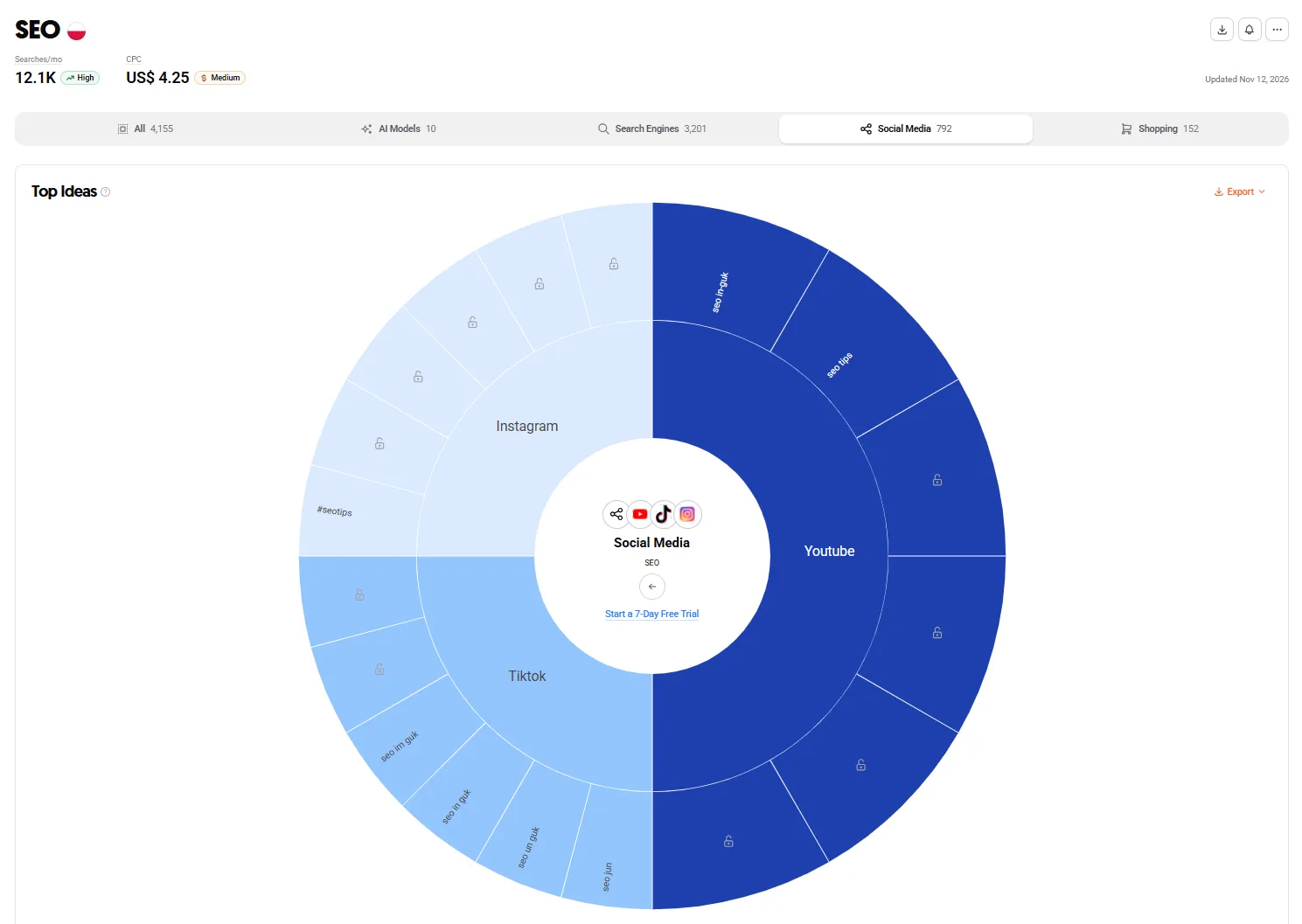
The tool generates related queries based on search engine suggestions once the user defines the location, language, and source platform - making it easy to tailor results to a specific market. Sources can include Google, Bing, YouTube, Instagram, TikTok, and Amazon, and the API documentation adds ChatGPT and Gemini to this list. As a result, Answer The Public makes it easier to identify the real needs of your audience. It lets you discover questions you would not find in a standard keyword planner - which comes in handy when planning articles, FAQ sections, and content visible both in traditional search results and in AI-generated answers.
How Answer The Public Works and Where It Gets Its Data
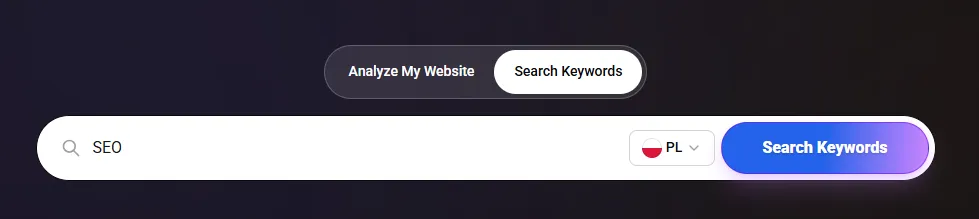
Answer The Public works on the principle of search listening: it aggregates suggestions from Google Autocomplete and other platforms, appending subsequent words and letters of the alphabet to the search term. Enter 1-2 broad keywords instead of a complex phrase, choose a country and language (e.g., Poland and Polish, despite the English interface), and select a source platform. The result depends on whether you start with a general keyword or a long, specific phrase: the broader the term, the wider the set of results. This is especially useful when you are just looking for an idea for a new topic. As an online tool, Answer The Public runs in your browser without any additional installation or a premium account. Data drawn simultaneously from several search engines gives a broader picture than a single source, and knowing your audience's language makes it easier to pick relevant seed terms.
Result Types and the Structure of Generated Queries
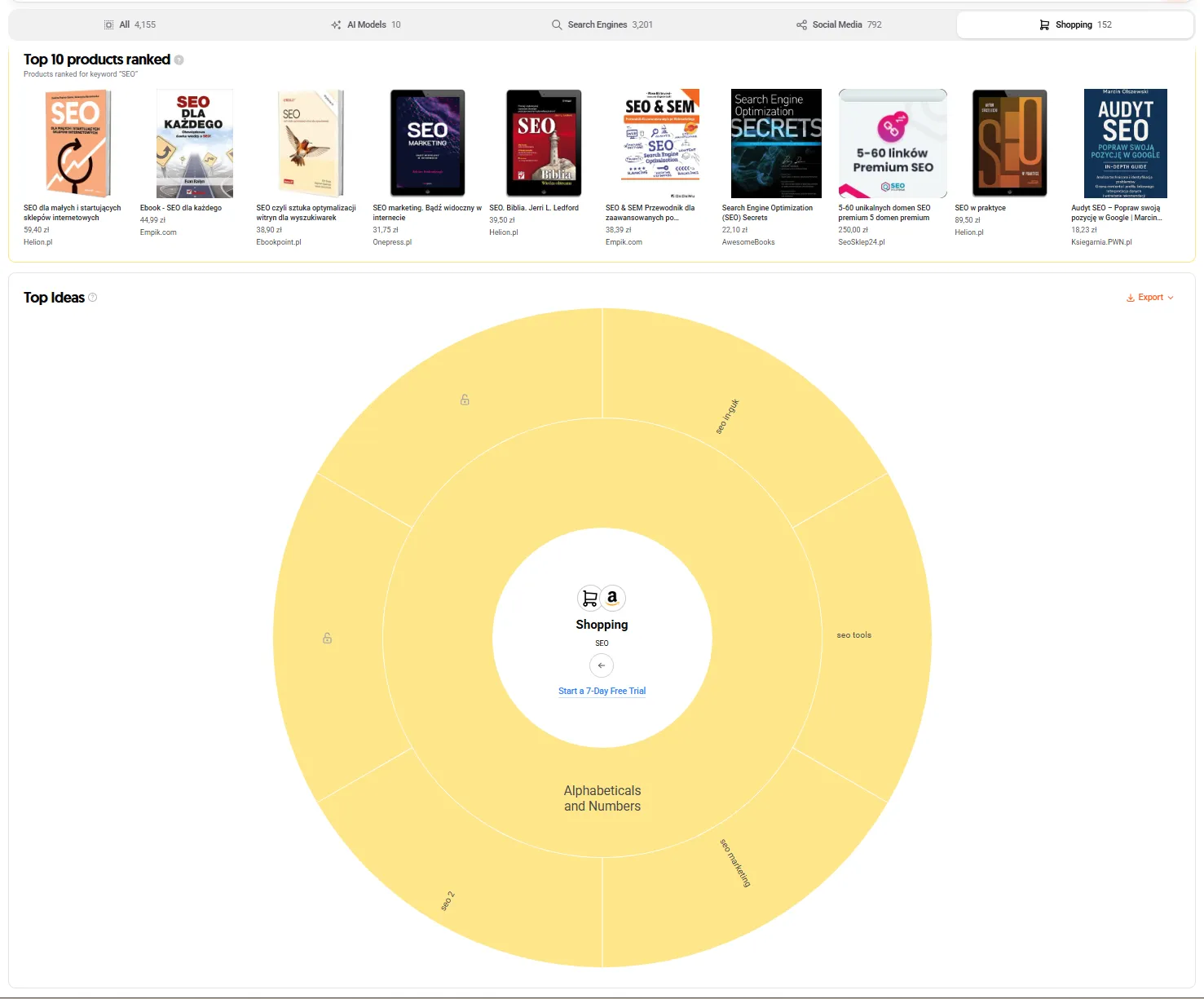
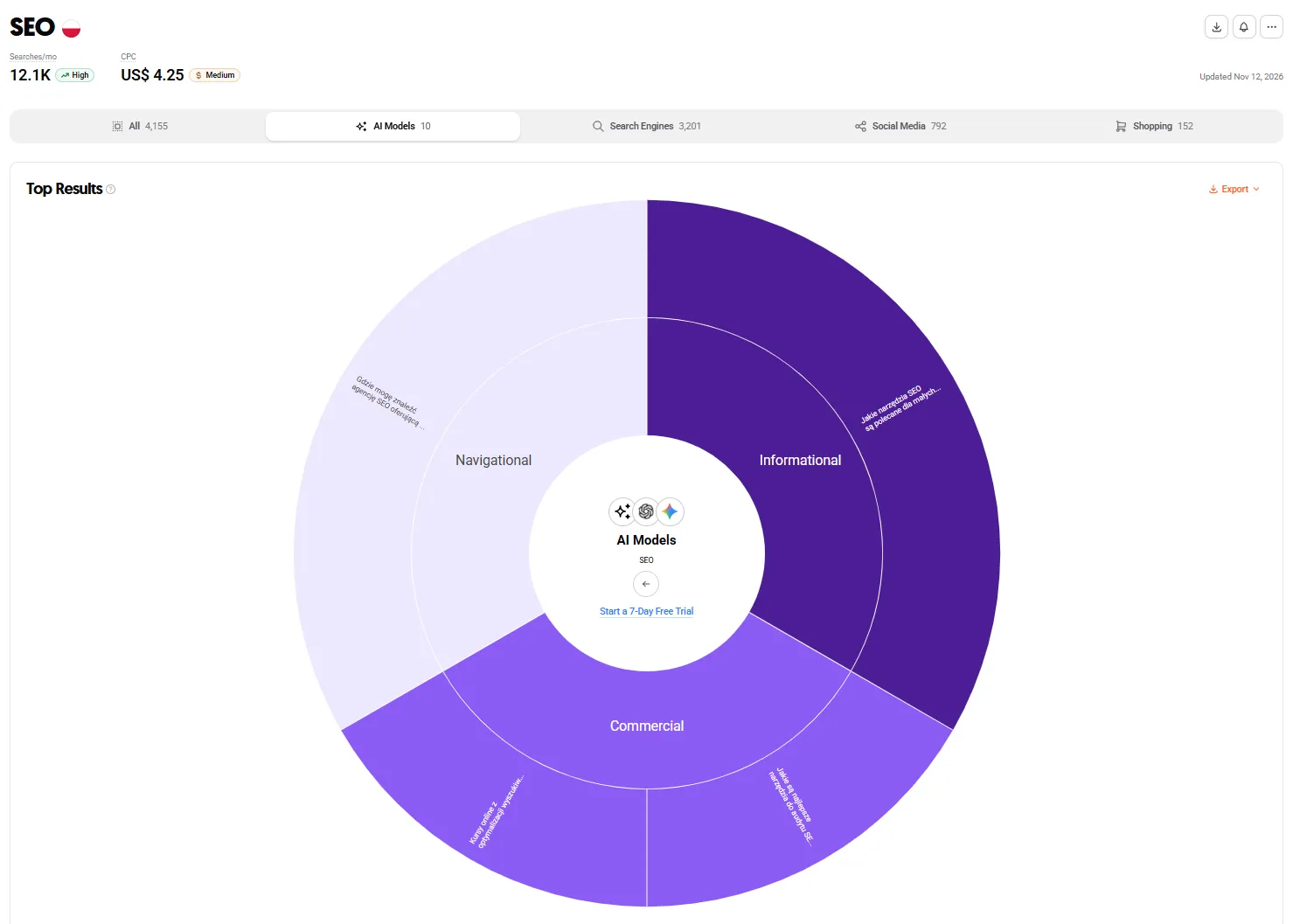
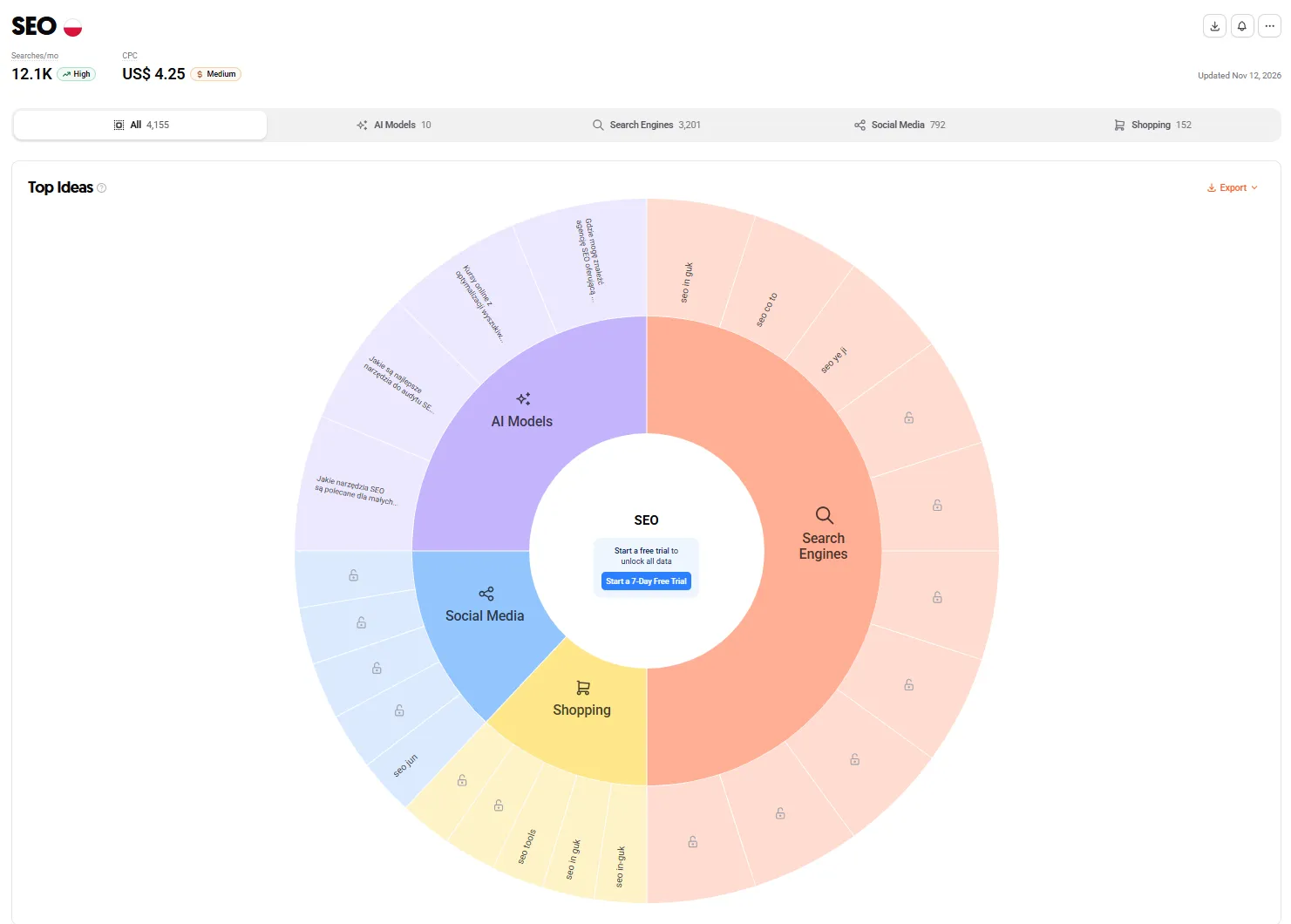
Answer The Public displays processed data as a query visualization wheel or as a categorized text list, divided into five categories:
- Questions: a questions report, i.e., question phrases (what, how, why, where, when, who).
- Prepositions: a prepositions section (with, about, without, for).
- Comparisons: a comparisons section (versus, vs, or).
- Alphabetical: terms arranged in alphabetical order.
- Related: related terms.
In addition to ready-made questions, the report also shows individual expressions and phrases entered into search engines. Some expressions do not have enough search volume to justify a standalone article, but it is worth reviewing them manually to select the most interesting ones for your industry. You can export the entire report as a CSV file, and downloading PNG images makes further spreadsheet processing easier.
| Source | User goal | Suggested content format |
|---|---|---|
| Information, comparison, purchase | Article, FAQ section | |
| YouTube | Tutorial, "how-to" | Video, step-by-step guide |
| TikTok | Inspiration, trends | Short-form video |
| Inspiration, visual topics | Carousel, reel | |
| Amazon | Product selection | Product description, ranking |
The tool shows what people ask on the internet, but it does not replace a keyword planner for tracking search volume. These are real phrases circulating online, not examples made up by a copywriter. Compiling such keywords is often a solid starting point for further analysis, although search volume and keyword difficulty should still be verified in an external database.
How to Use Report Data in Content and SEO
Systematized questions from the Answer The Public report become the foundation for pillar articles and topic clusters. They only gain real value once translated into specific phrases in headings and ready-made answers, rather than standalone, separate posts. Before doing that, it is worth deciding which topic deserves a separate article and which belongs in a shared FAQ section.
Building Topic Clusters and FAQ Sections
Every main topic deserves one pillar article and a few supporting pieces; distribute the rest across FAQ sections. The process of creating topic clusters begins with grouping related queries into a single structure. It is worth evaluating each query for its actual intent before it enters a brief, because individual queries gain value only after being combined into topic clusters: groups of articles built around one core topic and several subtopics.
These are what build Topical Authority - the site's topical authority in the eyes of search engines and AI engines - and increase the chances of being cited in AI summaries, although neither Google rankings nor citations are guaranteed here. Real user needs, not just keywords, should drive effective website SEO and e-commerce SEO: that is where such clusters become the backbone of the entire site. Many content creators treat this tool as the first step in working on an article - it speeds up drafting a brief for a copywriter, which typically ends with a short summary of the key phrases.
Topics that do not justify a separate article go into the FAQ section of the pillar piece instead. It is worth gathering such frequently asked questions in one place and answering them directly: clear specifics in 2-3 sentences, and for an online store, adding them to product categories. This is also an element of everyday SEO copywriting - it allows you to cover more phrases without multiplying the number of separate articles. The goal is to truly understand customers, rather than guessing potential customers' needs without any data. A good FAQ section should help customers and solve their problems, not just list definitions.
Optimization for AI Overviews and Conversational Search Engines
Answer The Public provides export data that an analyst organizes in four stages: filtering, grouping, heading mapping, and verification.
- Filter. Keep long-tail phrases with clear search intent, discard incorrect results and anything that does not fit the topic.
- Group. Move these queries, prepositions, and comparisons into folders. Alerts will notify you of new suggestions.
- Assign headings. The primary keyword defines the pillar topic, question groups become H2s, and comparisons and prepositions become H3s.
- Verify. Check volume and difficulty in an external database, as the tool does not validate them.
A well-chosen article topic stems directly from such data. Illustrative example (hypothetical):
- For the keyword "electric bike," the phrase "how to choose an electric bike" appears in the questions report. It becomes the H2 heading "How to Choose an Electric Bike?", followed by a concise, AI-friendly 2-3 sentence answer, e.g.: "Start choosing an electric bike by determining where and how often you will ride. Only then compare range, motor power, and weight. We describe the details of each criterion in the following sections." Comparisons from the report, such as "electric bike vs regular bike," then become H3 subsections.
A directly posed question, with a brief answer right beneath the heading, makes citations in Google AI Overviews easier and helps maintain visibility in classic search results. Such an answer should address their needs, not just keywords. Otherwise, you are guessing what customers expect instead of knowing it. This same set of best practices is also the basis of AI SEO - increasing the chance of being cited in other generative engines, such as Perplexity or Google Gemini. However, no tool, including Answer The Public, guarantees this. The built-in Content Studio module supports content ideation and AI draft generation, with limits depending on the plan: up to 6 drafts per month on the Starter plan, up to 35 on the Growth plan, and up to 80 on the Business plan.
Let's check your website's potential
Share your website and email - we'll get back to you with a real analysis, no strings attached.
When to Use the Tool and When to Avoid It
SEO specialists and copywriters turn to Answer The Public to better understand customers at an early stage of content planning. It comes in handy when uncovering informational queries, long-tail phrases, or selecting a topic that genuinely interests the audience. The tool is useful as early as the topic ideation stage, before a brief is created, but it does not replace a keyword planner for brand analysis or hard volume data.
| Situation | Decision |
|---|---|
| Planning a blog, FAQ section, or topic clusters | Use: the query database shows user needs |
| Content gap audit for an existing site | Use, but compare the list against published content and competitor activities to avoid content cannibalization |
| Branded keywords | Avoid: autocomplete suggestions for proper names yield a negligible number of unique results |
| Keyword selection for Google Ads | Avoid as the sole source: CPC and volume from an external database are required |
Answer The Public is based on the Google Autocomplete mechanism. AlsoAsked, on the other hand, pulls data directly from the People Also Ask section and builds a question tree from it, showing how subsequent topics branch out from one another. This better reflects how questions connect into continuous paths and makes it easier to identify relationships between them. For hard volume data, it is worth turning to other tools, such as Semrush or Ahrefs - these are among the most popular paid alternatives for conducting your own user query analysis, as they also display search volume and keyword difficulty. Local industries and online stores are areas where a query database can be especially useful, although reliable keyword analysis requires both sources here: queries from Answer The Public and search volumes verified separately.
It serves as a solid starting point for brainstorming topics, but it does not replace hard volume data or competitor analysis.
Answer The Public Pricing and Free Version Limits
Answer The Public is a freemium keyword tool - the paid plan lifts most restrictions. The free plan operates under a fair use policy. Different sources report different daily limits, usually in the range of 1-3 searches per day, with basic features and keyword lists, but without search volume data. It is always worth checking the exact, up-to-date number directly on the tool's website. A free account also allows you to save your search history and reports.
Paid plans (as of November 2026) unlock additional features.
- Starter: 72 PLN per month (48 PLN per month with annual billing, totaling 576 PLN per year, saving 288 PLN annually), 1 user, up to 100 searches per month, search volume and CPC data, around 1,000 AI prompt suggestions per month, up to 6 AI article drafts per month.
- Growth: 350 PLN per month (233.33 PLN per month with annual billing, totaling 2,800 PLN per year, saving 1,400 PLN annually), up to 3 users, up to 200 searches per month, data comparison over time and priority support, up to 35 AI article drafts per month.
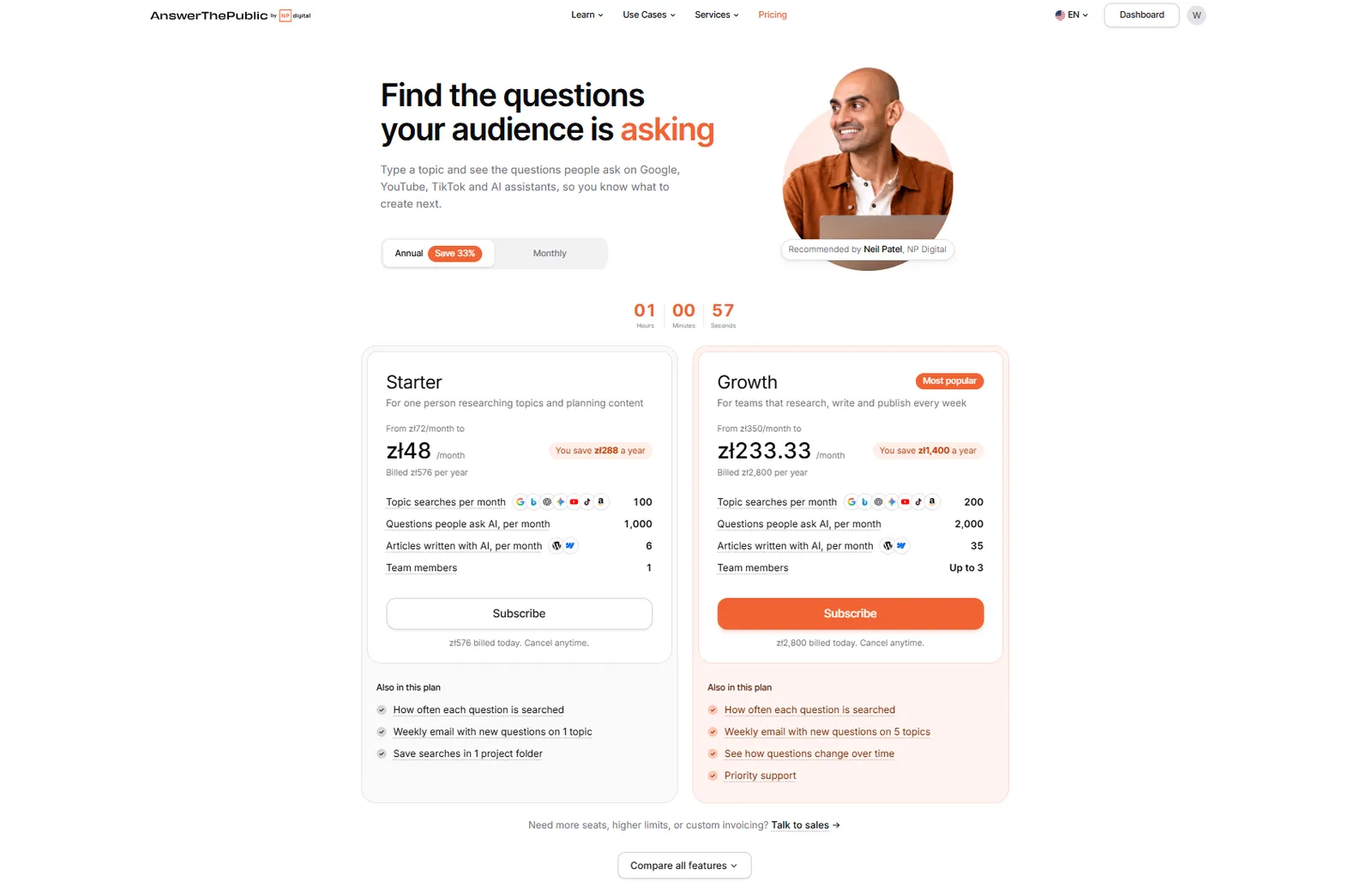
None of the current plans offer an unlimited number of users or unlimited searches. Billing is monthly or annual; a one-time fee for lifetime access is not currently confirmed in the official NP Digital pricing. For occasional analysis, the free limit is sufficient, but a team that regularly plans content for a company website will need a subscription. Detailed, up-to-date limits and subscription package prices are specified in NP Digital's official pricing, which may change, so it is worth checking directly on the tool's website before making a decision.
Search Volume is the estimated monthly search volume, and CPC is the estimated cost per click in paid ads. Remember that these are only estimates, so it is a good idea to confirm important decisions in an external database. The tool also allows URL analysis, meaning you can check related queries for an entered website address.
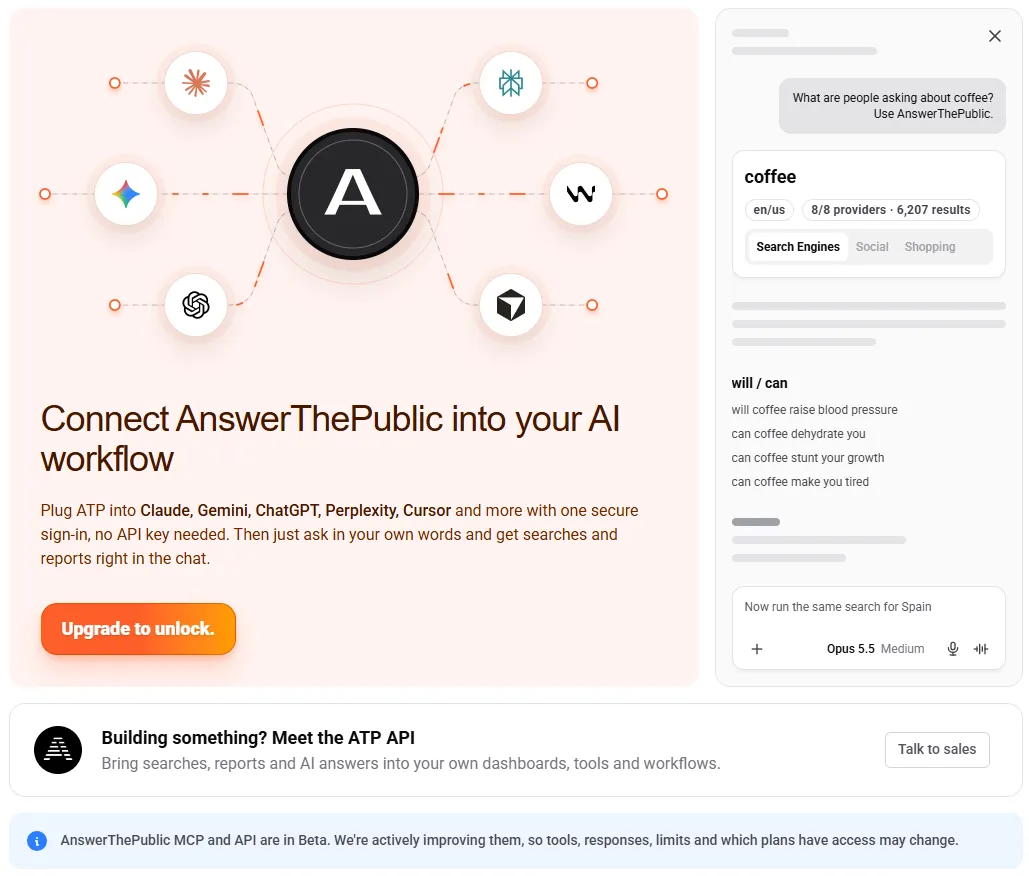
The public API requires an active, fully paid recurring subscription, either monthly or annual. Answer The Public also offers integration via MCP - a single login without an API key connects the tool to Claude, Gemini, ChatGPT, Perplexity, or Cursor, sending search results straight into the chat. Both MCP and the public API are labeled as beta by the developer, so the scope of features and limits may still change.
Frequently Asked Questions
Does Answer The Public work in Polish?
Yes. When searching, you select the country (Poland) and the Polish language, so the tool returns Polish queries from search engine suggestions. The interface itself is in English. Polish results can be less extensive than English ones, so it is best to enter short, general terms.
How many free searches does Answer The Public offer?
On its free plan, Answer The Public provides a limit usually stated as 1-3 searches per day, under a fair use policy. An account, even a free one, lets you save your search history and reports. The rules may change, so always check the tool's website for the current limit.
How is Answer The Public different from AlsoAsked?
Answer The Public generates hundreds of phrases from autocomplete (questions, prepositions, comparisons, alphabet) and works great for brainstorming. AlsoAsked is based on the People Also Ask section and uses this data to build a question tree showing how topics lead into one another, which helps structure an article.
Does Answer The Public data show monthly search volume?
Only in paid plans. The free version does not show volume, while paid plans include search volume and CPC data. However, these are estimates, so important decisions, such as ad budget planning, should be confirmed in an external keyword planner.