
Anchor Text: How to Choose Link Anchors to Boost SEO Effectiveness
A single poorly chosen anchor can cancel out the effect of dozens of valuable links. Anchor text (anchor), the visible, clickable part of a link, is a signal that Google uses to understand what the target page is about. Choosing anchors comes down to three rules: the anchor must match the content of the target page, sound natural within the sentence, and be concise. Quality and relevance matter, not the number of anchors. This guide is for people who run a website, blog, or online store and choose anchors themselves in internal and external links. In it, we explain what an anchor is, what types exist, how to select it, and how to avoid over-optimization.
Optimizing a website for anchors requires deliberately using different types of anchors: exact match, partial match, branded, URL, or generic, so that the profile looks natural to the algorithm. Excessive repetition of identical, heavily optimized phrases is often interpreted as an attempt at manipulation.
What is anchor text and what does it look like in a website's code
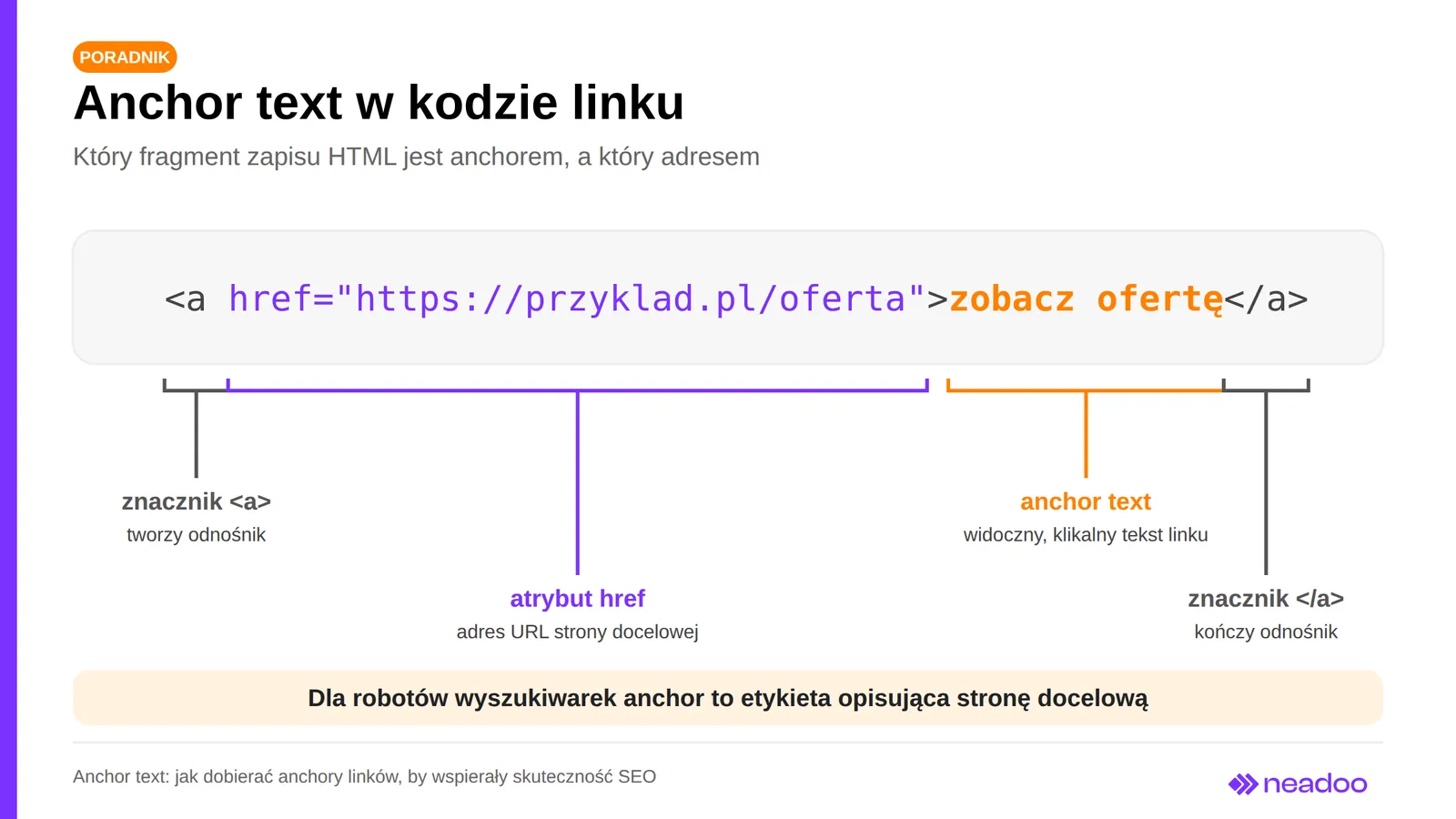
When someone types "what does anchor mean" into Google, they are looking for a simple answer: anchor text is the visible, clickable text of a link. Outside SEO, the word "anchor" can also refer to a news anchor or the anchoring effect in psychology, but here it refers to its meaning in link building. In HTML code, it sits between tags: <a href="url_address">anchor text</a>, where the element creates links leading to other places, and the href attribute specifies the URL of the target page. In the snippet <a href="https://example.com/offer">view offer</a>, the full URL is [https://example.com/offer](https://example.com/offer), and the anchor is "view offer."
Browsers highlight the anchor with color and underlining, and when hovering with the cursor, they show users the target address in the lower-left corner of the window, so the link destination is visible before clicking. For search engine crawlers, the content between the tags is a label describing the target page. This matters from an SEO perspective: it applies to both website SEO and the evaluation of the entire site's internal linking structure.
Types of anchor texts: exact match, partial match, branded, and others
Types of anchor texts differ in their function within a link profile, the strength of their topical signal, and the risk of over-optimization. In practice, eight main types are distinguished.
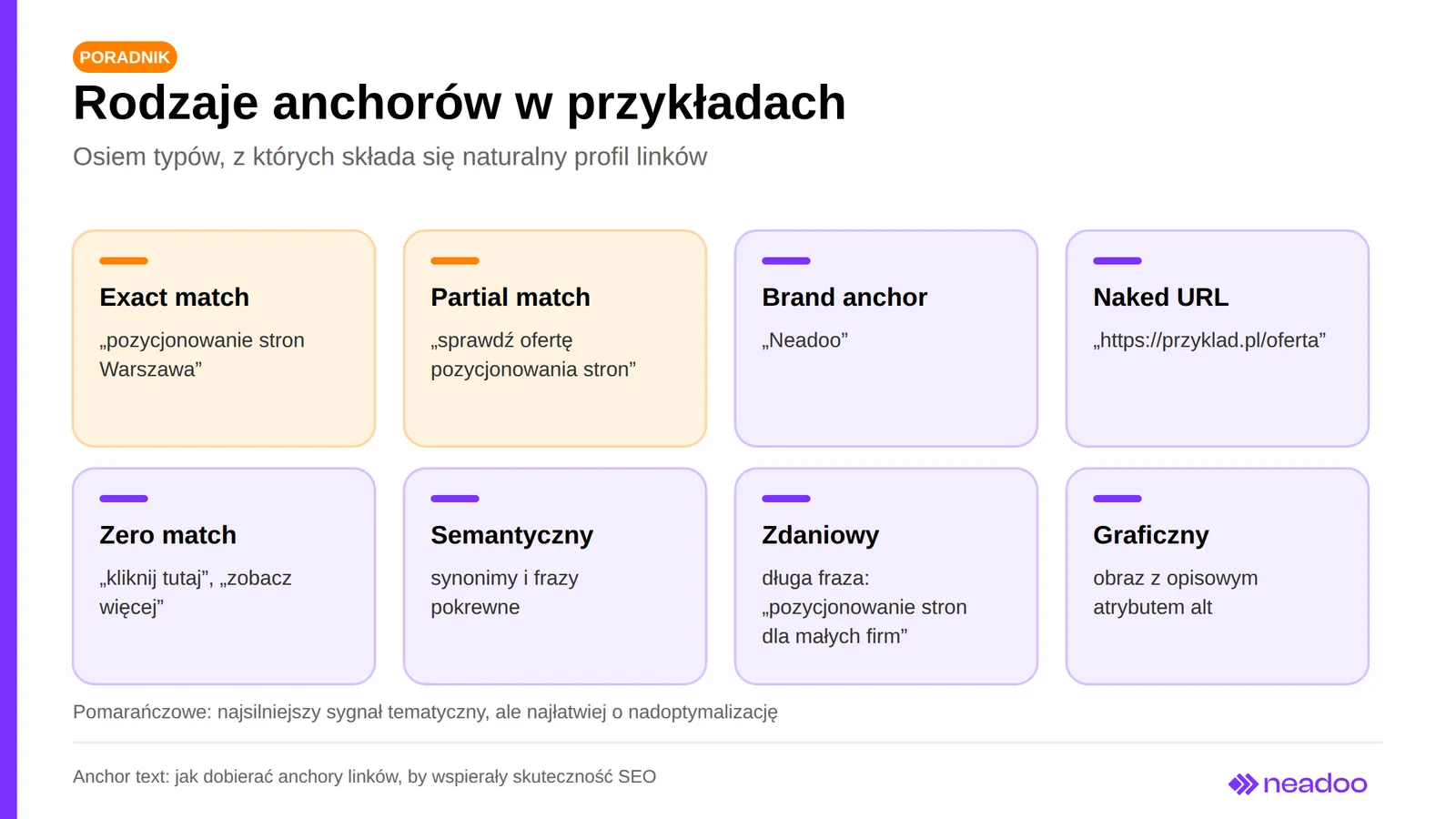
| Anchor Type | Example | Characteristics |
|---|---|---|
| Exact match (commercial anchor) | "Warsaw SEO" | An exact match anchor contains the exact, uninflected keyword: the strongest topical signal, but in excess, it can easily be flagged as manipulation |
| Partial match (semi-commercial anchor) | "check out our SEO services" | A partial match anchor contains an inflected or expanded phrase, so the partial match softens the optimization signal |
| Brand anchor | "Neadoo" | Builds website brand awareness and credibility; it dominates organic profiles |
| Naked URL | "[https://example.com/offer](https://example.com/offer)" |
Typical of comments and business directories, indicating a natural profile |
| Zero match (generic anchor) | "click here", "see more" | Serves a functional purpose and carries no topical signal |
| Semantic | synonyms and related phrases | Strengthens context without repeating the same phrase |
| Sentence (long tail) | "comprehensive SEO services for small businesses" | Precise and natural, typical of editorial content |
| Image | image with alt attribute | Requires a descriptive, concise alt attribute |
Exact match anchors and partial match anchors most often build topical strength in external links, while naked URLs and generic anchors dominate where links occur naturally, such as in forums and directories. A branded anchor is the foundation of a healthy profile. The choice of type depends on the target page, the publication venue, and the role the given link is meant to play.
Image anchor and the alt attribute
When an image acts as a link, the alt attribute takes on the function of an anchor, as Google confirms in its link guidelines. In code, it looks like this: <a href="url_address"><img src="..." alt="description"></a>. The alt text should concisely describe the image content and the purpose of the click, without keyword stuffing. An image link without alt text provides no topical signal to the search engine and deprives screen reader users of information about where it leads. This is a common mistake with banners, article thumbnails, and product graphics.
Why anchor text affects SEO and visibility on Google
Anchor text has been a ranking signal since Google's beginnings: analyzing incoming links and their descriptions was the basis for assessing relationships between pages even in the earliest versions of the search engine. A descriptive, relevant anchor helps search engine bots understand the topic of the target page before analyzing its content, which translates into the page's position in search results. Website SEO has therefore long been based on links and their descriptions. In its link guidelines, Google recommends anchors that are descriptive, reasonably concise, and relevant to both the page they sit on and the one they lead to.
The same mechanism can cause harm when used unskillfully. Google's systems interpret excessive use of identical anchors, especially exact match, as an attempt to artificially influence rankings in search results. Such anchors fall under the link spam guidelines: Google usually neutralizes their impact and, in egregious cases, issues a manual action against the domain.
The Penguin algorithm and anchors
Such patterns were detected by the Penguin algorithm (Google Penguin), which systematically penalized unnatural link profiles starting in 2012. Since 2016, it has operated continuously within the core ranking systems, evaluating links in real time without separate updates, while spammy links are also neutralized by the SpamBrain system. Following its introduction, link building shifted from link quantity to quality, and anchor diversity became critical. The takeaway for selecting anchors is simple: natural diversity is safer than a single optimized phrase.
Let's check your website's potential
Share your website and email - we'll get back to you with a real analysis, no strings attached.
How to choose anchor texts: rules for natural selection
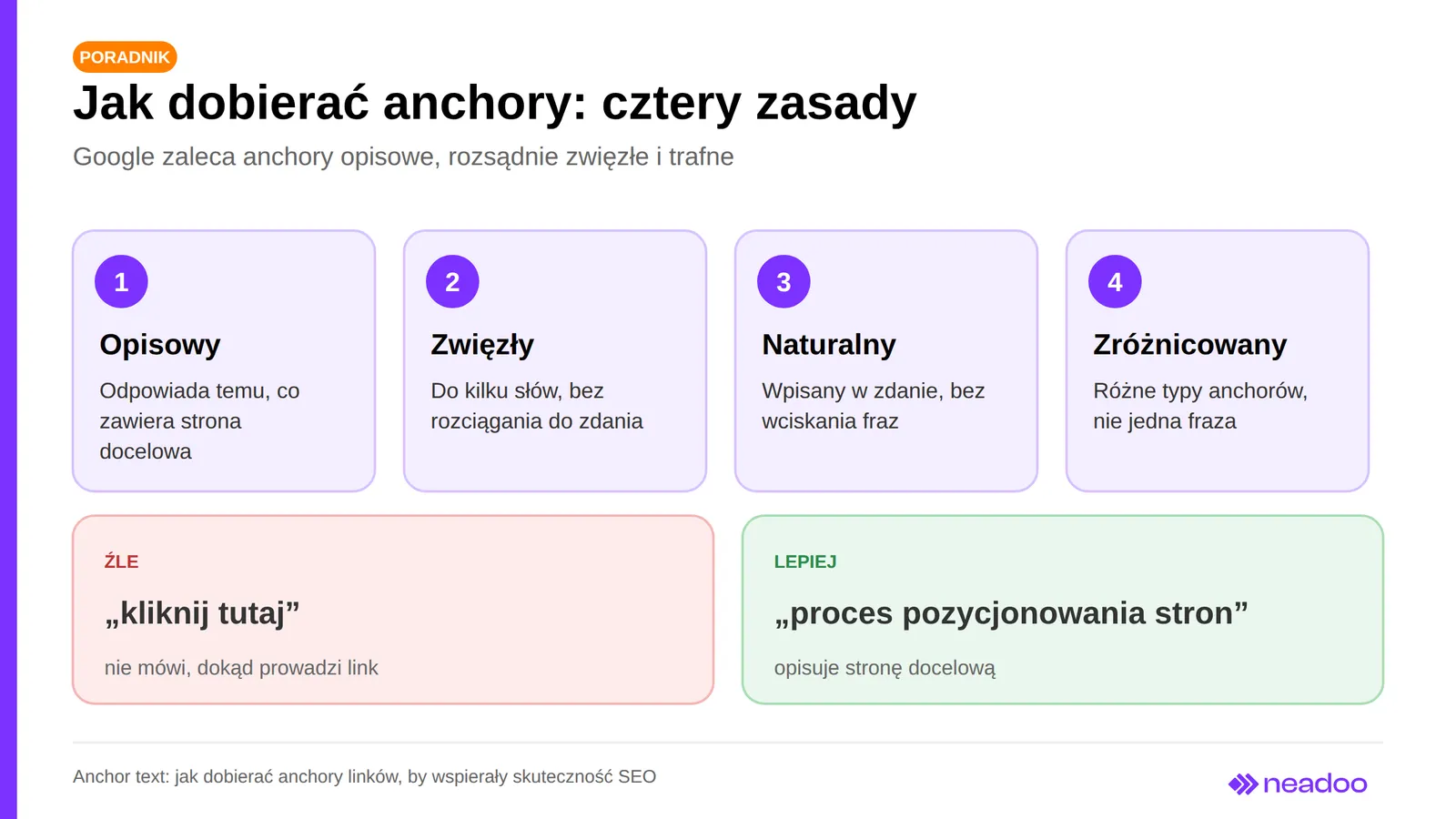
A good anchor text is concise, aligned with the target page's content, and naturally integrated into the sentence. Google does not specify a length limit, but in practice, anchors of up to a few words (roughly up to about 60 characters) work best. These three traits determine whether an anchor text supports a page's visibility in search results or looks like manipulation.
An anchor should descriptively match what the target page contains: the linked page must deliver on the anchor's promise. "See what the website SEO process looks like" conveys more than "click here," provided that this process is genuinely described there. When creating anchor text, think about the link's surroundings: Google advises paying attention to the words before and after the link and avoiding placing multiple links right next to each other.
Anchors that are too short ("here," "link") carry no topical signal, which is why descriptive phrases work better, while those that are too long lose readability and look stretched out. The tip from Google is simple: if you feel you are stuffing too many keywords into an anchor, you probably are.
Meeting the reader's expectations also matters. An anchor that does not match what the user finds on your page ruins the user experience and lowers trust, regardless of how well-optimized it is. Start your selection with the reader and the content of the page itself, and only then consider the algorithm.
Optimal anchor profile: what proportions are natural
A natural link profile usually assumes a predominance of brand and generic anchors over exact match phrases. In the industry, it is roughly assumed that brand anchors make up 30-40% of the profile, generic 20-25%, and exact match no more than 15-20%. This distribution reflects organic link acquisition: users and editors refer to a brand or write "see more" more often than they paste an exact keyword phrase, which is why natural links are rarely a perfect exact match.
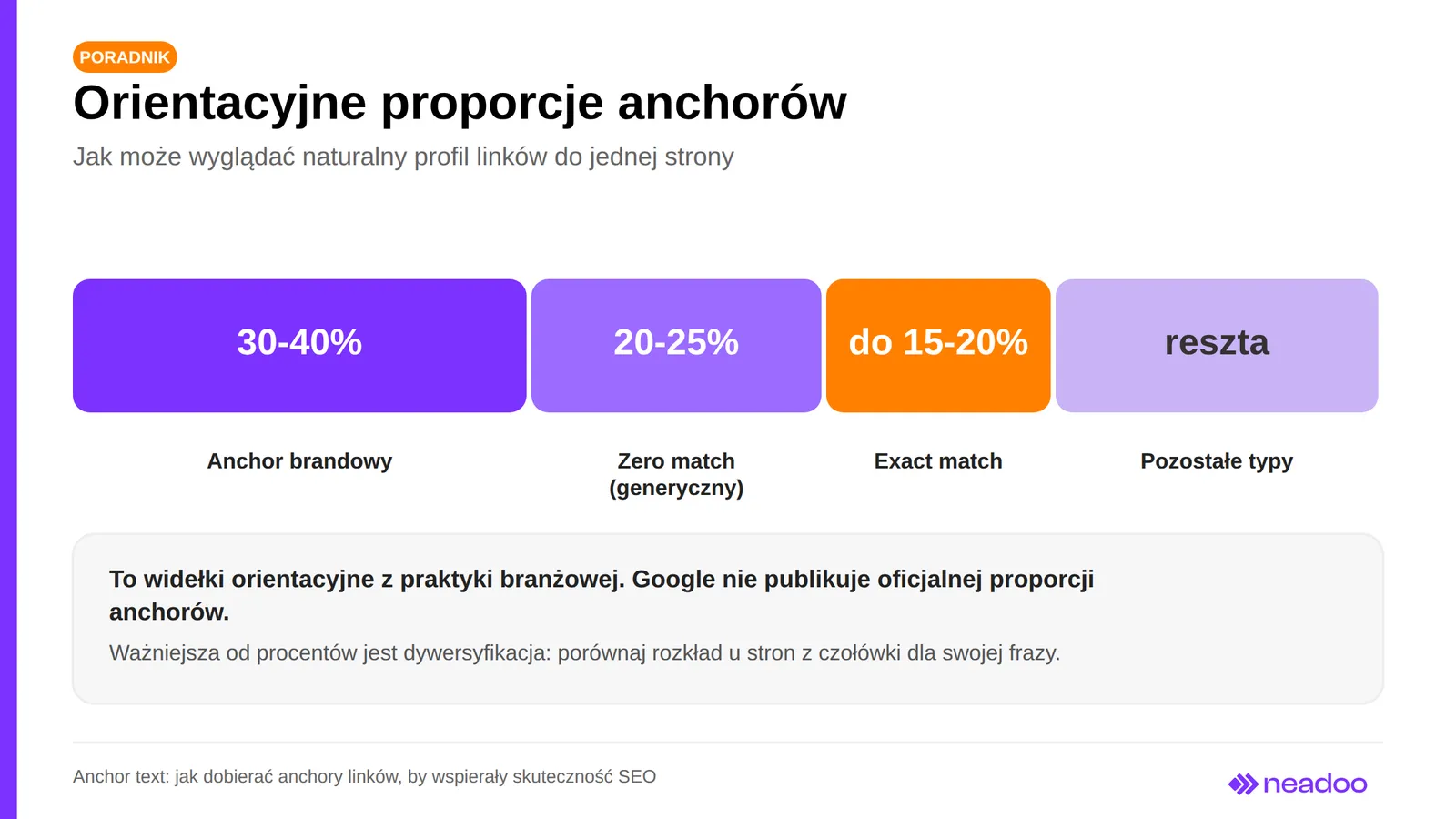
| Anchor text type | Approximate share | Notes |
|---|---|---|
| Branded anchor | 30-40% | Foundation of a healthy profile |
| Zero match (generic) | 20-25% | Useful for the reader |
| Exact match | up to approx. 15-20% | Excessive use increases the risk of an unnatural profile |
| Other types | remainder | Diversification without repetition |
These are rough ranges: Google does not publish official proportions, and the values given reflect industry practice, not a search engine rule. It is more effective to compare the anchor distribution of top-ranking pages for a given keyword phrase and match your own distribution to it. Knowing the types of anchors makes it easier to plan these proportions consciously. More important than the percentages themselves is diversification, because a profile dominated by a single anchor type is detected more easily, regardless of thresholds.
Anchor text in internal linking
The importance of anchors within a single domain lies in the fact that they act as signposts: they show bots and users how content is connected, organize it within the site structure, and reinforce the importance of key subpages. Googlebot, analyzing links between subpages, builds a map of topical relationships, and consistent, descriptive anchors make it easier for it to classify these relationships. Each internal link passes part of its value (link juice) from the source page to the target page, and the anchor clarifies the context of this transfer. When many pages link to a subpage with relevant, diverse anchors, it receives a stronger topical signal than one pointed to by sporadic or exclusively generic links.
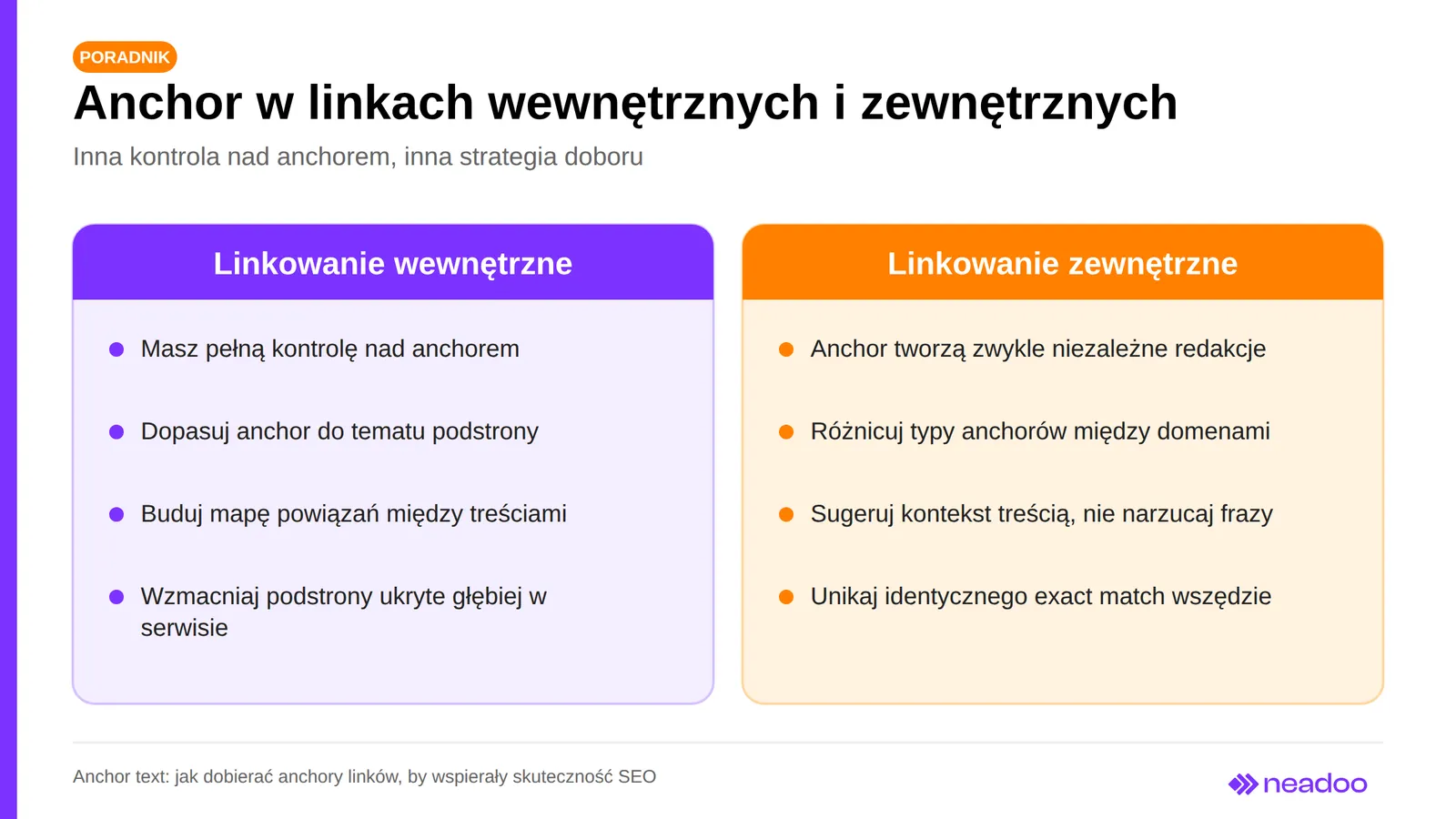
On your website, you have full control over internal anchors, unlike external links, where the anchor text is usually set by the editorial team of another website. Thanks to this, you can build a clear map of relationships, for example by linking guide articles to a service such as SEO positioning. In website optimization, a well-thought-out architecture based on internal anchors helps distribute value to subpages hidden deeper in the structure that receive external links less frequently.
Anchor text in external link building
With external links, safe anchor text selection consists of varying anchor types across referring domains. The rules of external linking are different from internal linking: anchors here are usually created by independent editorial teams, bloggers, and partners, and this natural diversity determines the credibility of the profile. When links from many unrelated websites contain anchors on a similar topic (not necessarily identical), the search engine reads this as confirmation of the website's value as an information source.
A realistic goal is to suggest context, for example through the content of a guest post, rather than imposing an identical set of keywords on all partners. It is therefore worth planning a link building campaign so that different domains receive different anchor variants: some brand, some descriptive, some woven into a sentence - a mix of different anchors.
Excessive use of exact match: risks and common mistakes
Identical or overly repeated anchors are a pattern that the Penguin algorithm used to react to, and today ranking systems and SpamBrain react to. The search engine may interpret them as an attempt at manipulation, putting the domain at risk of link neutralization or a manual action. The most common mistakes are exceeding a safe exact match share (above roughly 15-20% of links to a page), identical anchors from many domains at once, overly short anchors without context (like "here" or just the URL itself), keyword stuffing in the anchor, anchors stretched across an entire sentence, a lack of variation in types over time, and embedding an optimized anchor in content unrelated to the linked page.
A consequence of excessive exact match usage in manipulative link building can be a manual action, visible in Search Console as an unnatural links notice. Optimization should rely on descriptive, natural selection of a phrase relevant to the target page, rather than on mechanically maximizing the share of a single keyword phrase.
How to analyze and maintain an anchor profile over time
An anchor profile is not static: it is built over years as a result of actions by various editorial teams, link building campaigns, and content updates. In practice, you export a full list of anchor texts from a backlink analysis tool, group them by type (exact match, brand, generic, semantic, URL, image), and compare the distribution with that of top-ranking pages for the same keyword phrase. You evaluate a given link in the context of the entire profile, not in isolation. An audit also includes internal linking, because new subpages, changed headings, and a rebuilt architecture affect which anchors are used.
Companies running systematic website positioning include anchor analysis in regular reporting, alongside monitoring rankings and the quality of new links, to catch an accumulation of a single type before it starts looking like manipulation.
FAQ
What is an anchor and how does it differ from a regular link?
Anchor text (link text) is the visible, clickable part of a link, meaning the text between the ... tags. The "link" itself encompasses the entire mechanism together with the URL in the href attribute, while the anchor is its descriptive layer.
What are the types of anchors?
The most commonly distinguished types are exact match, partial match, brand, naked URL, zero match (generic), semantic, sentence, and image anchors. Good anchor types are those that together create a diverse, natural profile.
What is the optimal anchor length?
Google does not specify a limit; it requires descriptive and reasonably concise anchors. In practice, two to several words (up to roughly 60 characters) work best: shorter loses its descriptive nature, while longer weakens readability and the topical signal.
What percentage of links can be exact match?
Google does not set a threshold. In the industry, roughly no more than 15-20% of links to a given page is assumed, but diversity and naturalness of the profile are more important than the number.
Does the anchor "click here" harm SEO?
It does not cause a penalty on its own, but it is ineffective: it does not tell the search engine or the user where the link leads, so it loses out to descriptive, topically relevant anchors.
What is the anchor when a link is an image?
The alt attribute of the image. Briefly describe the content of the graphic and the purpose of the click in it.