
AI Music Generators - Ranking the Best Tools in 2026

Which AI music generator in 2026 will actually give you a finished, fully licensed track - and not just a demo you can't publish? That's the question everyone asks when they start looking for music-making AI: the market has changed dramatically over the past few months, largely due to licensing settlements with record labels (Warner, BMG, UMG) and the introduction of restrictive download limits by market leaders. There is no simple answer, because the best AI music generator depends on whether you are looking for top-tier studio vocal quality, full control over stem editing, or a safe commercial license for social media.
An analysis of six key platforms - Somio, Suno, Udio, MiniMax Music, and Mureka - reveals a clear picture: Suno v5.5 still leads in vocal quality, but limits free downloads to a token amount; Udio wins on the emotional naturalness of its sound, yet in 2026 blocked file exports due to its transition to a licensed model; and Somio, as a text-to-music AI software, stands out with its complete commercial license and video features. This 2026 AI music generator ranking compares the real capabilities, free plan limits, and legal status of each AI music app so you can choose a solution that genuinely fits your needs - whether it's a free AI music generator for personal projects or an online AI song generator for commercial release.
Ranking of the Best AI Music Generators in 2026
A comprehensive 2026 AI music generator ranking must include, alongside the best-known leaders (Suno, Udio), three specialized tools from the professional and developer segments: MiniMax Music, ElevenLabs (Eleven Music), and Mubert. Each represents a different model for using generative AI - from finished tracks to audio generated live within applications.
| Tool | Version / Model | Key Features | Commercial License | Best Use Case |
|---|---|---|---|---|
| MiniMax Music | 2.6 (April 2026) | Tracks up to 5 minutes, AI Cover feature, over 100 instruments used | Royalty-free, commercial | Producers looking for ready-made arrangements |
| ElevenLabs (Eleven Music) | Music Model (current generation) | Ultra-realistic AI voices, text-to-music generation | Stated for commercial use | Creators needing realistic vocals |
| Mubert | Generative API | Integration with apps/games, mood-matched tracks | Requires Pro plan | Developers and creators of recurring content |
MiniMax Music 2.6, released in April 2026, generates tracks up to 5 minutes long using over 100 instruments and offers an AI Cover feature - reinterpreting an existing track into a new arrangement. The platform provides a royalty-free license for commercial use, making it one of the most complete generators on the market. Available sources from 2026 confirm the existence of version 2.6 and its commercial focus, though they do not conclusively confirm whether the 5-minute limit and the "over 100 instruments" figure represent the current, officially published specification.
ElevenLabs, previously known primarily for voice synthesis, developed the Eleven Music product, which combines ultra-realistic AI voices with text-to-music generation. The user enters a prompt, and the system creates a complete track with vocals and a high-fidelity instrumental layer. Company materials state that it is intended for commercial use, but it has not been possible to conclusively verify the publicly described "Music Model v2" or the exact wording regarding full licensing of its training data - a notable difference compared to the rigid, confirmed licensing policies of its competitors.
Mubert represents a different market segment. Instead of ready-made, publishable tracks, it provides an API for integration with mobile apps, games, and streaming platforms, generating tracks matched to the user's mood in real time. It is the go-to solution for developers building their own AI audio tools. However, commercial use - publishing or monetizing generated content - requires a Pro plan, setting Mubert apart from the freemium models found among its rivals.
Comparing these three platforms with market leaders shows that the best AI music generator does not exist in a single, one-size-fits-all package. The choice depends on your priority - a finished track ready for release (MiniMax Music), realistic vocals from text (ElevenLabs), or scalable integration into your own app (Mubert). Companies building their own music services or AI-generated content catalogs should also consider their eventual visibility in search engines - where dedicated AI SEO is increasingly applied, tailored to the specific nature of content produced by generative models.
Suno AI vs Udio AI - Clash of the Giants and Differences in Audio Quality
Suno AI: The King of Smooth Structure and Text-to-Song Generation
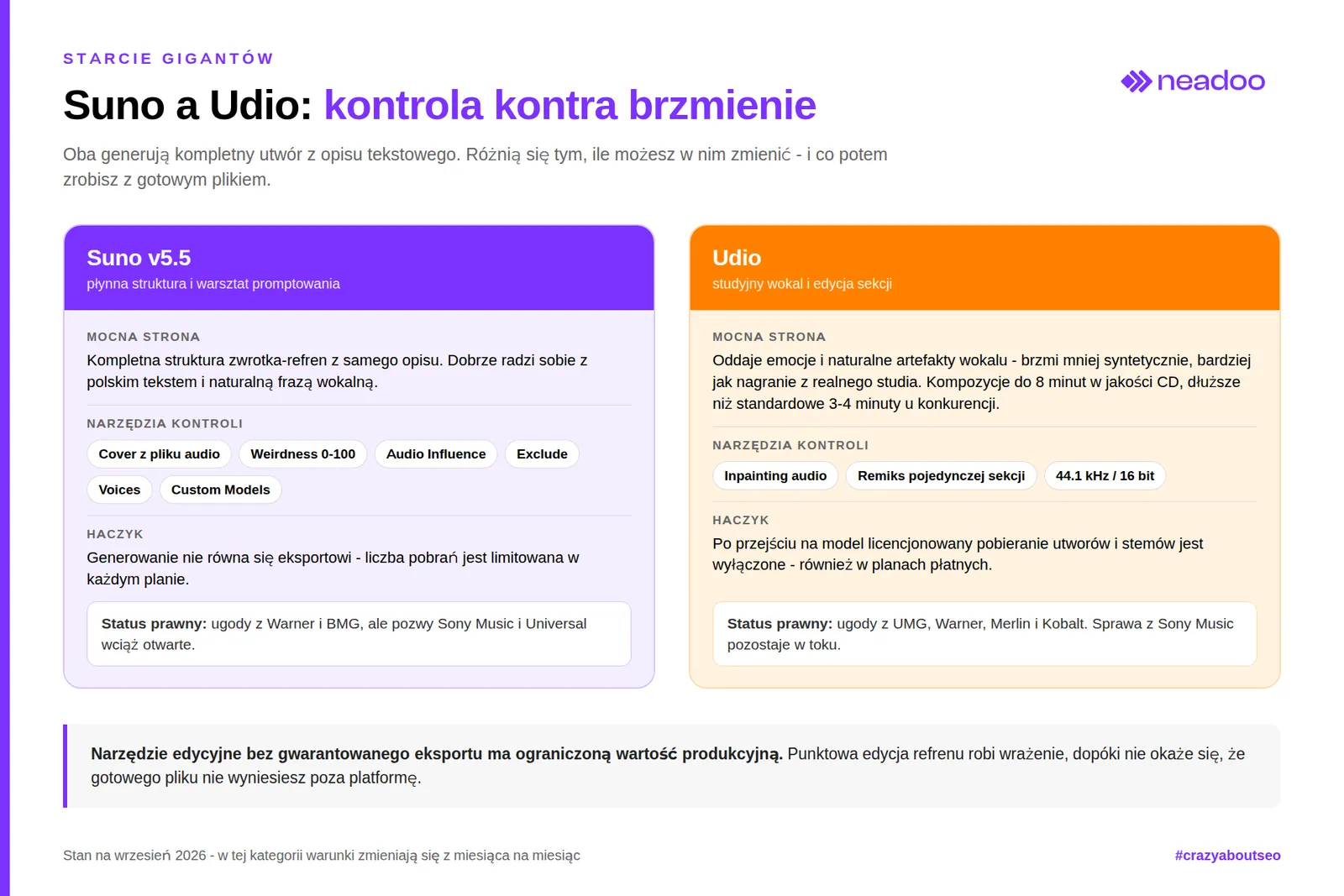
Suno remains the benchmark for AI song generators operating purely from text - creating complete tracks with vocals, arrangement, effects, and a verse-chorus structure starting solely from a prompt. The v5.5 model introduces Voices, Custom Models, and My Taste features, which tailor vocal tone and style to user preferences. Among Polish AI music creators, Suno remains the most recognizable online generator because it handles Polish lyrics and natural vocal phrasing well.
Suno's edge lies in its composition control tools. Cover mode takes an audio file as a template and generates a new version of the track, preserving the original's rhythmic framework. The Weirdness slider adjusts the level of experimentation on a 0-100 scale - higher values produce more unusual harmonies and structures. The Audio Influence slider determines how strongly the uploaded source material affects the final mix, while the Exclude field removes unwanted instruments from the arrangement (e.g., entering "banjo" or "violin" eliminates them from the track). Together, they form a genuine music prompt engineering toolkit, where precise keywords - style, genre, instrumentation - determine the outcome just as heavily as the lyrics themselves.
Starting September 3, 2026, Suno introduces significant restrictions on accessing generated files: the Free plan offers 7 lifetime downloads, Pro offers 20 per month, and Premier offers 60 per month, with options to purchase additional allowances. Access to generating tracks online alone does not guarantee unrestricted export for further production or publication - this is covered in more detail in the section on export blocks and label settlements.
Udio AI: Studio-Quality Vocals with Serious Licensing Restrictions
Udio beats Suno at capturing emotion and the natural artifacts of AI vocals - sounding less "synthetic" and more like a recording from a real studio. The platform generates full compositions up to 8 minutes in CD quality (44.1kHz/16-bit) from text descriptions, making it an attractive choice for creators needing longer, more complex structures than the 3-4 minute standard found among competitors.
Udio's unique advantage is section-level editing. Audio inpainting lets you regenerate a specific part - such as a chorus or bridge - without altering the rest of the track, working like the targeted inpainting familiar from image generators. The ability to remix an existing composition at the level of a single section rather than the entire track sets Udio apart from competitors focused primarily on generating from scratch. However, this functional advantage loses significance in light of the licensing restrictions described in the next section - an editing tool without guaranteed file export offers limited production value.
Export Blocks and Label Settlements - The New Legal Reality in 2026
Settlements with music giants - UMG, Warner, and BMG - have forced some AI music generator providers, including Udio, to block file downloads. As a result, the market is splitting into platforms that are fully legally compliant and those carrying high risks for commercial users. This is a crucial shift for anyone planning to use AI in published or monetized music: choosing a tool in 2026 effectively means choosing a legal model, not just audio quality.
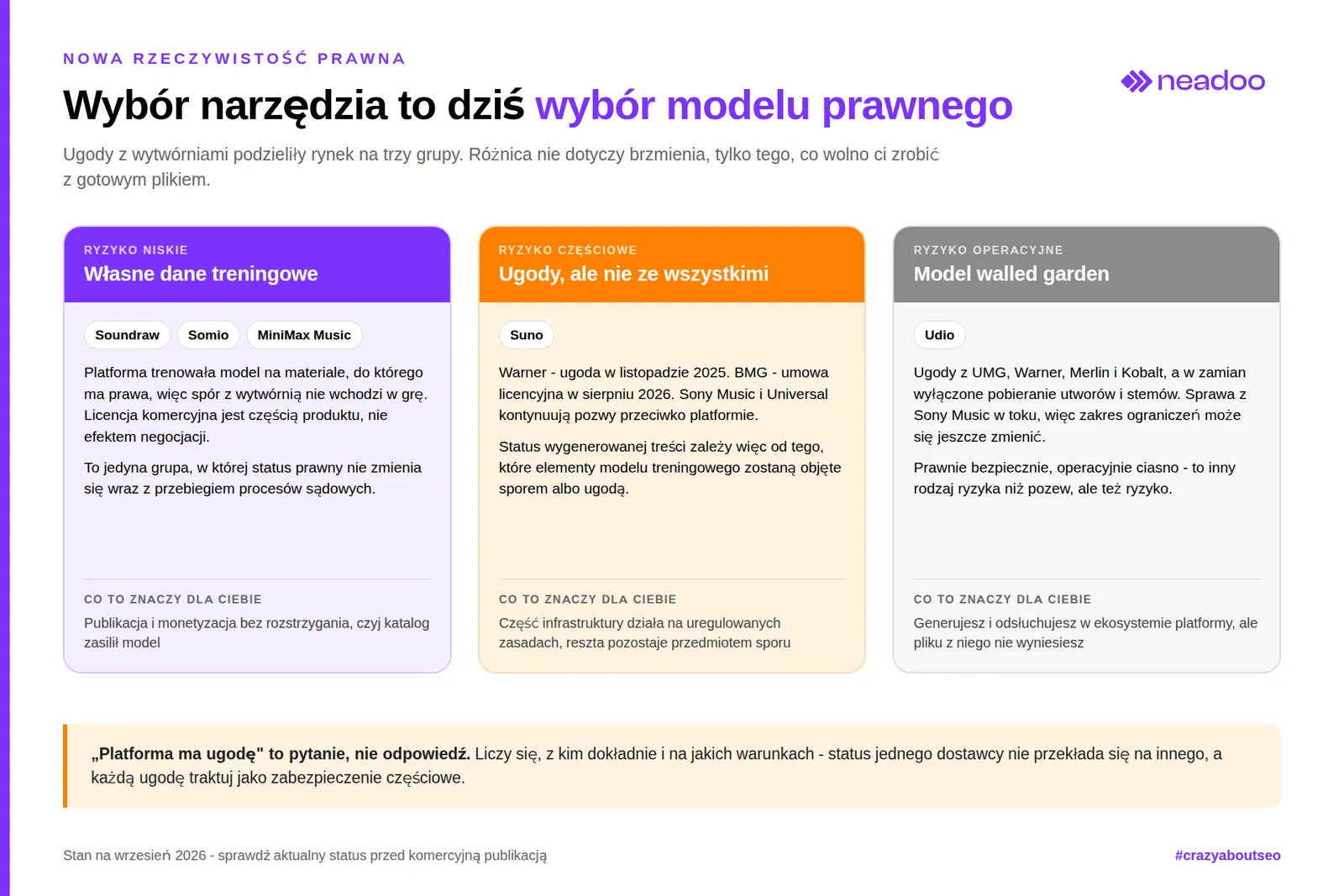
Udio shifted to a licensed model following settlements with UMG, Warner, Merlin, and Kobalt. The outcome of this transition is the disabling of track and stem download features in 2026. Users generate and listen to compositions within the platform, but there is no guaranteed file export for further production, mixing, or publication on external platforms. Udio's case with Sony Music remains ongoing, meaning even the current scope of restrictions may still change - anyone planning commercial use must be prepared for further limitations. Such an arrangement - access to generation without full control over the resulting file - is often described as a walled garden model: the platform locks the user inside its ecosystem and restricts moving content outside its boundaries.
Suno remains stuck in a more fragmented legal situation. Sony Music and Universal Music continue their lawsuits against the platform, while Warner reached a settlement with Suno in November 2025, and BMG signed a licensing agreement in August 2026. Part of Suno's catalog and infrastructure therefore already operates under regulated terms, but the risks associated with the Sony and Universal lawsuits have still not been resolved. For the user, this means that the legal status of generated content can vary depending on which components of the training model are ultimately covered by disputes or settlements.
These diverging paths - full settlements, partial licenses, ongoing lawsuits - create a real practical problem: AI copyright in music is not uniformly regulated even among market leaders, and the status of one platform does not automatically apply to another. A creator planning the commercial release of an AI-generated track should treat every label settlement as partial rather than complete protection - the scope of the license depends on which labels signed an agreement with a given provider and when. In our opinion, this is the most practical piece of advice in this entire roundup: "the platform has a settlement" is a question about with whom exactly and on what terms, not an answer in itself.
Let's check your website's potential
Share your website and email - we'll get back to you with a real analysis, no strings attached.
How to Legally Make Money from AI Music and Choose the Right Commercial License
To safely monetize tracks on Spotify and YouTube, choose platforms with a perpetual commercial license - like Soundraw - and avoid free plans that retain copyright for the tool provider rather than the user. A generator's legal status determines whether publishing royalties will flow smoothly into the creator's account or be blocked by a claim from a label or the platform itself.
Choosing a commercial license boils down in practice to three models, which differ in the scope of rights and the moment they transfer to the user:
- Soundraw - allows you to match instruments to the track's mood and fully customize the composition's structure. Key advantage: the cleanest legal status on the market thanks to the platform's proprietary training data, which eliminates the risk of disputes with labels. The perpetual license is preserved even after ending your subscription - a previously generated track can be legally monetized on YouTube and Spotify without an active plan.
- Beatoven.ai - generates emotion-based background music optimized for looping, making it a natural choice for podcasts, video channels, and content requiring a repeatable soundtrack. MP3/WAV downloads are provided under a non-exclusive monetization license - you can use the track commercially, though without exclusivity over the backing track.
- AIVA - specializes in orchestral and cinematic compositions in over 250 styles, making it well-suited for video productions and narrative scores. Key caveat: on the Free and Standard plans, copyright for the generated track belongs to AIVA, not the user. Full transfer of rights to the creator occurs exclusively on the Pro plan - only this subscription tier qualifies you for safe monetization on external platforms.
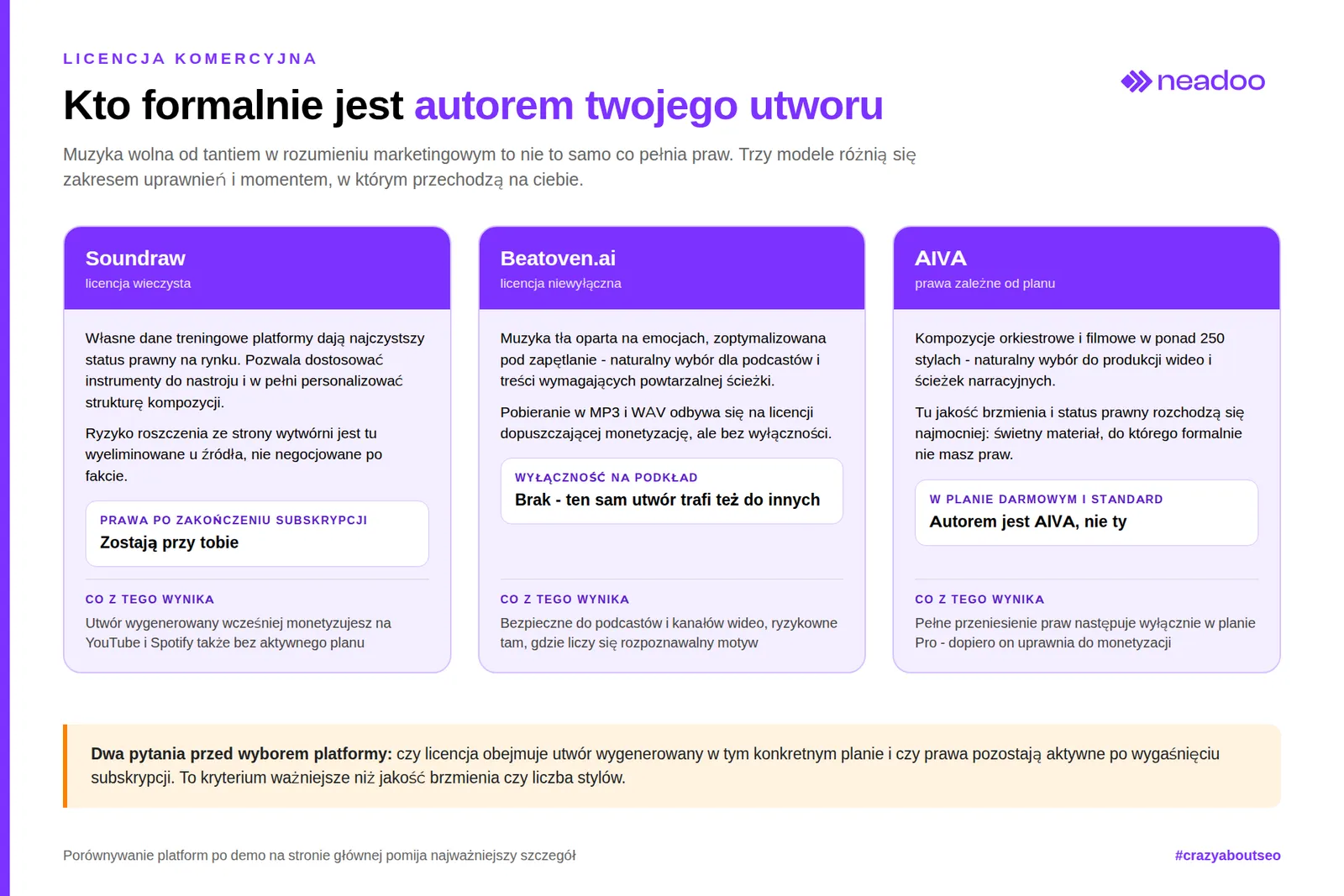
A practical rule of thumb when choosing a tool: check whether the commercial license covers the track generated under a given plan and whether the rights remain active after the subscription expires. Royalty-free music in the marketing sense does not automatically mean full ownership of rights - on free or intermediate plans (like AIVA Standard), authorship formally belongs to the provider, and the user receives only limited usage rights. When building an income channel around an AI background music generator, treat the licensing level as your primary criterion for choosing a platform - more important than sound quality or the number of available styles. In our assessment, this exact detail - who is formally the author - is what creators comparing platforms solely by homepage demos miss most often.
Integrated AI Video and Music Video Generation as the New Market Standard
In 2026, AI music generators no longer produce just audio - they also automatically generate beat-synced music videos and lyric videos. Creators can skip a separate video editor and editing workflow: the entire promotional asset is created within the same app that generated the track.
Somio AI best illustrates this trend. The platform combines a song lyric generator with a BGM (background music) engine in a single production environment. Users can create music from text, add lyrics to an existing track, generate background music for video, or produce a similar track based on an uploaded reference. The AI cover generator additionally allows you to remix existing material in a new performance style.
The audio editing layer includes extending compositions, replacing sections, vocal removal, and stem separation - features typical of professional production, available here without a standalone DAW. Vocals can be customized by gender, style, and performance delivery; the option to use your own voice lets you record a personalized version of the track instead of the default synthetic voice.
The key difference compared to audio-only generators is the video module: Somio creates AI music videos, lyric videos, and singing videos automatically synchronized with the generated track. For a creator publishing on YouTube, TikTok, or Instagram, this means publish-ready material - without an audio-video sync editing stage. At the same time, the platform offers a commercial license, allowing the generated audio-video package to go directly to monetized channels without additional rights negotiations.
Integrating music and video generation into a single pipeline is becoming part of a broader visibility strategy across search engines and AI systems - also relevant in the context of AI SEO for music and video content published online.
Professional Tools for Producers - Stem Exports, MIDI Files, and DAW Plugins
The key difference between production platforms and "ready-mix" generators is access to raw material: individual tracks (stems), MIDI files, and AI integrations directly inside DAWs (Ableton Live, FL Studio). Such access is a prerequisite for further work in professional music software.
- Mureka - clones voices and exports MIDI files as well as clean stems directly into your DAW. The Melody Idea feature generates a melodic sketch that producers can expand within their own production setup. Ableton Live integration lets you pull generated material into an existing project without format conversion. Despite its rich feature set, the platform has a very low Trustpilot rating - 1.3/5, suggesting customer support or service stability issues, regardless of its technical capabilities.
- Stable Audio - focuses on a different segment: sound design along with rhythmic and melodic loops ready for use in larger compositions. Key difference from competitors: it runs as a native DAW plugin, integrating into the producer's workflow at the plugin level rather than as a separate web app - eliminating the export and import steps between platforms.
The reverse direction is equally important: an audio-to-MIDI converter that transforms an AI-generated melody or vocal line into an editable musical score for further arrangement in a sequencer. This feature, found in production-oriented tools (such as Mureka), distinguishes "production" generators from platforms focused purely on quickly producing a finished track without access to its component layers.
Vocal cloning and audio fingerprinting - advanced personalization and copyright protection
The year 2026 brings two parallel trends in AI vocal generation for music: deep personalization of the user's voice and the systemic implementation of digital watermarks that protect copyright. Suno has announced audio fingerprinting - a mechanism built directly into the generation process that tags the output audio file with an inaudible identifier referencing the model version and the specific generation. In materials covering the v5.5 model, Suno describes the Voices, Custom Models, and My Taste features as tools for vocal and style personalization. However, it does not literally confirm that the generated vocals are "indistinguishable" from a human voice - this is a functional description of the tools, not a declaration regarding the level of sound realism.
Personalization at the level of the voice itself, rather than just the performance style, is implemented by the Somio and Mureka platforms, already known for music video generation and DAW export. Both tools offer advanced voice cloning: the algorithmic composer first generates the melody line and track structure, and then the AI audio synthesis module overlays the cloned timbre and articulation style of a specific person onto this structure - instead of a default synthetic voice. Stylistic consistency between the composition and the inserted voice is ensured by arrangement metatags: a data layer describing the tempo, key, and emotional character of a section, which the synthesis engine uses to match the phrasing of the cloned vocal to the rest of the arrangement.
Suno's audio fingerprinting works in the opposite way to voice cloning - it does not personalize the track, but rather protects it and its creator. The embedded identifier allows the platform and record labels to verify the recording's origin: confirming that the file originated from an AI model rather than being copied from a protected catalog, and tracking unauthorized redistribution outside the platform's licensing system. This is a technical layer supporting royalty accounting and copyright disputes, complementary to the export restrictions and label settlements described earlier in the context of the legal landscape for music generators.
The combination of both mechanisms - voice cloning as a deep personalization tool and fingerprinting as an intellectual property protection layer - defines the development path for music generators in 2026. The user gains control over the vocal identity of the track, while the platform retains the technical capability to prove its AI origin regardless of the recording's subsequent distribution.
Free AI music makers and hidden download limits
In 2026, free AI music generators restrict downloading files rather than generation itself - that is where the real barriers lie. Suno and Udio, the segment leaders, have introduced restrictive export limits that reduce the free plan to the role of a trial version rather than a full-fledged production tool.
Suno's free plan provides generation credits strictly for personal use, without a commercial license. As of September 3, 2026, a lifetime limit of 7 downloads applies - regardless of the number of generated tracks. A user can create dozens of compositions, but across the entire history of the account, they will only download seven of them to their hard drive. Paid plans do not remove limits, but rather increase them: Pro provides 20 downloads per month, Premier gives 60, and additional downloads can be purchased separately as a bundle.
Udio, on the other hand, limits the generation stage itself: the free plan allows 10 credits per day, which equates to a few track attempts per 24 hours. Following the 2025 settlement with Universal Music, the platform disabled the track download feature, transitioning to a licensed model. Data from 2026 does not confirm the reinstatement of file or stem exports - even on paid plans. Anyone looking for a free AI music generator with the real ability to save files to their device will not find this feature in Udio.
| Platform | Free plan limit | File downloads | Access to stems / vocal removal |
|---|---|---|---|
| Suno (Free) | Credits for personal use, no commercial license | 7 lifetime downloads (since September 3, 2026) | None on the free plan |
| Suno (Pro) | Increased credit allowance | 20 downloads per month | Limited |
| Suno (Premier) | Highest credit allowance | 60 downloads per month | Limited |
| Udio (Free) | 10 credits per day for generation | Download feature disabled | No stem export |
Mobile apps advertised as the best AI music making app for Android and iOS tend to be more lenient when it comes to in-app playback - however, exporting audio files outside the app is usually subject to the same limits as the web versions. Similarly, a no-login AI music generator, tested once without an account, rarely allows file downloads - it primarily serves for previewing demos in the browser. This can be a trap when building a content strategy around a tool that, in practice, only provides a preview rather than a usable file.
Restrictions also apply to advanced editing tools. The AI stem separator and AI vocal remover feature - available in free versions of some platforms, such as the tested solutions from MiniMax Music 2.6 or ElevenLabs' Eleven Music - are in practice reserved for paid accounts or limited to low-quality demo samples. Full export of separated instrumental and vocal tracks without watermarks requires an active subscription.
FAQ
Can you legally upload AI music to Spotify and monetize it?
Yes, but only with an appropriate commercial license - offered by platforms like Somio, Soundraw (perpetual license), ElevenLabs (fully licensed data), or Beatoven.ai (non-exclusive monetization license). Suno and Udio still have unresolved disputes with record labels (Sony, Universal), making the safe commercial use of their tracks on Spotify difficult.
Which free AI music generator does not add watermarks?
None of the described platforms guarantee unrestricted export on a free plan - Beatoven.ai allows you to download clean MP3/WAV files, but the monetization license requires purchasing a plan. On free versions, the barriers relate to download limits (Suno, Udio) rather than watermarks themselves.